Can Code Save Onshore Oil? Inside Heirs Energies’ $1.1 Billion Digital Experiment at OML 17
Key Takeaways
- •Heirs Energies bought the 45% stake in OML 17 held by Shell, TotalEnergies and Eni for about $1.1 billion in 2021, forming a joint venture in which NNPC retains 55%.
- •At the peak of the crude theft crisis in late 2021 and early 2022, only about 3% of the crude injected into the evacuation pipeline reached the Bonny Terminal.
- •The Integrated Operations Management Centre consolidates real-time data from wells, flow stations, gas plants and pipelines, and the company estimates the digital layer has helped avoid about 5% of daily deferred production.
- •Intruder-detection systems at producing wellheads coincided with reported intrusion incidents falling to zero from January 2025, after roughly 50 attempted or confirmed incidents between July 2021 and December 2024.
- •Heirs Energies secured a $750 million Afreximbank financing package by December 2025 and, with NNPC, plans a flare-gas project to capture about 180 million standard cubic feet per day, targeted for commissioning in the third quarter of 2026.
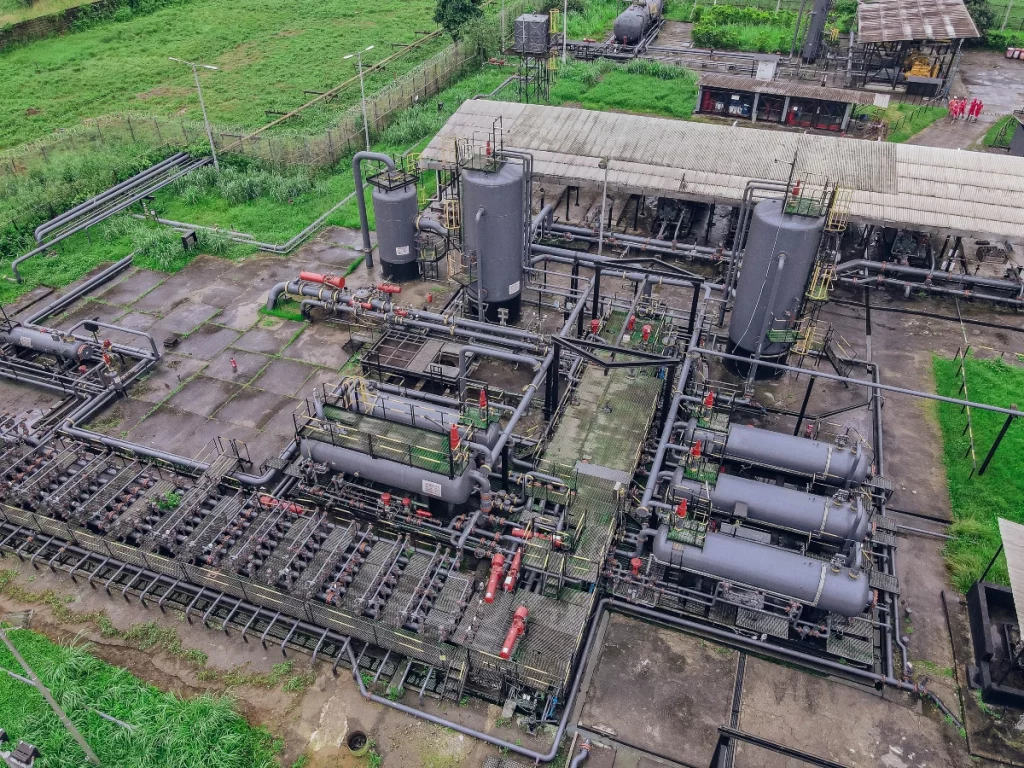
At its worst point, only three of every 100 barrels of oil Heirs Energies pumped into its evacuation pipeline arrived at the export terminal. The rest vanished into Nigeria’s $3.3 billion crude theft black hole. To rescue the $1.1 billion asset, the indigenous producer built the Integrated Operations Management Centre (IOMC), a digital control layer that tracks pressure drops, wellhead breaches and flow rates in real time. But in an industry governed by physical pipelines and security risks, how far can digital technology actually take an operator? In this feature, first reported by Frank Eleanya for TechCabal, the technology, the economics and the hard operational realities of turning around OML 17 are examined.
A distressed acquisition
When Heirs Energies took over operatorship of Oil Mining Lease (OML 17) in 2021, it inherited a large but distressed asset in the eastern Niger Delta: ageing infrastructure, a sprawling pipeline network, persistent crude theft and facilities increasingly surrounded by urban communities.
The company did not acquire the lease outright. Through TNOG Oil and Gas Limited, a vehicle connected to Heirs Holdings and Transcorp, it bought the 45% stake previously held by Shell, TotalEnergies and Eni in the former SPDC joint venture for about $1.1 billion, in a sale whose completion was reported at the time. The Nigerian National Petroleum Company (NNPC) retains the remaining 55%, making OML 17 an NNPC/Heirs Energies joint venture operated by Heirs.
The transaction became an early test of whether Nigerian operators could revive onshore assets divested by international oil companies. Five years later, Heirs Energies presents OML 17 as evidence that a troubled asset can be stabilised through a combination of capital, field management, security, gas development and digital monitoring. But the recovery also shows the limits of technology in an oil industry where pipelines, payment systems and field investment still determine whether production can reach the market.
From theft to visibility
OML 17 covers more than 1,200 square kilometres and includes 15 oil and gas fields, six flow stations and an extensive network of wells, pipelines and gas-processing infrastructure. Its scale made the asset valuable — and difficult to secure and operate.
According to Heirs Energies, wellhead components had been stolen, facilities attacked and crude siphoned from evacuation infrastructure. The crisis peaked in late 2021 and early 2022, when the company said only about 3% of the crude it injected into the evacuation pipeline reached the Bonny Terminal.
That figure does not mean the field was producing at 3% of its normal level. It refers to the gap between the volume of crude measured as entering the pipeline system and the amount that eventually arrived at the terminal and was accounted for. In practical terms, the company says that at the low point, for every 100 barrels injected into the pipeline, only about three reached Bonny Island in Rivers State. The missing volumes were attributed to crude theft.
The episode illustrates a reality of onshore Nigerian oil operations: production capacity means little when a producer cannot move crude to an export terminal.
Ayodele Oni, partner and chair of Bloomfield Law Practice’s energy and natural-resources group, said OML 17’s recent history shows the key risk was not necessarily the reservoir. “When production dropped in 2022 and 2023, the reservoir wasn’t the problem,” Oni said. “Getting the oil out was. Theft and disruption on the Trans-Niger Pipeline hit output hard. An onshore asset is only as good as its route to market.”
A digital nerve centre
Heirs Energies’ response included the Integrated Operations Management Centre, which consolidates operational data from wellheads, flow stations, gas plants and pipelines. Instead of relying wholly on periodic field visits, engineers can monitor production volumes, pressure, flow rates, temperatures, vessel levels and other indicators remotely.
The system does not replace field teams. It reduces the time between an abnormal event and a decision to investigate or intervene. “Technology is an enabler,” said Fidelis Akpoghiran, Heirs Energies’ senior vice-president for business transformation and improvements. “It is not technology alone that solved the problem, but technology has enabled every critical decision we have taken.”
Data arrives at the monitoring centre in real time — second by second or minute by minute, depending on the equipment and the parameter being tracked, Akpoghiran said. The company describes the IOMC as an integration layer: sensors generate information, communications systems transmit it, operators interpret it and physical teams act on it.
That distinction matters in a high-risk operating environment. A dashboard cannot repair a damaged valve, stop a vandal or restart a compressor. Its value lies in shortening the time before the right team is dispatched.
Technology has limits
At producing wellheads, Heirs Energies has installed intruder-detection systems that combine touch-sensitive fencing, surveillance cameras and monitoring tools to identify unauthorised approaches before equipment is damaged or removed. The company defines an intrusion as an unauthorised attempt to access or interfere with a protected wellhead or facility, including an attack intended to damage equipment or steal components — not every automated notification is a confirmed breach.
Akpoghiran said the company recorded about 50 attempted or confirmed intrusion incidents between the start of operatorship in July 2021 and December 2024, including cases in which equipment was stolen. After most producing wells were covered by the detection system, the company says it recorded no such incidents from January 2025, citing security reports, surveillance records and system event logs.
The result cannot be attributed to sensors alone. Detection systems create deterrence and provide early warning, but the outcome depends on the response chain that follows. Heirs says security personnel can be mobilised in roughly 10 minutes after an alert — evidence, the company suggests, that the technology is only as effective as the people and processes behind it.
The same applies to production reliability. Akpoghiran said the integrated digital technology layer, rather than the IOMC in isolation, has helped avoid an estimated 5% of daily deferred production. The estimate refers to a relative reduction in production that would otherwise be lost to theft, equipment failure or operational interruptions; it is not a five-percentage-point improvement in an annual deferment rate. If a constraint would otherwise defer 500 barrels in a day, for example, a 5% reduction would mean avoiding about 25 barrels of lost output. The company says the estimate reflects earlier detection and faster intervention, not a controlled study that isolates technology from security, maintenance and other operational decisions.
“It is more expensive not to do anything,” Akpoghiran said.
The digital systems are therefore best understood as a way to protect the value of high-producing assets. Heirs says it prioritises technology investment based on the production and commercial importance of wells and facilities, rather than applying the same level of monitoring to every asset.
Production and gas recovery
That approach has coincided with a significant recovery. Heirs Energies says oil output has risen from roughly 25,000 barrels per day at acquisition to more than 50,000 barrels per day, while gas production has increased from around 50 million standard cubic feet per day to at least 120 million standard cubic feet per day — a turnaround the company sets out in its own account of the OML 17 story.
Oni said the gas growth may be the more consequential result. Unlike crude, the gas is supplied into Nigeria’s domestic market, including power-generation customers such as the 188MW Geometric Power Plant in Aba, Abia State. That gives OML 17 a role beyond export crude: its performance is also tied to whether domestic power customers can receive and pay for the gas supplied to them. He argued that the company’s use of well rework, rather than immediately drilling expensive new wells, demonstrates how indigenous operators can raise output from existing assets. “Get more out of what’s already in the ground and already built before spending big on new wells,” Oni said.
Three risks to sustaining the recovery
Sustaining the recovery will require more than digital visibility. Oni identified three risks: protecting evacuation routes, collecting payment for gas supplied to power plants, and continuing to invest in field development.
The first remains security: pipeline disruption can quickly negate gains made at the wellhead or flow station. The second is the electricity market’s payment challenge — selling gas to power plants increases domestic energy supply, but upstream producers need confidence that invoices will be paid. The third is drilling: reworking existing wells can restore output, but it may not deliver Heirs’ longer-term ambition of 100,000 barrels per day or return the field to its historical peak.
By December 22, 2025, the company had secured a $750 million financing package from Afreximbank to support its capital structure and field-development plans — a sign that lenders see greater value in the asset than at takeover.
Its flare-gas project, which aims to capture gas currently burnt off, could offer a further test of whether an indigenous operator can combine commercial returns with lower emissions. Heirs and NNPC have said the project could capture about 180 million standard cubic feet of flare gas per day, with commissioning targeted for the third quarter of 2026.
Data first, AI later
Heirs Energies is also building toward AI-assisted operations. Akpoghiran said the company has spent years developing a real-time data historian across wells, flow stations and gas facilities before attempting more advanced analytics. “You don’t do analytics in the absence of data,” he said.
The sequence is logical: first generate reliable operational data, then make it visible, then use it to identify patterns and prioritise action. But the case of OML 17 suggests that the most important technology may not be AI. It may be the less glamorous ability to know, quickly and accurately, when a wellhead is under threat, a flow station is failing, or a pipeline has become the weak link in the value chain. The next test is whether that visibility can continue to support field response, financing, evacuation and gas payments as Heirs pursues further development.

