Gunnison Copper seeks government funding and partner to speed Arizona project
Key Takeaways
- •The updated preliminary economic assessment values the Gunnison project at nearly $2 billion in net present value and estimates 3.2 billion pounds of copper cathode output over 21 years.
- •The company says first production could start in 2032, but government funding or a major partner could shorten the timeline by about two years.
- •The project’s initial capital cost is estimated at $1.54 billion, and Gunnison plans to advance through further studies and permitting before a final investment decision.
- •Gunnison’s resource base includes 5.2 billion pounds of contained copper in measured and indicated categories, plus 397 million pounds in inferred resources.
- •The U.S. Geological Survey says the country imported 57% of its copper last year, and Gunnison believes its project could help reduce that dependence.
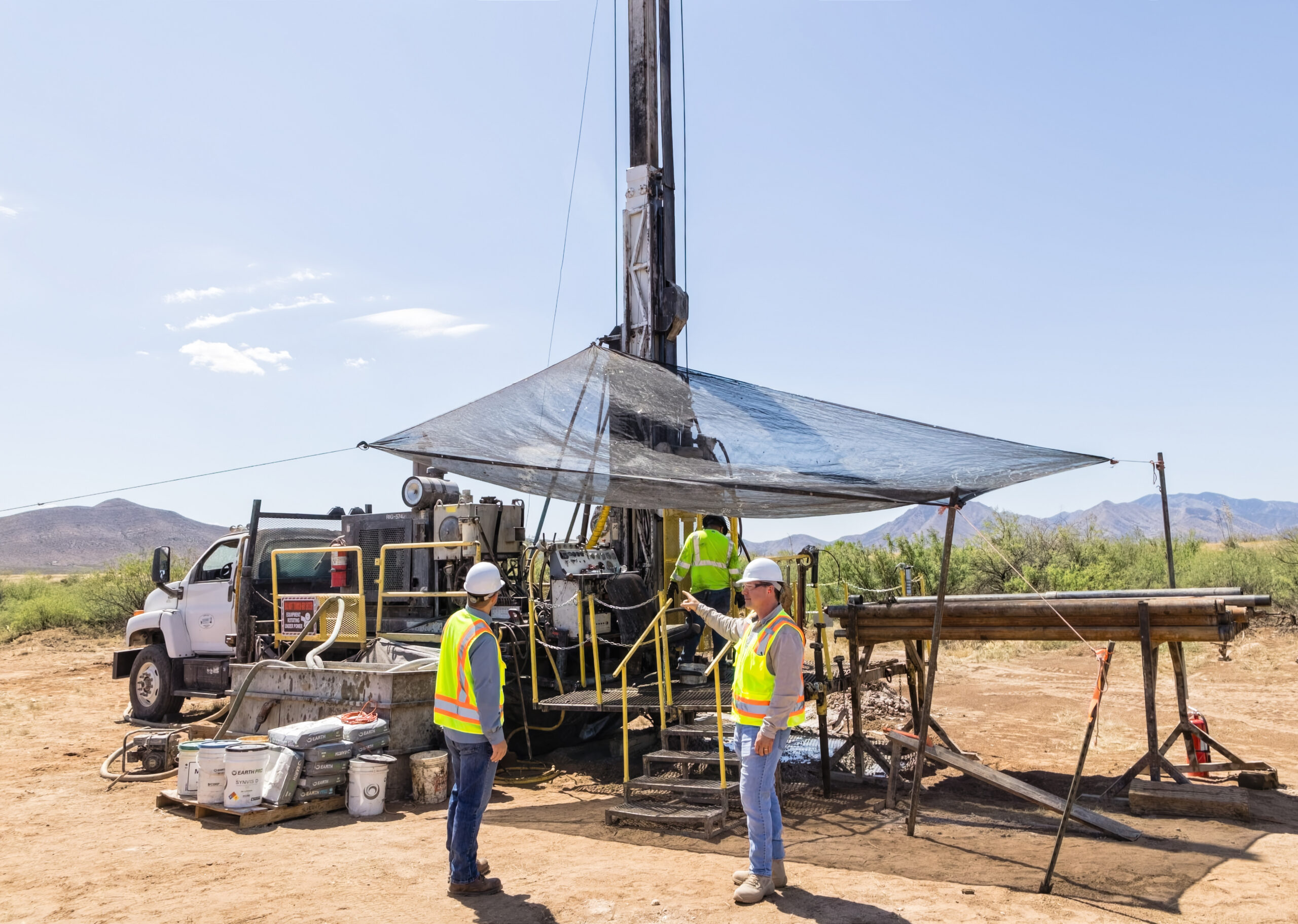
Gunnison Copper’s (TSX: GCU; US-OTC: GCUMF) role in helping reduce U.S. dependence on imported red metal now depends more on financing than on the rocks in Arizona.
Backed by an updated preliminary economic assessment (PEA) released in February, which gives the namesake Gunnison project an almost $2-billion ($C2.77-billion) net present value and forecasts 3.2 billion lb. of copper cathode output over a 21-year mine life, the company says production could begin by 2032. The project is 105 km east of Tucson.
“If the government funded something like 50% or more of the total costs between now and first production, then we would be able to accelerate the timeline by two years,” Gunnison CEO Craig Hallworth told The Northern Miner in a phone interview in July.
The proposed mine could become one of several tests of how far U.S. efforts to secure domestic supplies of critical metals — needed for AI data centres and other green-energy technologies — will extend beyond lithium and rare earths and into copper, a metal that is central to electrification and infrastructure.
Gunnison’s predecessor, Excelsior Mining, pursued an in-situ recovery copper mine at the site, but the operation failed to perform as expected. In 2024, the company changed course to an open-pit heap-leach plan and renamed itself Gunnison.
The site hosts 846.1 million measured and indicated tons (767.6 million tonnes) grading 0.33% copper, equal to about 5.2 billion lb. of contained copper, plus 94 million inferred tons at 0.21% copper for 397 million lb. of metal, according to the updated PEA. The study puts the project’s post-tax internal rate of return at 23%.
Big player
At that global contained resource, Gunnison ranks among the largest undeveloped copper projects in the United States, below Hudbay Minerals’ (TSX, NYSE: HBM) Cactus project with 8 to 9 billion lb. and above Faraday’s (TSX: FDY; US-OTC: CPPKF) Copper Creek project with 5 billion pounds.
At an average annual output of about 80,000 tonnes during the first 15 years of mine life, Hallworth said Gunnison could supply around 10% of U.S. refined copper production from ore, excluding recycled metal.
Through the company’s 42,000-metre drill program launched in June, Hallworth wants to add another 1.2 billion lb. of copper to the resource. Keeping the mine life at about 20 years could lift throughput to 100,000 tonnes annually.
“That’s really going to show this project is nationally significant,” Hallworth said.
The U.S. Geological Survey estimates the country relied on imports for 57% of its copper last year, according to its Mineral Commodity Summaries 2026 report, released in May.
“This is a major project, and it can really move the needle on closing the [supply] deficit,” Hallworth said. “Fifty-seven percent is coming from foreign sources. That’s risky, and for something like copper — it’s used in just about everything.”
$1.54 billion price tag
A number of steps remain before Gunnison can reach annual production of 220 million lb., including further economic studies, amended permitting and substantial funding.
The updated PEA put initial capital costs at $1.54 billion, an 18% increase from the earlier study.
“It’s $1.6 billion in construction capital, and there’s a number of dollars required to get to construction too. That’s a tough amount of money to raise when you’re sitting at US$150 million market cap,” Hallworth said.
Under Gunnison’s conservative development plan, the company would release a prefeasibility study (PFS) in 2028, followed by a feasibility study and a final investment decision by mid-2030, ahead of first production in 2032.
But if a government agency, such as the Department of Energy (DOE) or War, offered $1 billion under a long-term debt facility, Gunnison could skip a PFS and move directly to a feasibility study, Hallworth said.
“That’s the type of number that we’re talking for us to accelerate it by two years,” he said. “There’s government grants that can be used that could help us accelerate, probably [not by] two years, but it can definitely increase the probability of success that we can build this ourselves and not have to sell this project to a foreign company.”
Federal backing
Support of that scale is not unprecedented as governments move to build critical metals supply chains outside Beijing’s control.
In 2024, the DOE announced a $2.26-billion loan to finance the first stage of Lithium Americas’ (TSX, NYSE: LAC) Thacker Pass mine in Nevada. The amount was later amended to $2.23 billion.
In June, the Department of Defense (DoD) offered a conditional $725-million loan to Energy Fuels (TSX: EFR; NYSE-A: UUUU) to help expand its rare earth processing capacity. In July 2025, the department also made a $400-million equity investment in rare earths miner MP Materials (NYSE: MP), along with a $150-million loan.
Copper projects, despite their central role in electrification and infrastructure, have so far been left out of the largest U.S. support packages.
Hallworth said Gunnison is also considering adding a concentrator for the deeper sulphide zones, which could lift copper recoveries from about 60% to 80% to 85%. A flotation circuit could also allow the company to produce zinc and silver concentrates from material not included in the current PEA, although any polymetallic flowsheet remains at the study stage.
“With the concentrator process, this would become a polymetallic project because we’ve got over 800 million lb. of zinc and over 9 million oz. of silver that we know about,” Hallworth said. “That’s an enormous amount of value, maybe $2 billion on a revenue line in those two metals that are not in the current value.”
JV partner
Gunnison’s other route to production is to find a joint venture partner.
Based on the economics in the current PEA, Hallworth said a partner could be a mid-tier copper producer with a market capitalization of around $10 billion.
“I won’t name names, but there’s several that have existing platforms in Arizona,” he said.
Potential partners that fit that description and have the scale and technical expertise to develop a large U.S. copper project could include Capstone Copper (TSX: CS), which is advancing its Mantoverde-Santo Domingo copper district in Chile and is considering a final investment decision on Santo Domingo later this year.
Other possibilities include Hudbay, which is expanding its U.S. copper platform through its Copper World project in Arizona and the proposed acquisition of Arizona Sonoran Copper’s Cactus project; and KGHM Polska Miedź (WSE: KGH), the Polish copper producer that operates the Robinson mine in Nevada and has long-standing North American mining experience.
If Gunnison can increase production to 100,000 tonnes annually in a PFS, partnering with companies in the $10-billion to $30-billion market cap range becomes possible, the CEO said.
Data centres
Just 2 km north of Gunnison, across Interstate 10, is the company’s Johnson Camp Mine (JCM).
Although its resource is much smaller than Gunnison’s, the heap-leach mine produced its first copper cathodes in August 2025, making it the country’s newest red metal producer. In December, JCM became the first site to produce cathode using Rio Tinto (NYSE, LSE, ASX: RIO) venture partner Nuton’s sulphide bioleaching technology.
Among the buyers of the 4,500-lb. pure copper cathode bundles produced at JCM is Amazon Web Services.
“This is copper that would have had to been shipped overseas before, with all of the freight costs, the emissions, with penalties at the smelter, and then the country loses control of the copper at that point,” Hallworth said.
“We just make the finished thing right here, and then it goes right into those Amazon data centres.”
