Goldman Sachs Estimates China's Gold Buying Exceeded Official Figures by 128%
Key Takeaways
- •Goldman Sachs estimated that Chinese buyers acquired 148 tonnes of gold from May to August 2026, while the People's Bank of China officially disclosed only 65 tonnes, leaving an unverified 83-tonne gap.
- •The monthly difference between estimated and reported purchases shrank from 38 tonnes in May to five tonnes in August, when Goldman's 25-tonne estimate stood 25% above the official figure.
- •China's official gold holdings rose to 2,410 tonnes in September 2026 after a 23-tonne addition, extending the central bank's buying streak to 23 consecutive months.
- •The divergence stems from differing methodologies, with Goldman inferring demand from London OTC market flows while the PBoC reports recorded monetary gold holdings, so the gap does not prove secret purchases.
- •In the World Gold Council's 2026 survey, 89% of respondents expected global official gold holdings to increase over the following year and 74% anticipated a reduced US dollar share of global reserves within five years.
Goldman Sachs estimates that Chinese buyers acquired 148 tonnes of gold between May and August 2026, compared with the 65 tonnes officially disclosed by the People's Bank of China (PBoC) over the same four months. The estimated 83-tonne gap exceeds China's officially reported additions by 128% and remains unverified. Market reports published on October 19, 2026 highlighted the discrepancy, and The Kobeissi Letter circulated the estimates on October 22.
The divergence has placed China's gold demand under renewed scrutiny. It points to trading activity attributed to Chinese demand in London's over-the-counter (OTC) bullion market, where deals are negotiated directly between counterparties rather than on a central exchange, and transactions do not necessarily translate into prompt disclosures of central bank reserve changes. Because official reserve disclosures are among the few public windows into sovereign gold accumulation, gaps of this size draw attention from analysts who track global demand.
BREAKING: China purchased +25 tonnes of gold in August via the London OTC market, according to Goldman Sachs estimates. This is +25% more than the official +20 tonnes reported by China's central bank for this month. This also follows estimated purchases of +35, +40, and +48… pic.twitter.com/6qv1fCovBB
— The Kobeissi Letter (@KobeissiLetter) October 22, 2026
Source: The Kobeissi Letter on X
The comparison does not establish that Beijing secretly acquired 83 tonnes. Goldman's model estimates purchases using market flows and trade indicators, while the PBoC reports changes in its recorded monetary gold holdings. Because the two measures rest on different methodologies and timing conventions, they can diverge without either figure being inaccurate.
Monthly Gap Peaked in May, Then Narrowed
The monthly breakdown shows the largest discrepancy at the start of the period. In May, Goldman estimated 48 tonnes of Chinese demand against an official addition of approximately 10 tonnes, creating a 38-tonne gap. June followed with 40 tonnes estimated against 15 tonnes disclosed. July's figures narrowed to 35 tonnes versus 20 tonnes, before August recorded 25 tonnes against approximately 20 tonnes — a premium of just five tonnes, or 25% above the official report.
As a result, the estimated monthly excess fell from 38 tonnes in May to five tonnes in August. Nevertheless, the four-month cumulative difference remained substantial because the strongest divergences earlier in the period.
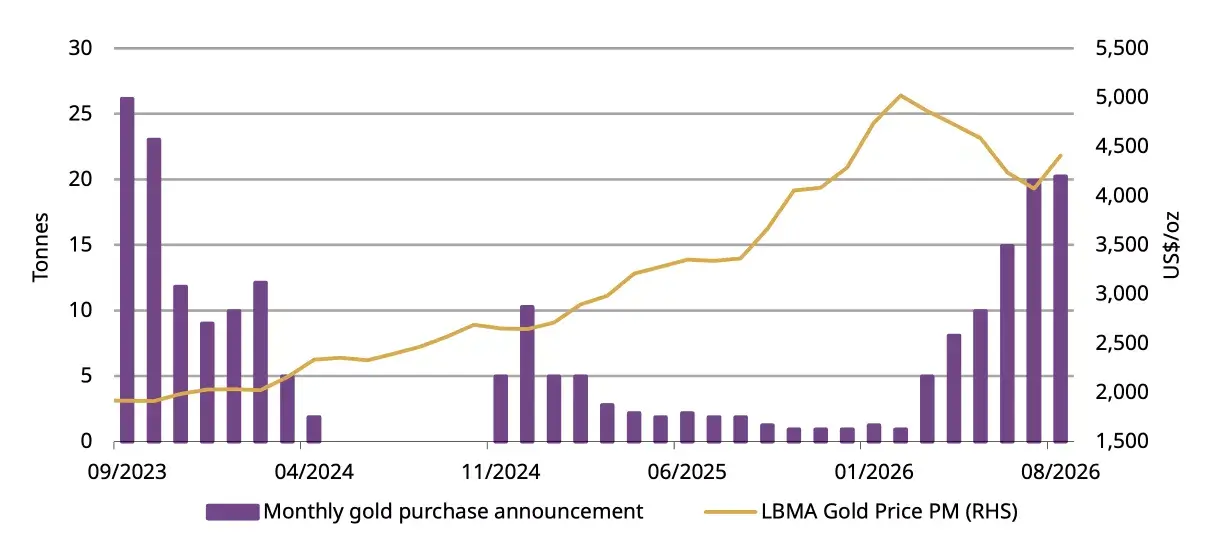
Data source: World Gold Council
According to the World Gold Council, China's official holdings stood at 2,387 tonnes in August after an increase of 20.2 tonnes. September 2026 brought a further 23 tonnes, extending the central bank's buying streak to 23 consecutive months and raising reserves to 2,410 tonnes. With September's disclosure already on record, upcoming monthly reserve updates and flow-based estimates will indicate whether the narrowing gap between estimated and officially reported purchases continued beyond August.
Global Central Bank Demand Shows a Similar Split
A similar split appears in estimates of worldwide central-bank demand. Goldman placed August purchases by central banks at 79 tonnes, approximately 4.6 times the pre-2022 monthly average of 17 tonnes. The World Gold Council, meanwhile, logged 39 tonnes in publicly reported net additions across the same month, underscoring the distinction between inferred market activity and officially disclosed transactions.
The figures reflect different methods of measuring demand rather than separate inventories of newly acquired bullion. In particular, the inferred 148 tonnes cannot be added to the officially reported 65 tonnes without double counting potential overlaps between the two series.
Reserve diversification provides broader context. In the World Gold Council's 2026 survey, 89% of respondents expected global official gold holdings to increase over the following year, while 74% anticipated a reduction in the US dollar's share of global reserves over the next five years. Those responses measure survey expectations, not completed purchases — and they underscore why official-sector demand remains a focal point for market participants even when headline disclosures and inferred market flows diverge.
The OTC-based estimates are therefore best understood as measures of market demand attributed to China rather than confirmed additions to official reserves. The documented difference is a measurement gap: it does not independently verify undisclosed sovereign holdings or prove intentional concealment, but it highlights how inferred market demand and official reserve reporting can move apart for months at a time.

