Goldman Sachs Favors Won, Taiwan Dollar and Ringgit Despite 2026 Declines
Key Takeaways
- •Goldman Sachs favors the South Korean won, Taiwan dollar and Malaysian ringgit because of AI-linked export and investment trends.
- •The bank expects South Korea’s current account surplus to nearly double to about $300 billion, or 13.9% of GDP, this year.
- •Goldman projects Taiwan’s current account surplus will reach 25% of GDP, supported by semiconductor exports and a wider trade surplus.
- •Energy-importer currencies including the Thai baht, Indonesian rupiah and Philippine peso face weaker prospects due to factors such as oil prices, policy concerns and lower real rates.
- •Despite outperforming energy importers, Goldman’s preferred AI-linked currencies have all weakened against a dollar index that is up nearly 3% in 2026.
Goldman Sachs is maintaining a bullish view on the South Korean won, the Taiwan dollar and the Malaysian ringgit, saying the artificial intelligence (AI) investment boom has become a key force in Asia’s foreign exchange markets.
The bank ranks those three currencies ahead of energy importers, including the Thai baht and the Indonesian rupiah, which it expects to continue underperforming.
Chips and Oil Divide Asia’s Currency Outlook
Goldman identifies two major forces driving Asian macro markets this year: an energy supply shock and AI-related capital spending.
That distinction has created a divide between economies that sell chips and those that buy oil. For chip exporters, stronger overseas demand can widen trade and current account surpluses, increasing foreign-currency inflows. For oil importers, higher energy costs can pressure external balances because more domestic income is spent on imported fuel. Goldman expects the divergence to persist as long as AI investment remains intact.
South Korea has the strongest bullish case, according to the bank. Goldman economists forecast the country’s current account surplus will nearly double to about $300 billion this year, equal to 13.9% of gross domestic product (GDP).
“Reduced foreign equity outflows has lessened offset to surging current account surplus, paving way for [the won’s] rally,” the bank wrote in a report.
Goldman Sachs also expects the Taiwan dollar to outperform, supported by rising semiconductor exports and a widening trade surplus. The bank projects Taiwan’s current account surplus will reach 25% of GDP this year.
Although interest rates are likely to remain unchanged, Goldman expects strong technology exports and large US dollar deposits to continue supporting the currency.
The Malaysian ringgit is the third currency on which the bank is bullish. Goldman cited resilient AI-led economic growth, strong export performance and sustained foreign direct investment as factors expected to support the ringgit.
The bank sees weaker prospects in other parts of the region. It says falling gold prices and lower real interest rates are weighing on Thailand’s baht.
Indonesia faces governance and policy questions even as it takes steps to attract foreign capital. Goldman also sees the Philippine peso as remaining sensitive to high oil prices.
AI-Linked Currencies Have Fallen Less, Rather Than Risen
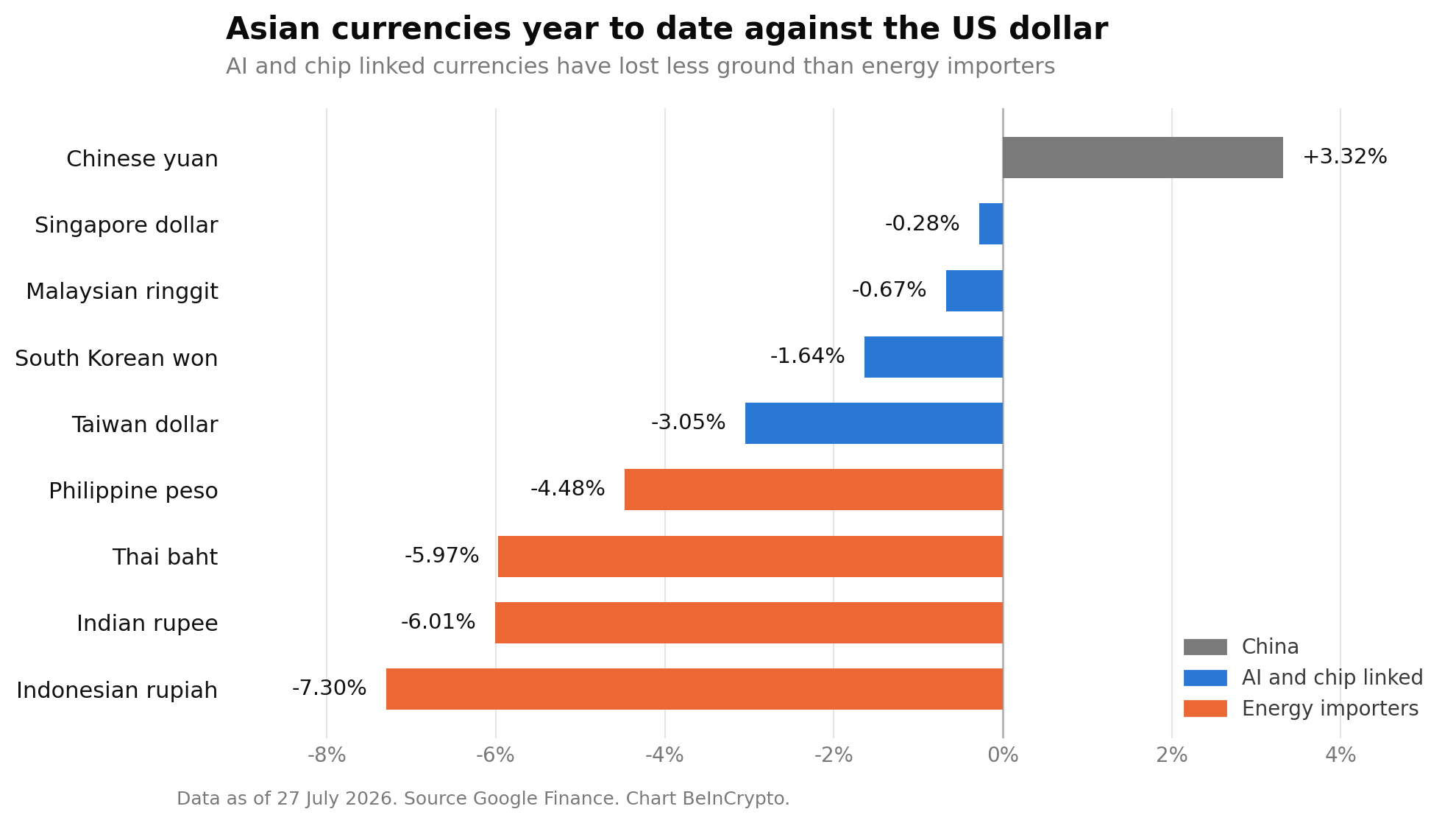
Market data shows that outperformance among Goldman’s preferred currencies does not mean outright gains. Every currency the bank links to AI has weakened against the dollar index, which is up nearly 3% in 2026.
The Singapore dollar has slipped 0.28% this year. The ringgit is down 0.67%, the won has fallen 1.64%, and the Taiwan dollar has declined 3.05%.
Energy importers have performed worse. The peso has dropped 4.48%, the baht 5.97%, and the rupee 6.01%. Indonesia’s rupiah has posted the steepest decline at 7.30%. Even the weakest AI-linked currency has outperformed the strongest energy importer by more than one percentage point.
China remains the exception. The yuan has gained 3.32% this year, making it the only Asian currency higher against the greenback. Goldman maintains a 12-month USD/CNY forecast of 6.50, citing undervaluation and Beijing’s efforts to internationalize the currency.
Not all of Goldman’s bullish currency calls are tied to AI. The bank expects measures from the Reserve Bank of India and softer oil prices to support the Indian rupee.
For the Singapore dollar, Goldman remains neutral after the Monetary Authority of Singapore left policy unchanged.
The bank’s AI case therefore applies specifically to three currencies. That distinction matters because the same export and investment channels supporting the won, Taiwan dollar and ringgit would be important indicators to watch if the AI capital-spending cycle changes.

