Technical Scoop: Jobs Surprise Weighs on Gold, but the Bull Case Holds - David Chapman
Key Takeaways
- •Gold fell 0.7% for the week after stronger-than-expected U.S. jobs data fueled expectations of higher-for-longer Federal Reserve interest rates.
- •Since Western governments seized $630 billion in Russian assets in 2022, central bank gold buying has lifted bullion's share of reserves from 5-7% to 11%, breaking the traditional link between rising yields and lower gold prices.
- •Gold broke above $4,500 resistance but needs a move above $4,700 to signal further gains, with key support at $4,200; silver needs to clear $72 and the TSX Gold Index 1,050.
- •The U.S. Dollar Index fell 0.5% despite the strong jobs report, while the Japanese yen surged 2.5% amid evident Bank of Japan intervention and rising Japanese interest rates.
- •Chapman argues unsustainable global debt growth could force the largest central bank rescue in history and recommends gold, noting North American portfolios hold only about 3% of the metal.
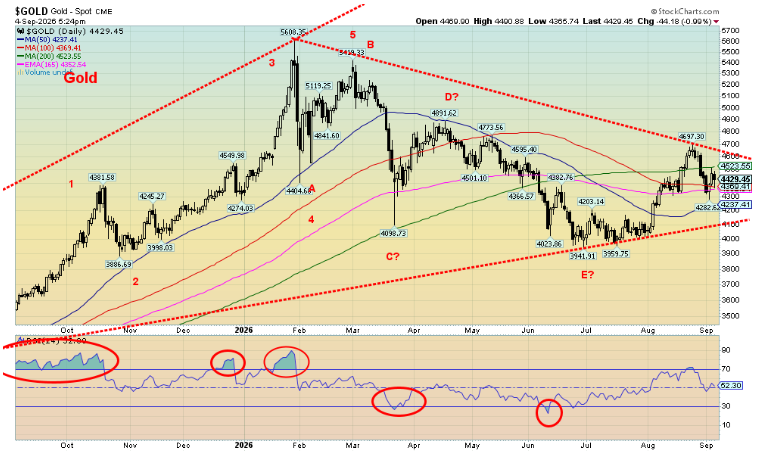
Gold had a difficult week, as stronger-than-expected job numbers took a bite out of prices. Firm employment data tend to reinforce expectations that the Federal Reserve can keep interest rates higher for longer, which historically pressures non-yielding assets like gold. Yet, in the view of analyst David Chapman, gold - and by extension silver and gold stocks - remains headed higher. Rising bond yields no longer appear to be the threat they once were.
Since the end of the gold standard in August 1971, gold has experienced three significant bull markets: 1971-1980, when it rose 1,850%; 2001-2011, when it gained 632%; and the current run since 2018, up 240% to date, though it was higher at its January 2026 peak. Traditionally, rising bond yields have pushed gold lower, but since 2022 that relationship has flipped. The turning point came when Western governments seized $630 billion worth of Russian assets following the invasion of Ukraine. In response, gold buying by major central banks, emerging market central banks, and sovereign funds accelerated, lifting gold from 5-7% of reserves to 11% today - and even higher for some holders. The shift reflects a broader move by countries seeking to reduce dependence on dollar-denominated assets that can be frozen or seized, a development that has structurally altered demand for bullion.
The United States holds the world's largest official gold reserves at 8,133 metric tonnes, representing roughly 71%-81% of its total reserves, yet values those holdings at only $42.22 per ounce - the book value set by the U.S. Treasury decades ago and never updated. China, meanwhile, has been increasing its gold reserves while reducing its U.S. Treasury holdings; gold still accounts for only about 7-8% of its total reserves, with China last reported holding 2,346 metric tonnes - a figure many analysts consider understated, given the country's persistent gold imports and production. Russia and Australia are believed to hold the world's largest in-ground gold reserves, each estimated at roughly 12,000 metric tonnes. Total reserves are limited, however, with the world estimated to have only about 15-20 years of proven, economically recoverable reserves, a constraint that underpins the long-term supply picture.
For the week, gold fell 0.7%, silver slipped 0.4%, and platinum dropped 0.3%. Palladium wavered, down 1.3%, while copper continued to climb, adding 0.6% and remaining the leader among the metals. Gold stocks wavered but were not crushed: the Gold Bugs Index (HUI) lost 0.9% and the TSX Gold Index (TGD) fell 1.1%. Chapman continues to look to silver and the gold stocks to lead the upward parade. Miners typically offer leverage to the metal's moves, which is why their technical behavior is watched closely as a confirmation signal for the broader precious-metals cycle.
On the technicals, gold broke above $4,500 resistance but has so far failed to build on the move. A break above $4,700 is needed to suggest higher prices, with new highs possible above $5,200. Silver stalled near its 200-day moving average and needs a firm break above $72 to signal further gains; above $106, new highs are possible. For the TGD, which has already taken out the 1,015 level where new highs are suggested, a break above 1,050 is the next requirement. The index is forming what looks like a fan pattern, and once above the third fan line, Chapman expects it to move higher. Key support levels to hold are $4,200 for gold, $62 for silver, and 875 for the TGD - levels where buyers have previously stepped in.
Helping the metals is the continued faltering of the U.S. dollar. The U.S. Dollar Index (USDX) fell 0.5% this week despite the stronger job numbers. Because gold is priced in dollars, a weaker greenback typically makes bullion cheaper for holders of other currencies. A big winner was the Japanese yen, up 2.5% as intervention from the Bank of Japan was once again evident, though there is no evidence the BOJ drew on its Fed facility, which allows it to borrow U.S. dollars against U.S. Treasury collateral and use those funds to purchase yen. Rising interest rates in Japan are putting considerable pressure on the BOJ and potentially forcing the unwinding of the massive yen carry trade - a decades-old strategy in which investors borrowed cheap yen to buy higher-yielding assets abroad, and whose reversal has historically sent ripples through global markets.
Chapman's broader thesis is that there is too much debt in the world. Its growth is unsustainable and poses a potential threat of a financial crisis of major proportions - one that could force the Fed and other central banks into their biggest rescue of the financial system ever, dwarfing what was done in 2008 and 2020. Whether they can manage it, in his view, is questionable. Hence his recommendation to own gold, which he describes as indestructible, irreplaceable, and carrying no liability. In North America, funds and individuals hold only about 3% gold in their portfolios; the percentage is higher in the EU and Asia, leaving room for allocation growth if Chapman's scenario were to unfold.
Source: www.stockcharts.com
Read the FULL report here: Technical Scoop: Jobs Surprise, Gold Waver, Wars On
Copyright David Chapman 2026
Disclaimer: David Chapman is not a registered advisory service and is not an exempt market dealer (EMD) nor a licensed financial advisor. He does not and cannot give individualised market advice. David Chapman has worked in the financial industry for over 40 years, including at large financial corporations, banks, and investment dealers. The information in this newsletter is intended only for informational and educational purposes and should not be construed as an offer, a solicitation of an offer, or the sale of any security. Every effort is made to provide accurate and complete information; however, no guarantees are made about the accuracy, completeness, or adequacy of the contents, and liability for errors, omissions is expressly disclaimed. David Chapman will always use his best efforts to ensure the accuracy and timeliness of all information. The reader assumes all risk when trading in securities, and David Chapman advises consulting a licensed professional financial advisor or portfolio manager, such as Enriched Investing Incorporated, before proceeding with any trade or idea presented in this newsletter. David Chapman may own shares in companies mentioned. Before making an investment, prospective investors should review each security's offering documents, which summarize objectives, fees, expenses, and associated risks. Although Artificial Intelligence (AI) may be deployed from time to time, AI output is monitored and adjusted, if necessary, for accuracy. Performance is not guaranteed, values change frequently, and past performance may not be repeated.
