Gold SWOT: Aya Gold & Silver Expands Moroccan Exploration Footprint Amid Broad Precious Metals Strength
Key Takeaways
- •Silver rose 10.28% over the past week, outperforming all other precious metals due to its higher sensitivity to gold price movements and weaker-than-expected U.S. payroll data.
- •Tether purchased 450,000 ounces of gold in Q2 2026, bringing its total holdings to 4.7 million ounces valued at $18.8 billion and representing 10% of its reserves.
- •Senior gold producers have announced $11.2 billion in annualized dividends and buybacks in 2026, exceeding the previous year's record of $8.6 billion.
- •Aya Gold & Silver expanded its Moroccan exploration land package by 35.4% to over 991 square kilometers through a $1.1 million acquisition spanning three new projects.
- •Zijin Gold's abandonment of its proposed $3.9 billion acquisition of Allied Gold Corp. suggests Chinese regulators may be applying tighter scrutiny to large outbound mining deals.
Gold SWOT: Aya Gold & Silver Expands Moroccan Exploration Footprint Amid Broad Precious Metals Strength
Strengths
Silver was the best-performing precious metal over the past week, rising 10.28%. The metal outperformed the broader complex due to its higher beta sensitivity to gold prices—silver typically amplifies gold's directional moves because of its smaller, more volatile market—supported by an unexpected decline in U.S. payroll data that pushed Treasury yields lower and dampened expectations for further interest rate hikes.
Both China and stablecoin issuer Tether continue to increase their gold accumulation, reflecting a broader trend of non-traditional buyers diversifying into bullion as a reserve asset. Global mine production reached a record 1,867 tonnes in the first half of the year, though production costs keep climbing as ore grades decline and energy expenses remain elevated. According to Canaccord, Tether purchased 450,000 ounces of gold in Q2 2026, more than doubling the 210,000 ounces acquired in Q1 2026. This brought Tether's total gold holdings to 4.7 million ounces, valued at $18.8 billion and representing 10% of its reserves.
Senior gold producers have announced annualized dividends and buybacks totaling $11.2 billion so far in 2026, well above the previous year's record of $8.6 billion. According to Canaccord, senior gold producers have returned more capital to shareholders during the 2024–2026 period than in the previous 13 years combined, a shift driven by record free cash flow generation at prevailing gold prices and growing investor pressure to demonstrate shareholder returns rather than reinvest in growth projects.
Weaknesses
Platinum was the worst-performing precious metal of the past week, though it still posted a gain of 5.96%. Over the past month, platinum and palladium have outperformed gold and silver, while silver and gold emerged as the catch-up trades during the most recent week.
Coeur Mining's Q2 financial results fell short of expectations, with earnings per share of $0.12 missing BMO's estimate of $0.32, primarily due to lower production. Output was affected by reduced grades stemming from mine sequencing, a common operational challenge where the sequence of mined areas temporarily yields lower-grade ore. The company lowered production guidance for both its New Afton and Rainy River operations.
According to CIBC, Torex Gold reported adjusted quarterly EPS of $0.91, below the consensus estimate of $1.01. All-in sustaining costs (AISC) came in at $2,459 per ounce, exceeding the consensus estimate of $2,355 per ounce. Q2 earnings were also impacted by lower sales of 92,351 gold-equivalent ounces, compared with previously reported production of 96,297 gold-equivalent ounces.
Opportunities
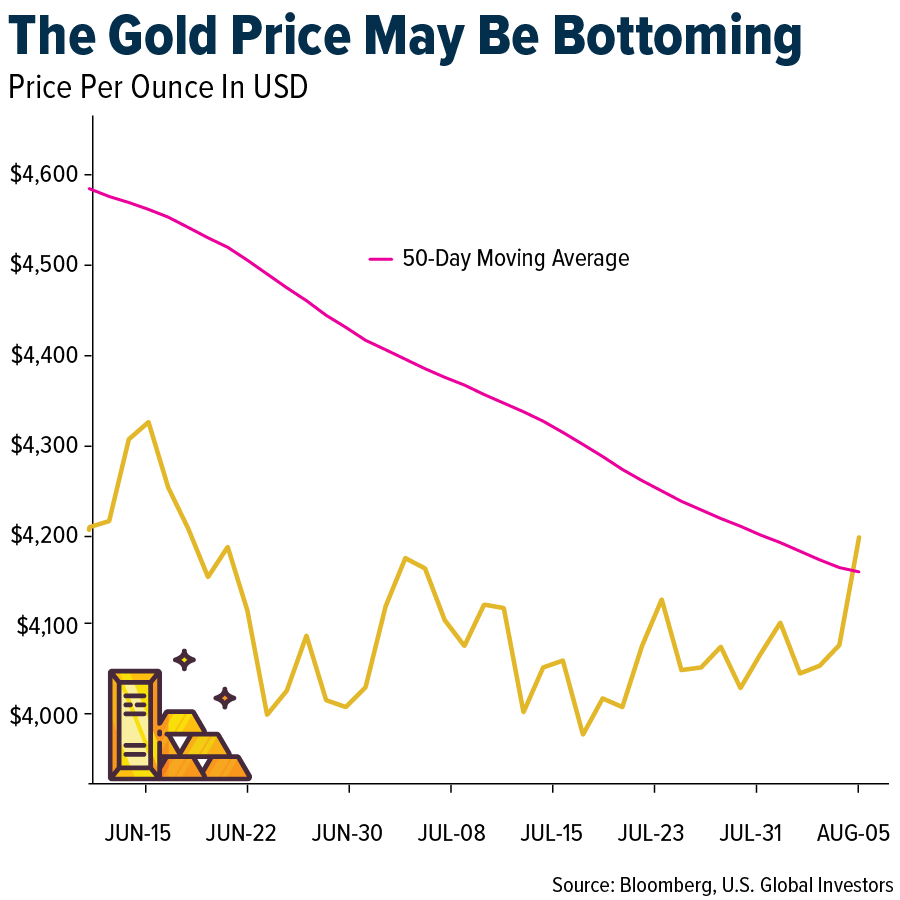
Gold is showing clear signs of a bottoming reversal, extending a sharp rebound after holding key technical support below $4,000 per ounce. The recovery has been driven by aggressive dip-buying following weak U.S. labor market data and steady institutional demand, highlighted by China's central bank accumulating gold for 21 consecutive months—a stretch that underscores sustained official-sector appetite as part of a broader de-dollarization trend among emerging-market central banks.
Aya Gold & Silver has expanded its Moroccan exploration footprint by 35.4% to more than 991 square kilometers through the acquisition of a 259-square-kilometer strategic land package spanning three new projects, at a cost of $1.1 million. Morocco has positioned itself as one of Africa's more mining-friendly jurisdictions, offering political stability and favorable terms for foreign explorers. The district-scale expansion broadens the company's asset base around the Zgounder mine, providing early-stage exposure to precious, base, and critical metals to support its long-term exploration pipeline.
UBS sees improving medium-term prospects for platinum group metals (PGMs), citing constrained primary supply, industry restructuring, and stronger-than-expected demand from hybrid vehicles, which rely on palladium and platinum in catalytic converters. This demand source could persist longer than many anticipate as hybrid adoption grows even amid the broader electric-vehicle transition.
Threats
Bloomberg cautions that gold's rally may be at risk following its rapid ascent, with key U.S. inflation data due next week that could alter the market's trajectory. Weaker-than-expected nonfarm payroll data drove gold sharply higher this past week. However, an upside surprise in next week's CPI report—particularly in core inflation—could reverse the recent decline in Treasury yields and weigh on gold, since higher real yields increase the opportunity cost of holding non-yielding bullion. Additionally, any escalation in geopolitical conflicts could push yields higher, creating a further headwind for the metal.
Zijin Gold International Co.'s decision to abandon its proposed $3.9 billion acquisition of Canada's Allied Gold Corp. in favor of a $295 million equity investment is the clearest indication yet that Chinese officials may be shifting their approach to overseas mining deals. While there was no formal rejection, Chinese regulators did not approve the transaction before the deadline. The development marks a notable shift from China's years-long push to secure critical mineral assets abroad and could signal tighter scrutiny of large outbound capital deployments. As a result, gold mining companies may have one fewer potential buyer willing to pay a control premium.
Ghana has attracted increased attention in the gold sector as the country's mining industry has grown in value, prompting changes to mining rules and regulations. However, according to the IMF, as reported by Bloomberg, Ghana's central bank incurred losses of 22 billion cedis ($1.9 billion) in 2025 under its domestic gold purchase program due to service fees, assay charges, and trading margins. Several emerging-market central banks have launched similar programs to build reserves through direct local purchases, but Ghana's experience illustrates the cost complexities that can arise when intermediary and verification expenses accumulate at scale.
Frank Holmes is CEO and Chief Investment Officer of U.S. Global Investors.

