Gold SWOT: Evolution Mining Expands Copper Growth Pipeline Amid Sector-Wide Capital Returns
Key Takeaways
- •Senior gold producers have returned $10.9 billion in annualized dividends and share buybacks year-to-date, already exceeding last year's record of $8.6 billion.
- •Evolution Mining agreed to acquire Carnaby Resources for A$213 million, representing a 60% premium to the last closing price, to expand its copper growth pipeline.
- •Nornickel's second-quarter palladium production fell 10% year-over-year to 590,000 ounces, while platinum output declined 6.5% to 145,000 ounces.
- •The Solomon Islands proposed a 15% export duty on alluvial gold and gold concentrates, though the measure has not yet been applied to Wanguo, whose effective rate remains at 1.5%.
- •Alamos Gold raised its all-in sustaining cost guidance to $1,775–$1,875 per ounce at its Mulatos mine after reducing production targets due to longer-than-expected leach cycles.
Gold SWOT: Evolution Mining Expands Copper Growth Pipeline Amid Sector-Wide Capital Returns
By Frank Holmes
Strengths
Platinum was the best-performing precious metal of the week, gaining 3.49%. BMO estimates that China has accumulated approximately 30,000 tonnes of above-ground gold—well above official figures—and now accounts for roughly one-third of global gold demand. The firm believes China's long-term strategy to strengthen the renminbi's credibility includes continued overseas mine acquisitions (approximately $18 billion to date) and sustained central bank gold purchases. At its current pace, the People's Bank of China could continue buying gold for another five years before its reserves reach levels comparable to U.S. Treasury holdings.
Senior gold producers continue to deliver record shareholder returns. Annualized dividends and share buybacks have reached $10.9 billion so far this year, already surpassing last year's record of $8.6 billion. From 2024 through 2026, senior producers are expected to return more capital to shareholders than they did during the previous 13 years combined. The scale of these returns reflects a broader industry shift toward capital discipline following past cycles of value-destructive acquisitions, with management teams increasingly prioritizing balance sheet strength over aggressive growth. With two quarters remaining and several buyback programs still underway, Canaccord expects total capital returns to increase further if precious metal prices remain at current levels.
Valterra continues to prioritize shareholder returns. The company's platinum business reported first-half 2026 EBITDA that was 9% above consensus expectations, while its dividend exceeded consensus estimates by 20%. The results extend Valterra's track record of returning excess cash to shareholders, reinforcing management's commitment to capital discipline and shareholder value.
Weaknesses
Silver was the worst-performing precious metal of the week, declining 1.60%. Impala Platinum temporarily suspended mining operations at its Rustenburg complex in South Africa from July 24–28 to conduct a comprehensive safety reset following an increase in serious workplace incidents. According to Bloomberg, the operation employs approximately 51,500 workers and accounts for nearly half of Implats' total platinum production, underscoring the significance of the temporary shutdown. South Africa's deep-level platinum and gold mines have historically faced elevated safety risks compared with open-pit operations elsewhere, making proactive safety interventions a recurring operational factor for producers in the region.
Nornickel reported lower platinum and palladium production in the first half of 2026. Palladium production declined 10% year-over-year to 590,000 ounces in the second quarter, while platinum output decreased 6.5% to 145,000 ounces, according to Interfax. For the first half of 2026, palladium and platinum production were down 14% and 16%, respectively, from a year earlier, reflecting weaker supply from one of the world's largest producers. As a major source of global palladium supply, Nornickel's production shortfalls are relevant to a market where palladium demand is closely tied to automotive catalytic converter manufacturing.
Petra Diamonds reported weaker-than-expected fourth-quarter results. Production and sales came in below BMO's estimates, primarily due to the suspension of operations at the Finsch mine during the quarter, while the Cullinan mine remained operationally stable. Revenue was also pressured by continued weakness in demand for smaller-sized diamonds.
Opportunities
Evolution Mining is expanding its copper growth pipeline. The company agreed to acquire 100% of Carnaby Resources for A$213 million, offering 0.0682 Evolution shares for each Carnaby share and valuing the transaction at A$0.77 per share. According to RBC, the offer represents a 60% premium to Carnaby's last closing price and a 31% premium to its 30-day volume-weighted average price (VWAP), undersoring Evolution's commitment to expanding its resource base. The acquisition reflects a broader trend among gold producers diversifying into copper, a metal whose demand is projected to grow with electrification and grid infrastructure buildout.
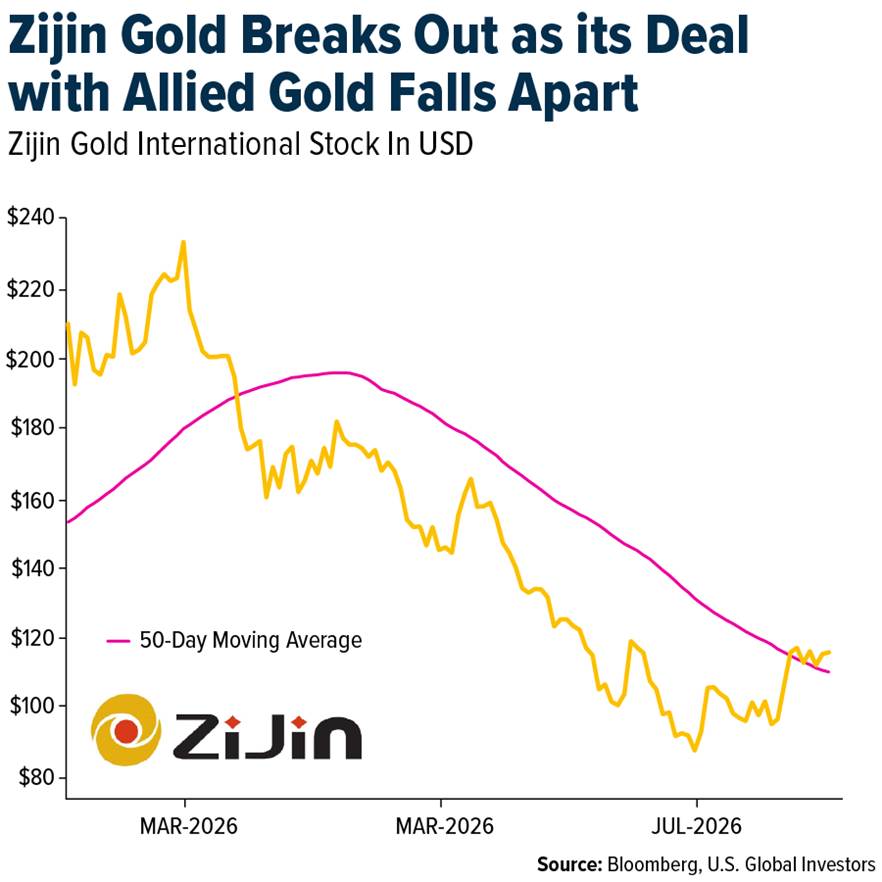
Allied strengthened its financial position ahead of Kurmuk's startup. Although the company terminated its arrangement agreement with Zijin Gold, it secured a $295 million strategic investment that preserves the relationship while significantly enhancing liquidity ahead of the Kurmuk project's expected August startup. According to CIBC, management also reaffirmed its strong production outlook for 2027–2028, reinforcing confidence in the company's long-term growth strategy.
Gold mining valuations remain broadly in line with historical averages. At current spot gold prices, RBC's royalty coverage trades at 1.69x P/NAV, slightly below its 1-year and 3-year averages of 1.73x and 1.79x, respectively. Meanwhile, its senior producer coverage trades at 1.10x P/NAV, also modestly below historical averages of 1.11x and 1.13x. At spot gold prices, senior producers are generating forward 12-month free cash flow-to-enterprise value (FCF/EV) yields of 7.0%, reflecting continued cash generation despite elevated gold prices.
Threats
The Solomon Islands is proposing higher export duties on gold producers. The country's Minister of Finance and Treasury announced a 15% export duty on alluvial gold and gold concentrates. According to UBS, the measure has not yet been applied to Wanguo, and discussions with the government remain ongoing. As a result, the company's current effective export tax rate remains at 1.5%, limiting the immediate financial impact while regulatory uncertainty persists. The proposal is consistent with a broader wave of resource nationalism across mining jurisdictions, where governments from Africa to Latin America have sought increased fiscal take from mineral exports.
Bellevue Gold lowered expectations for its production growth. According to UBS, the company previously targeted annual production of more than 200,000 ounces before revising its FY27 goal to 175,000–195,000 ounces. Its latest FY27 guidance of 160,000 ounces represents a meaningful downgrade, particularly as management now emphasizes a target of consistently producing 40,000 ounces per quarter, signaling a more conservative production outlook.
Alamos Gold raised cost guidance and lowered production expectations at Mulatos. According to RBC, the company reduced production targets for its Mulatos mine due to a longer-than-expected leach cycle. As a result, all-in sustaining cost (AISC) guidance increased to $1,775–$1,875 per ounce, while capital expenditure guidance was also raised modestly to $945–$1,035 million. Cost guidance increases have been a recurring theme across the sector as labor, energy, and consumable inputs remain elevated compared with pre-2023 levels.

