Gold SWOT: Large Asset Managers Rebuild Gold Positions After Price Pullback
Key Takeaways
- •Gold remained relatively resilient despite a weekly decline of 1.12% caused partly by a stronger dollar and higher Treasury yields.
- •Uruguay resumed physical gold purchases after roughly three decades, while Bolivia continued buying domestically produced gold.
- •Asset managers overseeing a combined $27 trillion have largely maintained or increased their gold positions following the earlier price pullback.
- •Palladium fell 2.58% during the week, with its ETF holdings down more than 10% year to date.
- •Mexico’s environmental ministry authorized 150 mining permits, while the economy ministry reported clearing approximately 95% of its permit backlog.
Gold SWOT: Large Asset Managers Rebuild Gold Positions After Price Pullback
By Frank Holmes
Strengths
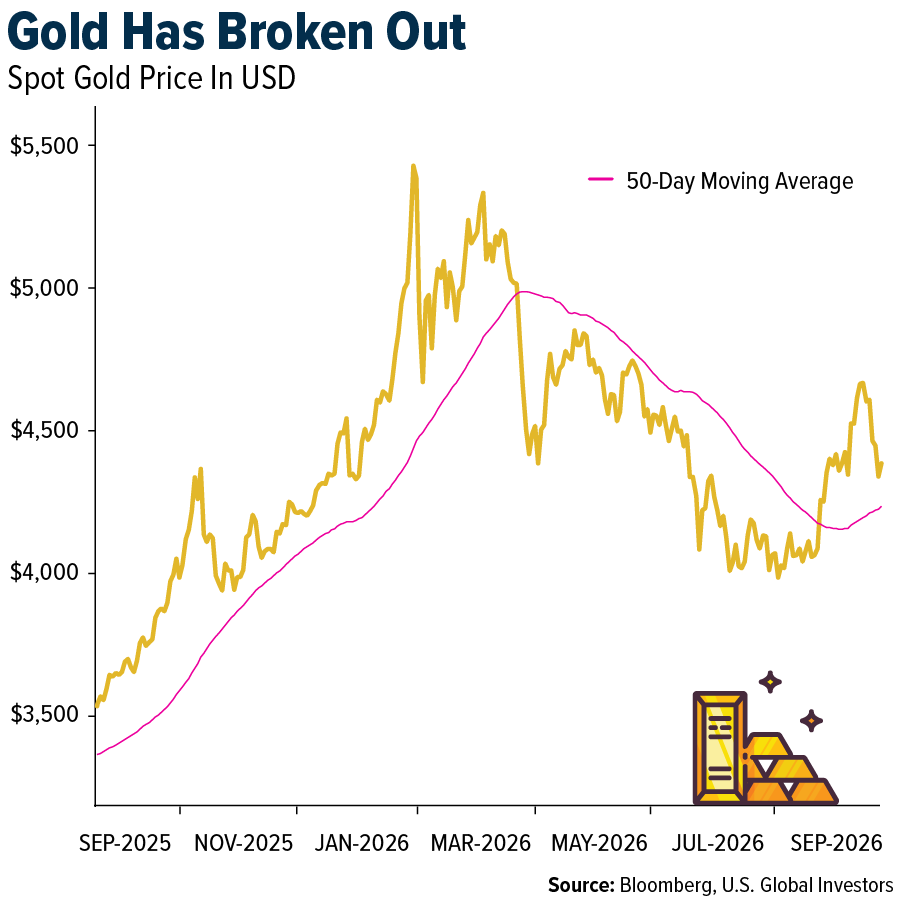
Gold was the best-performing precious metal over the past week, although it still declined 1.12%. The metal weakened after robust U.S. labor-market data strengthened the dollar and pushed Treasury yields higher. Gold has nevertheless remained resilient relative to other precious metals, while structural demand from central banks and improving exchange-traded fund (ETF) flows continue to provide longer-term support.
Central banks continue to diversify their reserves into gold. Uruguay added physical gold to its reserves for the first time in roughly three decades, while Bolivia continued accumulating domestically produced gold. The moves highlight continued interest in gold among Latin American central banks. Official-sector buying has become one of the most closely followed pillars of gold demand in recent years, since reserve managers tend to hold for the long term and are generally less sensitive to week-to-week price swings than other buyers.
Some of the world’s largest asset managers have also been rebuilding their gold positions following the metal’s pullback earlier this year. They have cited gold’s appeal as a portfolio hedge and expressed confidence in its long-term outlook. Bloomberg reported that firms managing a combined $27 trillion in assets have largely maintained or increased their gold exposure despite continuing uncertainty over the Federal Reserve’s policy path. For readers tracking the metal, institutional positioning through ETFs and managed accounts is among the most visible channels of investor demand, and whether this rebuilding of positions continues offers a gauge of conviction while the policy outlook remains unresolved.
Weaknesses
Palladium was the worst-performing precious metal over the past week, falling 2.58%. Investor sentiment toward palladium remains weak, with ETF holdings continuing to decline and year-to-date holdings down more than 10%. The sustained outflows indicate limited investor conviction compared with other precious metals.
Global bond yields rose to their highest levels since 2008, while the U.S. dollar strengthened, creating headwinds for gold. Higher yields increase the opportunity cost of holding non-yielding assets, potentially limiting investor demand for bullion.
ETF holdings of silver, platinum and palladium also continue to decline year to date, pointing to weaker investor participation across the broader precious-metals sector. Sustained outflows could weigh on sentiment toward the sector despite gold’s relative resilience. Because ETF balances are widely used as a proxy for investor participation, the divergence between steady official-sector buying and shrinking investor holdings is a tension worth monitoring across the precious-metals complex.
Opportunities
Artificial intelligence-related technologies are emerging as a new source of demand for platinum-group metals, including platinum, ruthenium and iridium. According to Metals Focus, this trend could become increasingly important as hydrogen-related demand remains relatively limited. Electrolysers are expected to account for only about 45,000 ounces of platinum consumption in 2026, a figure that illustrates how small the hydrogen channel remains today and why new technology-driven sources of demand are drawing attention.
Ned Davis Research’s “Debasement Trade Index” warns that a negative feedback loop could develop if foreign buyers step back from Treasuries. Such a shift could increase financial repression and drive investors toward real assets such as gold, potentially providing additional support for gold prices. The framework gives readers a lens for watching foreign demand for U.S. government debt, a flow that sits alongside Fed policy and the dollar among the macro variables most often cited in gold analysis.
According to BMO, Mexico’s Ministry of Environment and Natural Resources, known as Semarnat, has authorized 150 mining permits. Fernando Aboitiz, head of the Ministry of Economy’s Extractive Activities Coordination Unit, made the statement while speaking at Mexico’s Mining Forum yesterday.
Aboitiz said Semarnat has completed 85% of its permit backlog, while the National Water Commission is around 50% complete and the Ministry of Economy has cleared approximately 95% of permits. Mexico’s Sheinbaum administration inherited a large backlog of permit applications accumulated during the AMLO presidency from 2018 to 2024, when there was effectively a moratorium on new concessions. Because permits are a prerequisite for moving mining projects toward development, progress on the remaining backlog is a variable that companies operating in Mexico and observers of the country’s future mine supply track closely.
Threats
Investor conviction remains a risk. Despite strong central-bank demand and continued reserve accumulation, gold has not consistently responded to supportive economic signals. This could limit upward momentum if market participants begin to question the strength of traditional bullish drivers.
Indian Prime Minister Narendra Modi has renewed calls for citizens to avoid non-essential gold purchases as the country seeks to curb import-driven pressure on its trade balance and currency. However, given gold’s longstanding role in household savings and cultural traditions, it remains uncertain how much these appeals will reduce demand. India ranks among the world’s largest gold consumers, which is why shifts in its import demand are watched closely within the global demand picture.
Although recent comments from Federal Reserve Governor Christopher Waller tempered expectations for a September rate hike, traders have since increased the perceived likelihood of additional policy tightening. The shift in rate expectations has pressured gold, although the metal continues to show relative strength compared with other precious metals. Upcoming Fed communications and labor-market data will shape how those expectations settle, and with them the yield-and-dollar backdrop that defined this week’s trading.
About the author
Frank Holmes
Frank Holmes is the CEO and chief investment officer of U.S. Global Investors. He purchased a controlling interest in U.S. Global Investors in 1989 and became the firm’s chief investment officer in 1999.
In 2006, Holmes was selected as mining fund manager of the year by the Mining Journal. In 2011, he was named a U.S. Metals and Mining “TopGun” by Brendan Wood International. In 2016, Holmes and portfolio manager Ralph Aldis received the award for Best Americas Based Fund Manager from the Mining Journal. Holmes is also the co-author of The Goldwatcher: Demystifying Gold Investing. More than 30,000 subscribers follow his weekly commentary in the award-winning Investor Alert newsletter, which is read in more than 180 countries.
Under Holmes’s guidance, the company’s mutual funds have received recognition from Lipper and Morningstar, two independent financial authorities. In 2015, he led the company into the ETF business with the launch of the U.S. Global Jets ETF, which invests in the global airline sector. In 2017, U.S. Global Investors made a strategic investment in HIVE Blockchain Technologies, listed in Toronto, and Holmes was appointed non-executive chairman of the board.
Holmes received the Huron Medal of Distinction from Huron University College in 2013, his alma mater for the class of 1978. The award recognizes individuals whose life achievements set an example of excellence and reflect Huron’s arts and social sciences missions.
A native of Toronto, Holmes graduated from the University of Western Ontario with a bachelor’s degree in economics. He is a former president and chairman of the Toronto Society of the Investment Dealers Association.
Holmes is a keynote speaker at national and international investment conferences. He has spoken at the Investing in African Mining Indaba conference, the Denver Gold Group’s European Gold Forum and numerous Money Show events. He has participated in panels with prominent industry leaders, including the editor of Barron’s, and continues to be invited as a keynote speaker at conferences throughout the United States, Canada and overseas.
Holmes is a regular commentator on CNBC, Bloomberg, BNN and Fox Business. He has been profiled by Fortune and The Financial Times. His views on gold are presented each week on Gold Game Film, a program produced in collaboration with Kitco News and TheStreet.com. Holmes was also featured in a Barron’s cover spread during the commodity rally at the start of 2004. He is a regular contributor to Forbes, Business Insider, Seeking Alpha and the Wall Street Journal’s Experts Corner.
Frank Holmes has been appointed non-executive chairman of the Board of Directors of HIVE Blockchain Technologies. Both Holmes and U.S. Global Investors own HIVE shares, directly and indirectly. This interview should not be considered a solicitation or offering of any investment product.
