Gold Extends Decline to Near $4,280 as Surging Oil, Rising Yields and Hawkish Fed Outlook Weigh
Key Takeaways
- •Spot gold traded near $4,280 an ounce on Thursday, extending the prior session's 1.7% decline, while silver fell about 0.6% to roughly $64 an ounce.
- •Iranian President Masoud Pezeshkian told the United Nations that Iran will block commercial shipping through the Strait of Hormuz for as long as American sanctions remain in place.
- •Gold has lost nearly 20% of its value since US-Iran military hostilities began in late February, with rising energy costs serving as a primary driver of the correction.
- •Treasury yields reached their highest levels in roughly two decades, with the five-year yield topping 5% for the first time since 2007 after stronger-than-expected US economic data.
- •Interest rate markets price in at least three Federal Reserve rate increases by April of next year, after Governor Michael Barr signaled further tightening would likely be needed to restore 2% inflation.
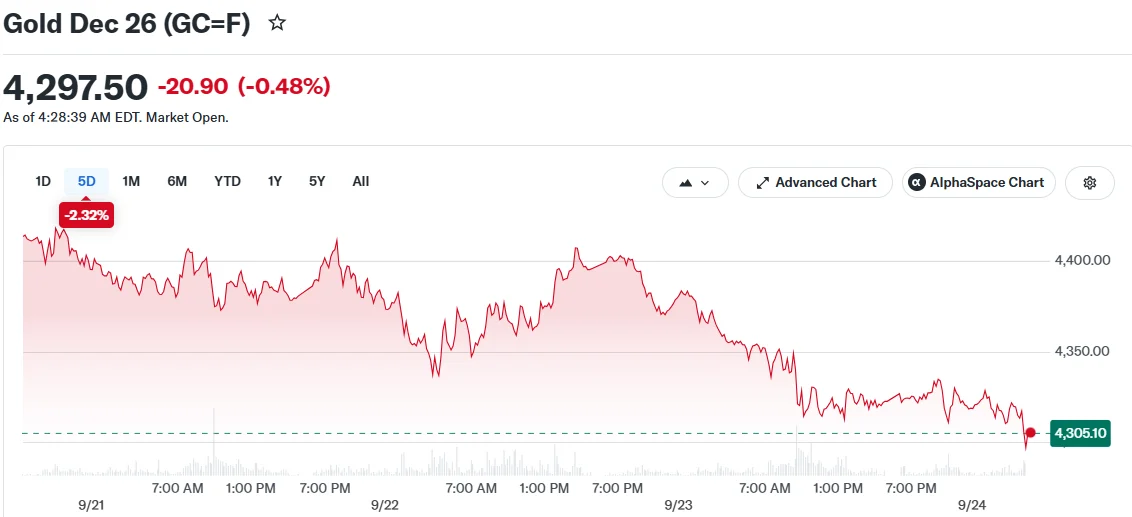
Gold drifted lower on Thursday, building on the previous session's steep retreat, as elevated crude oil prices, a firmer dollar and climbing government bond yields combined to create a challenging environment for bullion.
Spot gold hovered around $4,280 per ounce throughout Asian market hours, extending Wednesday's 1.7% decline. Silver also lost ground, retreating roughly 0.6% to settle near $64 per ounce. The platinum group metals delivered a mixed performance, with both platinum and palladium posting modest advances.
Oil Climbs as Iran Threatens to Close the Strait of Hormuz
Energy markets rallied following remarks from Iranian President Masoud Pezeshkian during his address to the United Nations. The Iranian leader declared that Tehran would block commercial shipping through the strategically vital Strait of Hormuz for as long as American sanctions and economic restrictions persist. strait, which lies between Iran and Oman, is one of the world's most important energy chokepoints and carries a large share of globally traded crude.
Oil is rising as Iran says the time for negotiations is over. Hopium for a Hormuz reopening is vanishing. There is no deal, no Hormuz reopening, and no reason for lower oil prices. Brace for inflation. pic.twitter.com/engvLbUr2D
— Lukas Ekwueme (@ekwufinance) September 23, 2026
Pezeshkian emphasized that his nation remains open to diplomatic engagement while making clear that coercive measures would not produce the desired outcomes. He additionally stated that Iran harbors no ambition to develop atomic weapons, though Tehran maintains its sovereign entitlement to civilian nuclear capabilities.
The statements emerged just twenty-four hours after President Donald Trump characterized bilateral discussions with Iranian officials at the UN gathering as "very good." Notwithstanding the encouraging diplomatic rhetoric, comprehensive normalization between Washington and Tehran remains a distant prospect.
Gold has surrendered nearly 20% of its value since military hostilities between the United States and Iran commenced in late February, and escalating energy expenses have functioned as a primary catalyst behind the substantial correction.
Resilient Economic Data Drive Bond Yields Higher
Gold has remained acutely sensitive to monetary policy signals in recent trading sessions. While the metal is traditionally viewed as a hedge against inflation and geopolitical turmoil, its lack of yield leaves it exposed when rates rise, and market participants continue to assess whether persistent energy inflation will compel policymakers to implement additional restrictive measures.
Government debt securities came under significant selling pressure following better-than-anticipated economic releases and disappointing auction demand. Yields across multiple maturity segments surged to levels unseen in approximately twenty years, and the five-year Treasury note yield penetrated the 5% threshold for the first time since 2007 — a development that intensified the headwinds confronting gold valuations.
American business conditions improved at the most robust pace in more than half a decade. The S&P Global flash composite purchasing managers' index for September surged to 58.4, marking the strongest reading since July 2021, as vigorous customer demand stimulated increases in both order backlogs and employment levels across the manufacturing and service sectors nationwide.
Federal Reserve Governor Michael Barr indicated that additional monetary tightening would likely prove necessary to restore price stability consistent with the central bank's 2% inflation objective. His assessment aligned with cautionary messages delivered by fellow monetary policy officials throughout the week, several of whom have acknowledged that inflationary dynamics are proving more persistent than initially anticipated.
Interest rate derivatives markets currently incorporate expectations for no fewer than three policy rate increases by April of next year, a recalibration from the projections established earlier in the week.
The US Dollar Index consolidated after four consecutive sessions of appreciation, during which the benchmark reached its most elevated level in approximately eight weeks. A stronger greenback typically weighs on dollar-denominated commodities by making them more expensive for buyers using other currencies.
The convergence of strengthening economic fundamentals, ascending yields, advancing energy prices and dollar firmness continues to exert downward pressure on precious metals. The trajectory of US interest rates remains the dominant near-term theme for bullion traders, and investors will maintain focus on forthcoming Federal Reserve communications and macroeconomic releases for additional clarity.
This article originally appeared on Blockonomi.

