Technical Scoop: Stagflation Possible, Rate Fall, Temporary Whack
Key Takeaways
- •Gold dropped after Jackson Hole comments were seen by markets as leaving open the possibility of a Fed rate hike.
- •The Gold Bugs Index and TSX Gold Index declined less than gold and silver last week, which the author views as a positive sign for the sector.
- •Gold mining indices had a record August rally, with the HUI and TGD posting large monthly gains and the TSX Venture Exchange also rising strongly.
- •The U.S. dollar index rose 0.8% last week, while the euro, Swiss franc, pound sterling, and Japanese yen all weakened.
- •The author says gold is entering a favorable seasonal period, but only new highs would confirm a renewed uptrend.
Technical Scoop: Stagflation Possible, Rate Fall, Temporary Whack
By David Chapman — Excerpt from this week's Technical Scoop: Stagflation Possible, Rate Fall, Temporary Whack
Gold and Silver
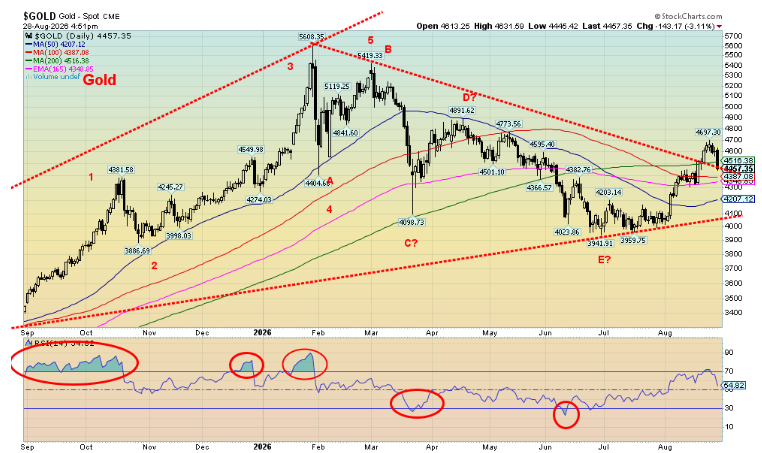
Ouch! Kevin Warsh's remarks at the Jackson Hole symposium — the Kansas City Fed's annual economic policy conference in Wyoming, a venue closely watched for signals about the direction of monetary policy — left the impression that the Fed might hike interest rates. That he didn't actually say that is irrelevant — the market perceived it as a possibility. As a result, gold tanked, stocks waffled downward, bond yields rose, and the US$ Index jumped higher. But a reminder: with $40 trillion in debt and interest payments eating up an increasing share of the U.S. budget, gold still has only one way to go, and that is up.
We can't say the end-of-the-week drop for gold is over. The market is now testing the breakout near $4,500. A break under $4,300 is of more concern, and a break under $4,100 suggests new lows under $3,900. The same applies to silver, which so far is the only one that hasn't broken out of its downtrend. A break under $58.35 suggests new lows below $54.74, and a move under $62.50 suggests lower prices. Obviously, the argument over further declines or new lows ends with new highs above $4,700 gold and $71 silver.
Gold Stocks Hang Tough
The gold stocks continue to hang tough. This past week gold fell 3.4% and silver dropped 4.3%, but the Gold Bugs Index (HUI) — the NYSE Arca index of gold mining companies that do not hedge their gold production beyond 1.5 years — fell only 2.8% and the TSX Gold Index (TGD), its Canadian counterpart, dropped 2.2%. This outperformance by the gold stock indices suggests that the current decline for gold and silver should be only temporary. We'd be more concerned if the gold stock indices fell more percentagewise than gold and silver, as that would suggest the gold stocks were leading. Gold stocks leading is what we normally see; that they didn't lead is viewed as a positive. Both the HUI and the TGD have surpassed — albeit not by much — levels that could suggest new highs ahead. This could be merely a bump in the road.
Elsewhere, platinum joined the down move, off 3.3%, but palladium jumped 5.3%. Copper fell 0.5%, just off new all-time highs.
A Record Month for Mining Indices
Gold stocks have enjoyed a very strong month, with the HUI up 35.9% so far and the TGD up 34.3%. At the recent highs, the HUI was up 53.6% in August and the TGD up 50.9% — a record month for both indices. Gold stocks have been leading, which is what we'd expect; if they were not, we'd be concerned about the rally. The drop thus far is a setback, a correction after a strong move.
Signs continue to be positive in the junior mining market as well. The TSX Venture Exchange — the Toronto-based junior exchange where small-cap resource and exploration companies list — has gained 17.8% in August and was up 20.5% at the recent highs. A reminder: the CDNX is only about 50% mining stocks, and not all of those are gold mining stocks — many are metal stocks. Nonetheless, it's all positive. Junior gold mining developers don't usually start to move higher until after Labour Day.
Currencies
Currencies were universally down this past week, given the jump in the US$ Index, which rose 0.8%. The euro fell 0.8%, the Swiss franc 1%, the pound sterling 0.8%, and the Japanese yen 0.7%. A falling Japanese yen is not good, as both the BOJ and the U.S. Treasury want it higher. Japan has a history of intervening in currency markets to support the yen, and Japanese authorities have repeatedly warned against one-sided yen selling. Another intervention coming?
Seasonality and Outlook
Gold has entered a positive seasonal period. History suggests a high sometime in September or October, then another correction into December before a stronger seasonal period gets underway in January. One can't quite take it to the bank. Only new highs will confirm that we are indeed in a new up phase. Otherwise, all we can say about the current action is that it is a correction to the January/July down move. Once it tops, another down move might be expected to test the lows.
That said, our expectations are for higher gold prices. There is simply too much debt — not just in the U.S. but everywhere. Gold is the safe haven. It's tangible, indestructible, and has no liability.
Gold vs. Bitcoin
Bitcoin has also jumped higher, with gold gaining 35% in August. But Bitcoin is not tangible. It can be destroyed, and as to liability, just ask those who lost their Bitcoin to hackers. For gold bugs, there is no comparison: gold is real, Bitcoin is illusion. Gold can't be destroyed; Bitcoin can be hacked. It relies on codes on a computer, and on computers and the internet to move it. But yes, Bitcoin is limited — only 21 million coins exist and supply is not expanding. Gold is still being found, but it is limited. All the gold that ever existed is still here, even if it fell to the bottom of the ocean.
Charts: www.stockcharts.com
Read the full report at GoldSeek.
Copyright David Chapman 2026.
About the Author
David Chapman has worked in the financial industry for over 40 years, including at large financial corporations, banks, and investment dealers. Website:
Disclaimer: David Chapman is not a registered advisory service and is not an exempt market dealer (EMD) nor a licensed financial advisor. He does not and cannot give individualised market advice. The information in this newsletter is intended only for informational and educational purposes and should not be considered a solicitation of an offer or sale of any security. The reader assumes all risk when trading in securities, and David Chapman advises consulting a licensed professional financial advisor before proceeding with any trade or idea presented in this newsletter. David Chapman may own shares in companies mentioned in this newsletter. Ideas and opinions are shared for informational and educational purposes only, and readers are expected to perform due diligence before considering a position in any security, including consulting their own licensed professional financial advisor.
