Headlines Change, the Monetary Reality Does Not, Says David Morgan
Key Takeaways
- •Gold and silver rebounded sharply after Fed Governor Christopher Waller's comments reduced expectations of an immediate rate increase.
- •Central banks purchased roughly 1,000 tonnes of gold per year in 2022 and 2023, according to the World Gold Council, as they diversified reserves away from the dollar.
- •Silver supply is slow to respond to price signals because new mines take years to develop and most silver is produced as a by-product of other metals.
- •Morgan cautions that tokenized gold does not guarantee safe ownership, since value depends on verified, allocated physical backing and custodial integrity.
- •Morgan advises that physical gold and silver should serve as financial insurance and capital preservation, with trading kept as a separate activity.
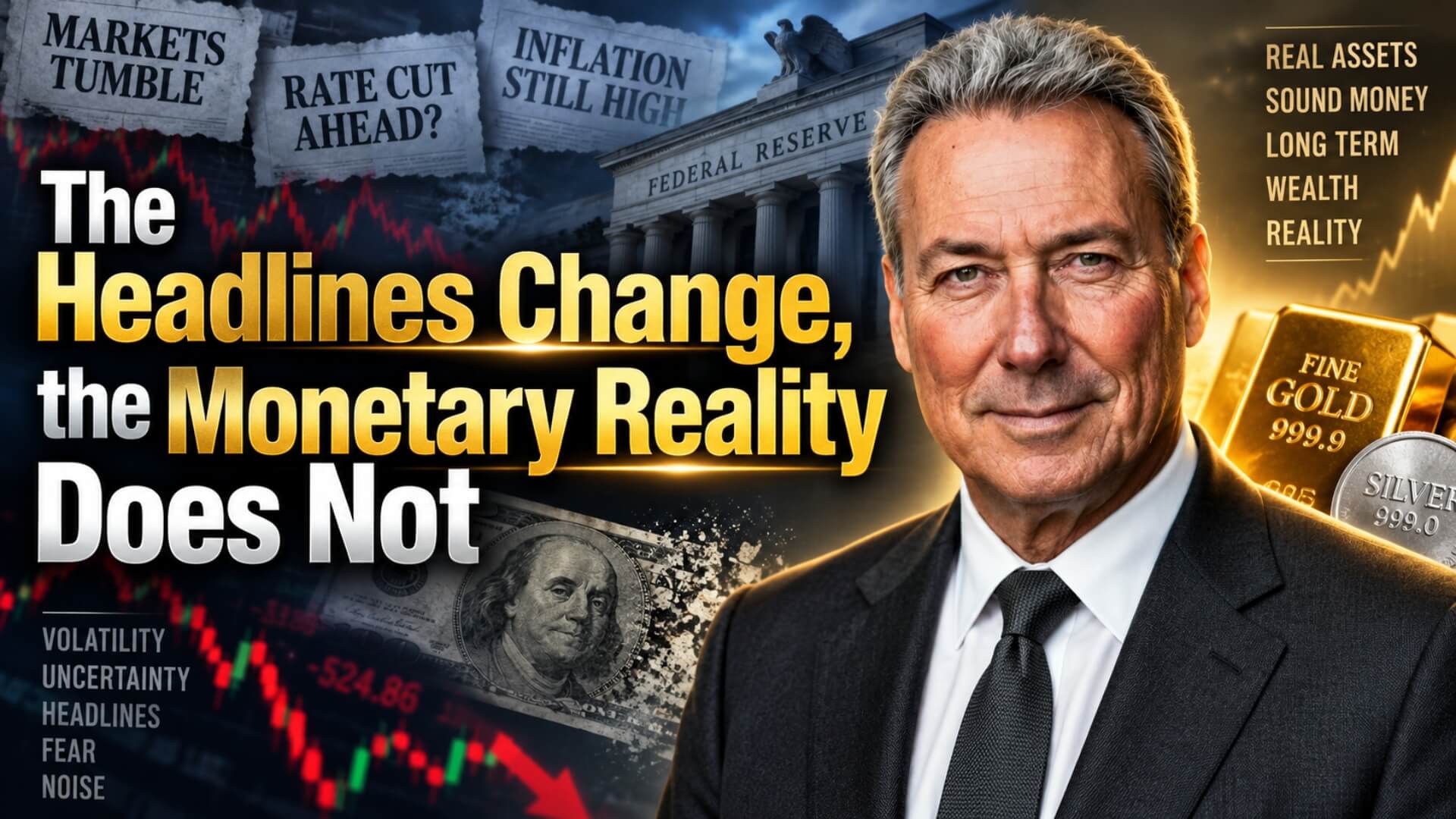
The Headlines Change, the Monetary Reality Does Not
David Morgan's weekly perspective draws a sharp distinction between short-term market volatility and the long-term monetary case for precious metals.
Fed Language Moves Markets; the Monetary Structure Moves Slowly
Gold and silver initially came under pressure as the dollar and bond yields strengthened and expectations of a Federal Reserve rate increase climbed. However, after comments from Fed Governor Christopher Waller reduced expectations of an immediate hike, yields and the dollar retreated, and precious metals rebounded sharply.
For Morgan, this episode illustrates how modern markets can reprice trillions of dollars on the basis of shifting probabilities and central-bank language, even while the underlying monetary structure changes far more slowly.
Gold's Long-Term Record Since 2000
Morgan revisits gold's performance relative to stocks, bonds, and real estate since 2000. While acknowledging that the choice of starting dates can influence such comparisons, he maintains that gold has ultimately outperformed the major asset classes over this period.
More importantly, he argues that gold should not be evaluated like a stock, because it produces no earnings or dividends. Its primary purpose, in his view, is monetary insurance and protection against currency debasement, financial instability, growing government debt, and systemic risk. He believes the acceleration in gold since roughly 2022 may represent the later stages of a much larger monetary transition. That period has coincided with record central-bank gold purchases—reported by the World Gold Council to have run at roughly 1,000 tonnes per year in 2022 and 2023—driven notably by banks diversifying reserves away from the dollar.
Silver: Bearish Forecasts Do Not Solve Physical Constraints
On silver, Morgan emphasizes that bearish price forecasts do nothing to resolve the physical constraints facing the market. Prices can change instantly, but new mine supply takes years to develop because of declining ore grades, permitting difficulties, capital requirements, political risk, and long development timelines. Most silver is also produced as a by-product of mining other metals, which limits how quickly supply can respond even to sustained price strength. Meanwhile, industrial demand—particularly from photovoltaic panels and electronics—has grown to represent a large share of total silver consumption, a shift the Silver Institute has documented in its annual world silver surveys. This is pushing investors to pay closer attention to deposit quality, jurisdiction, management, and project economics.
Tokenization Raises Ownership Questions
Morgan also raises concerns about the growing tokenization of financial assets, including gold. A token may make gold easier to transfer, but it does not necessarily make ownership safer. Investors still need to know whether the underlying metal actually exists, whether it is allocated and independently audited, who controls custody, and what happens if an issuer, exchange, custodian, or technological system fails. His caution parallels a broader trend: major exchanges and financial institutions have launched tokenized gold products whose value depends entirely on verified, allocated physical backing.
Own First, Trade Second
His central message is simple: do not let short-term price swings obscure the long-term purpose of owning precious metals. Physical gold and silver should primarily serve as financial insurance and capital preservation, while trading and speculation should remain separate activities. As Morgan puts it: own first, trade second, and never confuse volatility with invalidation.
About the Author
David Morgan became interested in silver at the age of 11 and started investing in the stock market while still a teenager. A precious metals analyst with degrees in finance, economics, and engineering, he created the Silver-Investor.com website and originated The Morgan Report, a monthly publication covering economic news, the overall financial health of the global economy, currency problems ahead, and reasons for investing in precious metals.
David considers himself a big-picture macroeconomist whose main job is education—teaching people about honest money and the benefits of a sound financial system—and whose second job is teaching people to be patient and maintain conviction in their investment holdings. A frequent speaker around the world, he is also the author of "Get the Skinny on Silver Investing," available as an e-book or through Amazon.com. As publisher of The Morgan Report, he has appeared on CNBC, Fox Business, and BNN in Canada, and has been interviewed by The Wall Street Journal, Futures Magazine, SilverSeek, and numerous other publications.
Website:
Second Chance Book:
The Silver Manifesto:
Blog:
Twitter: http://twitter.com/silverguru22
