Technical Scoop: Weak Jobs, Gold Down, Economy Tippy
Key Takeaways
- •Gold rallied roughly $50 after Friday's soft U.S. September jobs data but reversed to close the session down $36 at $4,145, a move Chapman described as a negative sign.
- •Chapman links gold's decline to rising bond yields, which lift the opportunity cost of holding assets that pay no interest, and says a deeper sell-off cannot be ruled out.
- •The metals and mining space fell broadly last week, with gold down 3.3%, silver 5.9%, platinum 4.0%, palladium 8.2%, copper 2.7%, the HUI down 6.3%, and the TSX Gold Index down 5.3%.
- •A close under $4,100 for gold would make new lows below $3,942 probable, with Chapman's worst-case scenario at $3,500, while a silver break under $58 would signal new lows below $54.74.
- •Chapman expects the final low could come anytime until mid-December, views it as a buying opportunity rather than a panic, and sees support from global debt problems, weakening U.S. bond auctions, and fractured geopolitics.
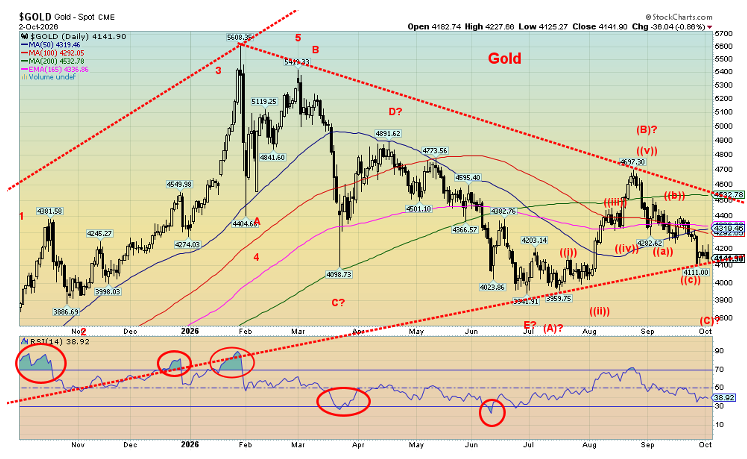
Gold and silver remain on their heels, and last week's weaker-than-expected U.S. September jobs report offered only a fleeting reprieve. Writing in his latest "Technical Scoop" commentary published on SilverSeek, market technician David Chapman noted that gold initially jumped roughly $50 after Friday's release of the soft employment data, only to close the session down $36 — a reversal he described as "not a good sign."
According to Chapman, gold is responding negatively to rising bond yields — higher yields lift the opportunity cost of holding an asset that pays no interest — and the pressure may get worse as yields remain on a continued trajectory to the upside. In his assessment, a deeper sell-off "quite possibly" cannot be ruled out.
Bear market lows now in play
Chapman has long expected that the bear market following the big gold run-up that topped in January 2026 would test its lows. "So far, so good," he wrote, adding that the market is now on the cusp of that move — a signal to him that lows are probable. Gold closed Friday at $4,145. A close under $4,100 would make new lows below $3,942 probable.
Should this be a surprise? In Chapman's view, no: the market is in a period that is not friendly to gold, a phase that can last into December. The final low could come anytime from now until mid-December. Is it a panic? Probably not, he argued; rather, it will be a buying opportunity.
The past week also offered opportunities for gold to close higher, with weaker-than-expected PCE prices — from the personal consumption expenditures price index, the Federal Reserve's preferred inflation gauge — arriving alongside the soft job numbers, prints that would ordinarily be "music for gold." Not this time.
Broad declines across metals and miners
Gold closed the week down 3.3%, silver fell 5.9%, and platinum dropped 4.0%. The near-precious metals fared no better, as palladium slid 8.2% and copper fell 2.7% — even though copper remains in a strong uptrend. Gold equities sold off as well, with the Gold Bugs Index (HUI), a benchmark of major unhedged gold producers, down 6.3%, and the TSX Gold Index (TGD), the Toronto-based gold equity gauge, down 5.3%. Downtrends dominate on daily charts and even some weekly ones, Chapman noted. Charts accompanying the commentary are sourced from StockCharts.com.
How low could prices go?
The result of all this, Chapman wrote, is that investors will have to ride out what appears to be another thrust to the downside. How low could prices go? His worst-case scenario for gold is $3,500, with a swing-down target of $3,200 — though he said he would be quite surprised if prices fell that far.
For silver, a break under $58 would signal new lows below $54.74, with major support at $50 — a level he would also be surprised to see tested. Ideally, he wrote, either gold or silver makes a new low while the other does not; that divergence would signal a potential bottom.
Another potentially positive sign is that the HUI and TGD are nowhere near their earlier lows, meaning the odds of new lows for the two indices are low — another potential positive divergence.
On momentum, the relative strength index (RSI) — a widely followed momentum gauge on a 0–100 scale where readings under 30 are conventionally deemed oversold — for both gold and silver is under 40 but, for the moment, remains above the 30 oversold level. A decline under 30 would be welcome — and could even be expected, Chapman wrote. To turn the technical picture encouraging, breakout levels sit at $4,500 for gold and $65 for silver. For greater confirmation, he would prefer to see gold above $4,600 and silver above $73. For the indices, a breakout for the TGD is above 1,025, and for the HUI above 860, initially above 800.
A supportive macro backdrop
Despite the pain of the year-long correction across gold, silver, and the gold stocks, Chapman remains positive. There is simply too much debt, he argued, and the United States is in a pickle with weakening bond auctions and deficits that are too big. Wars continue, geopolitics is fractured, and U.S. politics is seriously fractured as well, with what he described as continued attempts to fix the upcoming mid-terms in favour of the Republicans.
The U.S. is not alone, he added, as Japan and the EU have significant debt problems of their own. "It's one thing if Sudan goes under, but it's another if France goes under," he wrote. "To gold that's music. Gold is currency."
One further headwind is a strengthening U.S. Dollar Index, which tracks the greenback against a basket of major currencies and which higher interest rates are pulling higher. Chapman noted that the US$ Index's RSI is now well above 70, while currencies such as the Canadian dollar and the euro carry RSIs under 30, in oversold territory. Does that mean a turn is imminent? No, he cautioned: overbought and oversold readings are just a state, and they do not pinpoint a top or a bottom.
A familiar frustration
It has been a frustrating year for gold bugs, but they have been here before, notably during 2011–2015 — the multi-year bear phase that followed gold's 2011 peak, when bullion slid from above $1,900 to below $1,100 before bottoming in late 2015. So far, Chapman wrote, the current decline is "a picnic" compared with that episode.
The full report, "Technical Scoop: Weak Jobs, Gold Down, Economy Tippy," is available via GoldSeek. The excerpt appeared at SilverSeek.
Copyright David Chapman 2026.
Disclaimer
David Chapman is not a registered advisory service and is not an exempt market dealer (EMD) nor a licensed financial advisor. He does not and cannot give individualized market advice. David Chapman has worked in the financial industry for over 40 years including large financial corporations, banks, and investment dealers. The information in this newsletter is intended only for informational and educational purposes. It should not be construed as an offer, a solicitation of an offer or sale of any security. Every effort is made to provide accurate and complete information. However, we cannot guarantee that there will be no errors. We make no claims, promises or guarantees about the accuracy, completeness, or adequacy of the contents of this commentary and expressly disclaim liability for errors and omissions in the contents of this commentary. David Chapman will always use his best efforts to ensure the accuracy and timeliness of all information. The reader assumes all risk when trading in securities and David Chapman advises consulting a licensed professional financial advisor or portfolio manager such as Enriched Investing Incorporated before proceeding with any trade or idea presented in this newsletter. David Chapman may own shares in companies mentioned in this newsletter. Before making an investment, prospective investors should review each security's offering documents which summarize the objectives, fees, expenses and associated risks. Although Artificial Intelligence (AI) may be deployed from time to time, AI output is monitored and adjusted, if necessary, for accuracy. David Chapman shares his ideas and opinions for informational and educational purposes only and expects the reader to perform due diligence before considering a position in any security. That includes consulting with your own licensed professional financial advisor such as Enriched Investing Incorporated. Performance is not guaranteed, values change frequently, and past performance may not be repeated.
About the author
David Chapman has worked in the financial industry for more than 40 years, including at large financial corporations, banks, and investment dealers. His website is enrichedinvesting.com. He shares his ideas and opinions for informational and educational purposes only and expects readers to perform due diligence before considering a position in any security, including consulting a licensed professional financial advisor. He may own shares in companies mentioned in his newsletter.

