Gold Rises Above $4,095 as U.S.-Iran De-Escalation Sends Oil Lower
Key Takeaways
- •Spot gold rose 1.1% on Monday to $4,095.37 per ounce, while August gold futures settled at $4,097.40 per ounce.
- •Crude oil fell more than 5% after a pause in U.S.-Iran military operations helped ease concerns over regional supply disruptions.
- •The U.S. Dollar Index declined 0.3%, and the benchmark 10-year Treasury yield posted its steepest one-day drop in about 30 days.
- •Markets widely expect the Federal Reserve to keep interest rates unchanged on Wednesday, though CME FedWatch models show about a 33% probability of a rate increase.
- •Silver, platinum and London Metal Exchange copper also gained, reflecting broader strength across the metals complex.
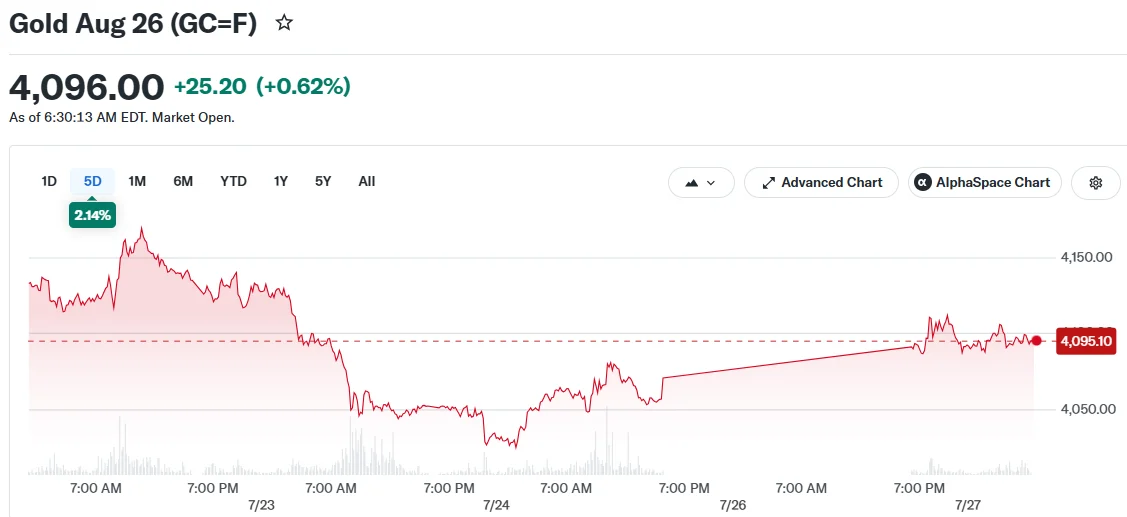
Precious metals moved higher on Monday as a weaker dollar, lower Treasury yields and a sharp pullback in crude oil prices reshaped investor positioning following a temporary halt in U.S.-Iran military confrontations.
Spot gold rose 1.1% to $4,095.37 per ounce in early Monday trading. August-dated gold futures gained 0.7% to settle at $4,097.40 per ounce. The metal had already finished the previous week about 1% higher, despite significant price swings during the period.
The move came as crude oil fell more than 5% after a weekend pause in military operations between Washington and Tehran. The retreat in energy prices eased some near-term inflation concerns and coincided with renewed demand for defensive assets.
Oil Falls as Regional Tensions Ease
Oil prices dropped more than 5% on Monday, reversing a substantial portion of the previous week’s gains. Brent crude had briefly approached the $100-per-barrel level as concerns grew over possible disruptions to maritime traffic through key chokepoints, including the Strait of Hormuz and Red Sea shipping lanes. The Strait of Hormuz is a critical route for Persian Gulf crude and liquefied natural gas exports, so even temporary concerns about shipping security can quickly feed into energy-market pricing.
BREAKING: Trump has cancelled plans to sharply escalate the war on Iran over concerns that Iranian attacks could dangerously drain the Pentagon's already diminished stockpile of Patriot antimissile interceptors and other air defense munitions in the Middle East close to zero, per… — The Hormuz Letter (@HormuzLetter) July 25, 2026
https://x.com/HormuzLetter/status/2081159589819490641?ref_src=twsrc%5Etfw
The Trump administration ended its aerial bombardment campaign on Friday after 13 consecutive nights of offensive operations targeting Iranian infrastructure. Officials described the halt as an opportunity for potential diplomatic engagement.
Tehran did not launch counter-attacks over the weekend against regional countries hosting U.S. military installations. The mutual de-escalation helped steady energy commodity markets after the prior week’s volatility.
The decline in crude prices may reduce short-term inflation pressures. Lower energy costs typically filter through to retail price measures, potentially giving the Federal Reserve more flexibility in assessing monetary policy.
Federal Reserve Decision Due Wednesday
Financial markets are focused on this week’s Federal Reserve policy meeting. The central bank is widely expected to leave interest rates unchanged when deliberations conclude on Wednesday.
However, CME FedWatch probability models show roughly a 33% chance of a rate increase. Market participants will examine remarks from Federal Reserve Chairman Kevin Warsh for guidance on the policy outlook.
Investors are looking for clarity on the possible timing of future rate cuts and on policymakers’ assessment of current inflation trends. Gold often benefits from lower borrowing costs because it is a non-yielding asset, making real yields and the dollar key variables for bullion traders.
The U.S. Dollar Index declined 0.3% during Monday trading. A weaker dollar makes gold less expensive for buyers using other currencies, which can support demand.
Government bond yields also fell. The benchmark 10-year yield recorded its steepest one-day decline in roughly 30 days.
Silver, Platinum and Copper Also Advance
The broader metals complex strengthened alongside gold. Silver rose 2.1% to $59.39 per ounce, while platinum advanced 2.3% to $1,630.83 per ounce.
Copper contracts on the London Metal Exchange gained 0.4% to $13,693.58 per metric ton. U.S.-traded copper futures were little changed at $6.36 per pound. Unlike gold, copper is closely tied to industrial demand, while silver and platinum have both investment and industrial uses, leaving the broader metals complex exposed to both macroeconomic policy signals and physical-demand indicators.
Market observers will continue to monitor upcoming U.S. inflation data and employment figures for further indications of the Federal Reserve’s policy trajectory.

