Gold Slips Friday but Remains on Track for Weekly Gain Ahead of Fed Decision
Key Takeaways
- •Gold fell 0.5% on Friday to roughly $4,030 per ounce but was on track for a weekly gain of about 0.8%, breaking a two-week losing streak.
- •Houthi forces struck two Saudi oil tankers in the Red Sea, doubling shipping insurance costs and heightening concerns over commercial maritime traffic and energy supplies.
- •U.S. initial jobless claims unexpectedly dropped to 187,000, the lowest level in decades, lifting the 10-year Treasury yield to its highest since January 2025.
- •Traders assign approximately a 34% probability to a 25-basis-point Federal Reserve rate increase at next week's meeting, while Nomura expects policy to remain unchanged.
- •Capital Economics analyst Thomas Ryan said persistent inflation could prompt the Fed to begin tightening policy with a 25-basis-point hike in September, a scenario now fully priced in by markets after crude oil surpassed $90 per barrel.
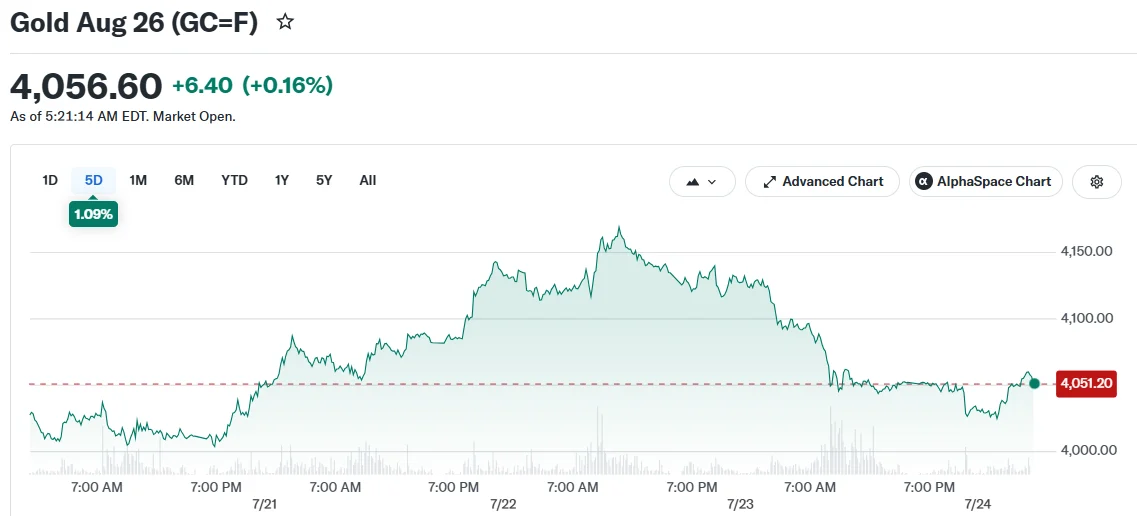
Gold prices edged lower on Friday but remained on course to end the week higher, breaking a two-week losing streak as investors weighed Middle East tensions, rising oil prices, U.S. labor-market data and expectations for the Federal Reserve’s next policy decision.
The precious metal fell 0.5% during morning trading to about $4,030 per ounce. Despite Friday’s decline, gold was still up roughly 0.8% for the week, putting it on track for its first weekly gain in three weeks.
The week’s advance was driven largely by heightened regional instability in the Middle East. Houthi forces from Yemen, which maintain ties with Iran, launched strikes against two Saudi oil tankers traveling through the Red Sea, adding to concerns over commercial shipping and energy supply routes. Gold is often sought during periods of geopolitical stress, but its gains can be limited when the same events also push inflation expectations and bond yields higher.
Insurance costs for shipping through the southern Red Sea doubled in a single day. The jump came after Houthi forces hit at least one tanker overnight, with some companies now paying twice what they paid yesterday. War risk premiums are the fastest signal in this whole… pic.twitter.com/w7OG07YfWT
— Mario Nawfal (@MarioNawfal) July 23, 2026
President Donald Trump warned that the United States would hold Iran responsible for any further Houthi attacks on commercial maritime traffic. He also threatened broader military operations targeting Tehran.
The New York Times reported that Iran rejected a Washington-backed ceasefire proposal, reducing expectations for a near-term diplomatic resolution to the regional conflict.
Interest Rate Concerns Weigh on Gold
The escalation in the Middle East pushed oil prices higher, adding to existing inflation concerns. Those worries were reinforced by stronger-than-expected U.S. employment data released during the week.
Initial jobless claims unexpectedly fell to 187,000, the lowest level in multiple decades. The data helped lift the 10-year Treasury yield to its highest level since January 2025.
Higher interest rates tend to weigh on gold because the metal does not pay yield. When fixed-income assets offer higher returns, demand for non-yielding assets such as gold can weaken. That trade-off has kept investors focused on whether safe-haven demand from the Middle East can offset pressure from a firmer dollar and higher real yields.
Traders now assign about a 34% probability to a 25-basis-point Federal Reserve rate increase at next week’s policy meeting. That probability rose after the stronger employment figures.
Nomura’s research team expects the central bank to keep policy unchanged. The team said Fed Chair Kevin Warsh is unlikely to offer clear forward guidance at the July meeting because officials will not have updated economic forecasts.
Technical Levels Remain in Focus
Tony Sycamore, a senior market analyst at IG, said Friday’s weakness reflected rising Treasury yields, a stronger U.S. dollar and reduced demand for riskier assets.
The U.S. Dollar Index held near 101.45, continuing to pressure gold prices. A stronger dollar makes gold more expensive for buyers using other currencies.
Sycamore said gold still appears to be forming a base above its late-June low of $3,942. Market participants are watching that level as an important near-term support area.
A move above $4,202 would strengthen the bullish technical outlook and could open a path toward $4,495, a level near the 200-day moving average.
Thomas Ryan, an analyst at Capital Economics, said persistent inflation could lead the Fed to begin tightening policy with a 25-basis-point increase in September. Market pricing now fully reflects that scenario after crude oil rose above $90 per barrel. For gold traders, the next key inputs remain the Fed’s policy language, movements in Treasury yields and the dollar, and whether Red Sea disruptions continue to feed into energy and shipping costs.

