Gold Price Rises Above $4,400 as U.S. Inflation Data and Iran Talks Weigh on Markets
Key Takeaways
- •Spot gold rose 0.4% to $4,407.79 per ounce on Tuesday, reaching its highest level in more than two months and extending a two-session gain of 3.6%.
- •Markets are pricing a 52% probability of a Federal Reserve rate hike in September and an 81% chance by December, according to CME FedWatch data.
- •The People's Bank of China increased its gold reserves in July by the largest amount since October 2023, bolstering demand alongside stronger inflows into Chinese gold-backed ETFs.
- •Iran stated it will not reopen the Strait of Hormuz until the United States lifts its naval blockade on Iranian ports and meets additional conditions including compensation and sanctions relief.
- •Analysts identify technical resistance in the $4,460 to $4,500 zone, with a breakout potentially opening the path toward $5,000.
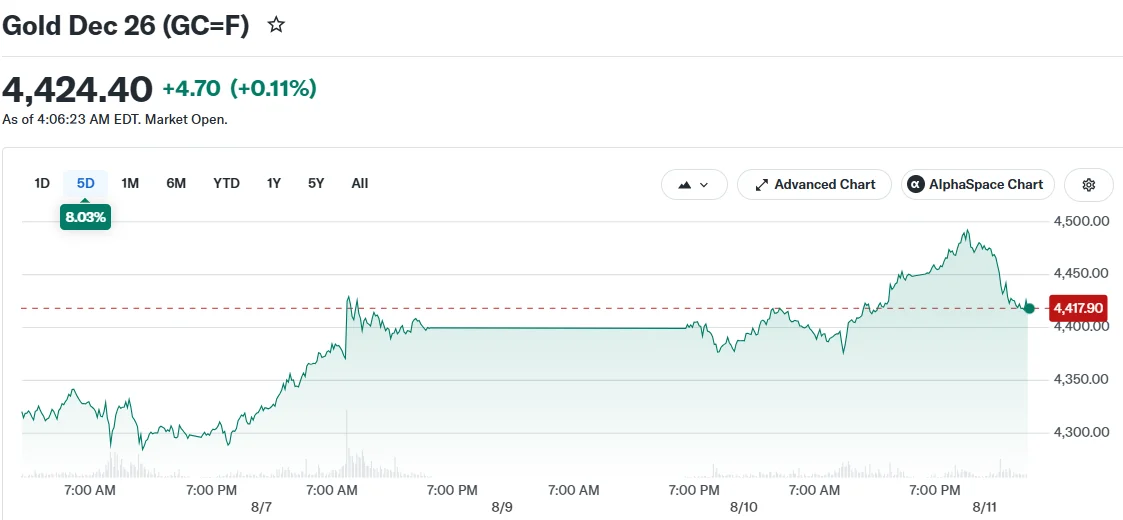
Gold is pushing higher as investors keep a close eye on upcoming U.S. inflation data and ongoing diplomatic tensions around the Strait of Hormuz. Spot gold climbed 0.4% to $4,407.79 an ounce on Tuesday, while gold futures gained 1.1% to $4,467.59. The metal is now at its highest level in more than two months.
The latest move builds on a strong two-session run. Gold added 3.6% over Monday and Friday combined, after U.S. nonfarm payrolls came in weaker than expected for July. Friday's session alone saw a 2.4% jump. Monday's close near $4,390 marked the highest daily finish in almost ten weeks. Gold has now recovered from a June low of $3,942.
Inflation Data in Focus
Traders are awaiting Wednesday's consumer price index (CPI) report. Economists expect a 0.1% rise in July, following a 0.4% decline the month before. Thursday's producer price index (PPI) will also be closely watched. Together, the two reports could shape expectations for the Federal Reserve's next move on interest rates, and by extension, the opportunity cost of holding non-yielding assets like gold.
Markets are currently pricing a 52% chance of a rate hike in September and an 81% chance by December, according to CME FedWatch data. Cleveland Fed President Beth Hammack said multiple rate hikes may still be needed to bring inflation back to 2%. She was one of three officials who voted against holding rates steady last month.
Gold does not pay interest, so it tends to lose appeal when rates rise. However, buyers have returned despite that risk. Analysts at IG point to fear-of-missing-out (FOMO) buying, short-covering, and safe-haven demand as the main drivers. Investors who missed gold's dip toward $4,000 are now chasing the rebound.
Iran Tensions and Oil Prices Add Pressure
The Strait of Hormuz remains a key risk factor. The narrow waterway handles roughly one-fifth of global oil consumption, making any disruption a direct threat to energy prices and, by extension, inflation expectations worldwide. Iran said it is close to a deal with Oman on alternative shipping lanes, but added that the U.S. must meet further conditions before the strait reopens.
Iranian Foreign Ministry spokesperson Esmail Baghaei said Iran will not reopen the Strait of Hormuz until the United States ends its naval blockade on Iranian ports. Iran wants the U.S. to lift the blockade, pay compensation for months of war damage, lift economic sanctions and… pic.twitter.com/jABYrN4exa — The Associated Press (@AP) August 10, 2026
President Donald Trump made new demands on Iran this week, clouding hopes for a near-term agreement. Oil held a three-day gain as a result. Higher oil prices raise inflation risks, which could force the Fed to keep rates elevated for longer, creating a mixed picture for gold — one where safe-haven demand and rate-pressure headwinds pull in opposite directions.
China Provides Steady Demand Support
China is providing steady support from the demand side. The People's Bank of China increased its gold reserves in July by the most since October 2023. Gold-backed exchange-traded funds in China also saw greater inflows last week, adding to buying momentum. Central bank gold purchases have been a structural pillar of demand in recent years, with emerging-market reserve managers consistently accumulating bullion as a hedge against currency and geopolitical uncertainty.
Technical Outlook
Technically, analysts see resistance in the $4,460 to $4,500 zone. A break above that range could open the door to a move toward $5,000, though that level remains well above current prices. Gold is still roughly 17% below where it traded before the Iran war began in late February.

