Illinois Gibson City Solar Project Reaches Commercial Operation Using Existing Grid Switchyard, Robots and Terrain-Following Trackers
Key Takeaways
- •The 346-MW Gibson City Solar Project, developed by Earthrise Energy and built by Burns & McDonnell, has achieved commercial operation across roughly 1,700 acres in McLean and Ford counties, Illinois.
- •The project connected to the grid through the existing switchyard of an adjacent gas-fired peaking facility, avoiding the need for a new interconnection amid widespread grid-connection delays.
- •The facility is expected to generate enough renewable electricity to power approximately 46,000 homes and was developed to serve multiple power purchase agreements.
- •Burns & McDonnell deployed AI software and robotics from Gritt to install a portion of the solar modules, an early commercial-scale example of construction automation on utility-scale solar sites.
- •Terrain-following trackers from Nextpower followed the site's natural contours, limiting grading to fewer than 40,000 cubic yards and reducing grading requirements by as much as 90% versus conventional construction.
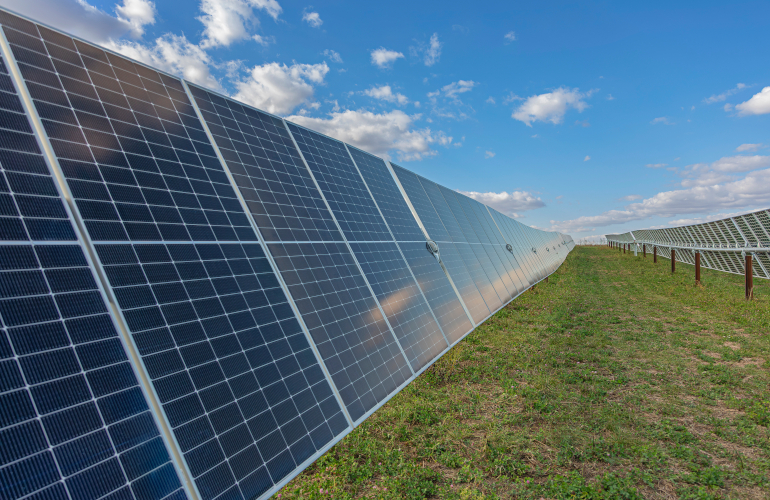
The 346-MW Gibson City Solar Project, developed by Earthrise Energy and constructed by Burns & McDonnell, has achieved commercial operation in Illinois using Earthrise Energy's surplus interconnection strategy. By connecting through the existing switchyard of an adjacent gas-fired peaking facility, the project leveraged available grid capacity rather than requiring a new interconnection, illustrating one approach to accelerating renewable energy deployment while maintaining grid reliability. The approach also reflects the pairing of solar generation with existing thermal plants — sometimes described as "power boost" or hybrid-site strategies — where new renewable capacity shares infrastructure and coordinated controls with conventional units.
As utilities and renewable energy developers across the United States face growing delays connecting new generation to the electric grid — a backlog widely documented in interconnection queue studies — the project demonstrated faster ways to bring renewable generation online using existing assets. Beyond the interconnection strategy, Burns & McDonnell paired advanced construction technologies with terrain-following solar trackers to reduce environmental impacts and improve construction execution. Construction automation is drawing wider industry attention as utility-scale solar developers confront labor-intensive installation schedules and large module counts per site.
"Interconnection has become one of the defining challenges for new energy projects," said Jami Stone, construction project manager for Burns & McDonnell. "Projects like Gibson City demonstrate how developers can take advantage of existing infrastructure while combining innovative construction methods to deliver new renewable generation more efficiently. It's an example of how the industry can rethink traditional approaches to meeting growing energy demand, and we applaud Earthrise Energy for this creative solution to help bring clean power online faster."
Spanning approximately 1,700 acres across McLean and Ford counties, the facility is expected to generate enough renewable electricity to power approximately 46,000 homes.
Burns & McDonnell's scope of work covered EPC services. AZCO, a construction subsidiary of Burns & McDonnell, self-performed construction of underground electrical systems for a portion of the project, drove piles, and installed trackers and modules. The project team also provided environmental support, constructed a 34.5-/138-kV collector substation featuring a two-transformer station, and built a gen-tie line connected to a new line position in the existing Gibson City energy center substation. The site was built with union labor under the National Maintenance Agreement.
Burns & McDonnell worked with Nextpower to provide the terrain-following trackers, Shoals to provide the aboveground collection system, and SMA to supply the inverters. Earthrise procured Runergy solar modules, high-voltage breakers and transformers.
The project was developed to serve multiple power purchase agreements. To support this coordinated operation, Burns & McDonnell designed and commissioned the project's supervisory control and data acquisition (SCADA) systems, providing the controls needed to safely manage both generating resources — a requirement that co-located solar and gas sites face when a single control framework must coordinate dispatch across both resource types.
The Gibson City site also served as a proving ground for next-generation construction automation. Burns & McDonnell deployed AI software and robotics from Gritt to install a portion of the solar modules on-site. Gritt combines AI and robotics to automate labor-intensive construction activities by creating intelligent systems that can be attached to standard construction equipment. At Gibson City, the Gritt machines lifted and placed solar modules, reducing the need for repetitive heavy lifting while improving safety and productivity. The deployment is an early field example of robotics moving from pilot demonstrations into commercial EPC work on utility-scale solar sites.
The project further demonstrated how engineering and technology can substantially reduce construction impacts. Using Nextpower terrain-following tracker technology, the design follows the site's natural contours, limiting grading to fewer than 40,000 cubic yards across the project's footprint. Compared with conventional utility-scale solar construction, the approach reduced grading requirements by as much as 90%, helping preserve existing landscapes, minimize erosion risks and reduce reseeding requirements. Burns & McDonnell also worked with the owner to establish a native seed mix and start growth before mobilizing to the site, enhancing the appearance of the finished project. Reduced grading also shortens earthwork schedules and limits disturbance to farmland soils, a consideration for solar sited in agricultural regions of the Midwest. Whether surplus-interconnection strategies can be replicated at scale will depend on how much untapped capacity exists at existing substations and how regulators treat such connections — a question other developers facing long queue waits are watching closely.
News item from Burns & McDonnell (burnsmcd.com, Earthrise Energy)
