Fourth-generation Georgia cattleman says the cattle cycle that built his $30-million-a-year farm is broken
Key Takeaways
- •White Oak Pastures, a 5,700-acre regenerative farm in southwestern Georgia, earns $30 million annually and employs 170 people, making it the largest private employer in its county.
- •The U.S. cattle herd has fallen to a 75-year low due to droughts and record-high operating costs, and ground beef reached a record price of $6.90 per pound earlier this year.
- •Institutional investors and developers, including data center companies, are outbidding farmers for rural Georgia farmland, and a data center has been approved for Harris's Clay County.
- •Harris abandoned industrial farming for regenerative methods in 1995, and since Jan. 1 the USDA has reserved the 'Product of USA' label for animals born, raised, slaughtered, and processed domestically.
- •Through his nonprofit Center for Agricultural Resilience, Harris hosts six interns per quarter and runs monthly week-long courses drawing 25 to 30 aspiring ranchers from multiple countries.
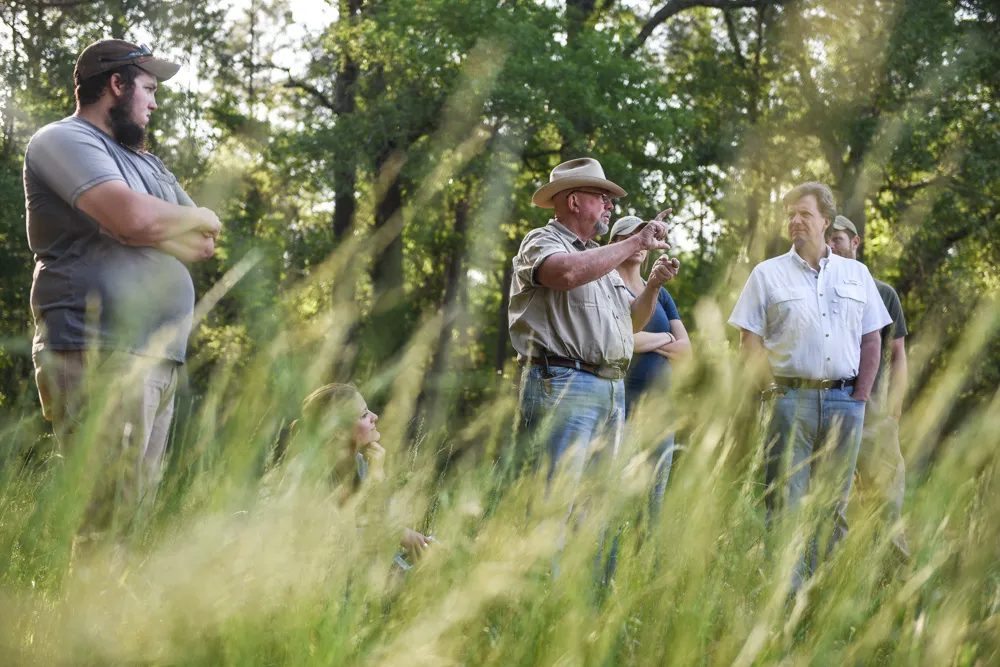
The southwestern Georgia farm where Will Harris raises cattle has been in his family since 1866, when his great-grandparents rose at dawn six days a week to work its 3,200 acres. They raised and slaughtered chickens, ducks, hogs, and cows, loaded the meat onto a mule-drawn wagon, and drove it two miles up a dirt road to the town of Bluffton — recorded at a population of 117 at the last census — to sell.
Harris, now 71, has built that operation into White Oak Pastures, a 5,700-acre farming ecosystem that he told Fortune is the largest private employer in the county. It employs 170 people — nearly everyone in Bluffton who is not retired or unable to work for other reasons — making its workforce larger than the town itself.
“Just about everybody in town that works, works for us,” Harris said.
The business, which raises livestock, processes the meat, and sells it directly to consumers, brings in $30 million a year. Yet Harris says the cattle cycle that built farms like his has broken. Record cattle prices once would have sent ranchers rushing to rebuild their herds. Now the land required costs more than cattle can pay for, as investors and developers outbid farmers across rural Georgia. So instead of expanding, Harris is training new ranchers and is open to a data center coming to his county, because he is not sure the old way of building a farm still works.
“I don’t know how this is going to end,” he said.
A herd at a 75-year low
The U.S. cattle herd stands at a 75-year low, the result of droughts and record-high operating costs. Historically, that herd has followed a cycle that typically runs about a decade: when prices rise, ranchers hold back heifers for breeding rather than sending them to feedlots, which tightens near-term supply further, and rebuilding takes years because cattle reproduce slowly — heifers generally have their first calf at around age two. The pattern has repeated across generations of American ranching, which is why Harris calls it the cycle that built farms like his. Ground beef, typically the most affordable part of the animal for consumers, hit a record $6.90 per pound earlier this year.
Farmland is also harder to buy, as institutional investors and developers — including the data center companies spreading across rural Georgia — outbid farmers. Harris said a data center has been approved for construction in his Clay County but has not started construction.
“If you can get a tremendous amount of money to sell the land, most people sell it. It happens every day, and it’s not just data centers,” Harris said. “The land is moving out of the hands of the farmer or cattle producers into the hands of others.”
Living through the ups and downs of the cattle industry
White Oak has not always operated as it does today — as a regenerative farm, a concept Harris defines as “not breaking the cycles of nature.” When his father inherited the farm after World War II, he got rid of everything except cattle and began selling calves to feedlots instead of slaughtering and delivering meat himself, using pesticides and chemical fertilizers to cut costs. Harris studied animal science in college, then returned home and ran the farm the same way for 20 years, until 1995.
“I wanted nothing in my pastures except cattle and Tifton 85 Bermuda grass, and if you were not a cow or Tifton 85 Bermuda grass, I would kill you,” he said. “I went to my pastures every single day with the focus of looking for something to kill.”
But he came to see how hard that approach was on the animals and the land, and changed course to reflect “the very old-fashioned way of farming” of his great-grandparents — raising cattle alongside sheep, pigs, goats, and poultry, dropping pesticides, and allowing in more types of grasses.
“It was not easy, but I went from raising cattle very industrially to raising cattle in a very natural manner,” he said. “Now, when I go to the pastures, I’m looking for how to keep everything alive and prospering.”
The shift proved timely. In the early 2000s, Harris said, “the messaging for grass-fed beef” became more widespread and shoppers began looking for it. That let him put his beef on shelves at Whole Foods and Publix, since the four meatpackers that control 85% of U.S. beef supply had little of it. He said sales grew to about $25 million in 2015.
Then the U.S. changed its country-of-origin labeling rules for beef, opening the door for imported beef from places such as Australia, Brazil, and Argentina that was processed or packaged in the U.S. to carry a “Product of USA” label. While Harris kept selling the same volume of beef, he had to cut prices to compete, and the business became unprofitable.
“We went from being quite profitable to not being profitable because of that change, and I had a few rough years,” he said.
That changed this year. Since Jan. 1, the USDA has reserved the “Product of USA” label for meat from animals born, raised, slaughtered, and processed in the U.S.
The pandemic had already given White Oak a new path. The big meatpackers had to shutter some operations, while Harris’s daughter came home from college and launched the company’s online store, allowing it to sell directly to customers instead of going through grocery stores. Harris opened his first physical store, in Atlanta, this year, though he has no further plans of expansion.
“We want to do better, not bigger,” he said.
Supporting the next generation of farmers
Harris is now teaching other farmers to do what he does. He said most industrial farmers cannot easily switch to regenerative methods because they have already invested so much in equipment — he put a cotton picker at about $1.4 million and a grain combine at nearly $1 million — and, like him, learned their methods from their predecessors.
“I don’t want to make it sound like I’m doing it right and they’re not and they’re bad people,” he said. “These farmers are doing it the way they learned from their granddad and dad, the way they learned at the land grant university.”
His nonprofit, the Center for Agricultural Resilience, takes six interns per quarter for three-month stints on the farm, and White Oak offers jobs to about half of them. Harris also runs week-long courses on raising cattle and hogs about once a month, drawing 25 to 30 people from across the country and even from England, Spain, Germany, and Mexico.
“They’re frequently young people that are just out of college, or maybe they’ve taken an entry-level job and didn’t like it,” he said. “There are some people who have inherited farms at 30, 40, 50 years of age, and then they come, so it’s all over the board.”
He said counties like his own in Georgia once thrived on farming, but since World War II, companies such as Tyson and Cargill have taken a bigger share of the profits from agriculture, leaving less for those communities. That is why he is more open to data centers despite having concerns, though he said he is not part of the opposition because he does not know enough yet.
“These agricultural counties in southwest Georgia are economically impoverished, and we need some other things going on,” he said. “I don’t know if data centers are what we need, but it is some initial relief, and we will see how it goes.”
This story was originally featured on Fortune.com.

