Coinbase Co-Founder’s Venezuela Oil Bet Could Affect Crypto’s Macro Backdrop
Key Takeaways
- •Primavera has secured production-sharing contracts with PDVSA, although the eventual scale of its Venezuelan operations remains uncertain.
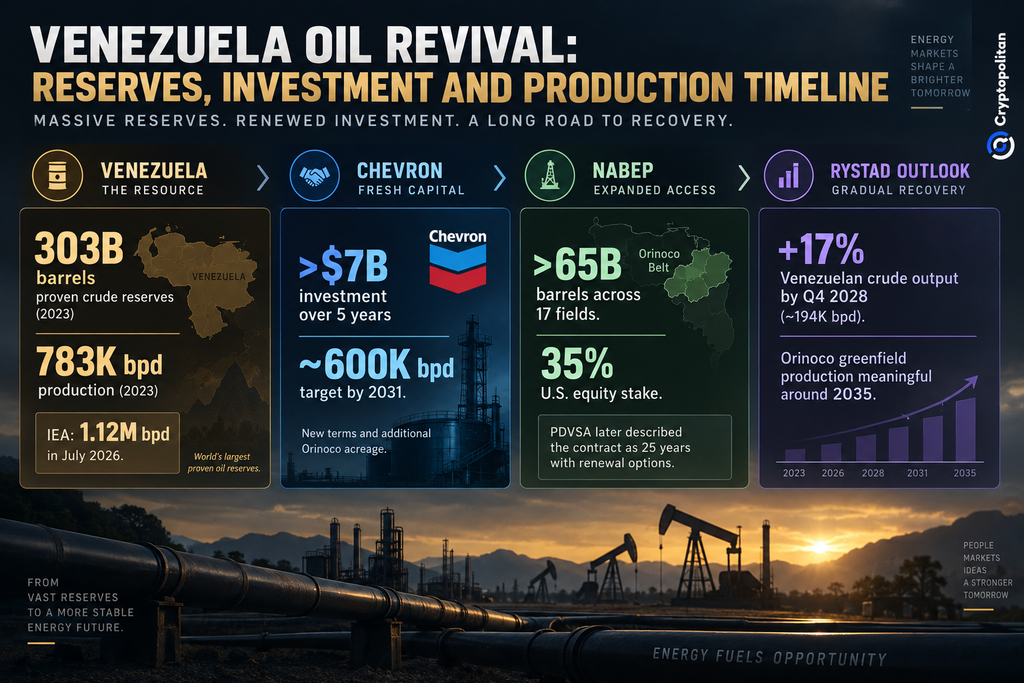
- •Venezuela held an estimated 303 billion barrels of crude reserves in 2023, while production was about 783,000 barrels per day that year.
- •Rystad Energy expects most near-term production growth to come from existing fields and forecasts significant Orinoco Belt additions only around 2035.
- •Legal uncertainty and questions about the structure of Venezuela’s oil agreements present additional risks for foreign investors.
- •Higher Venezuelan oil output could ease energy-driven inflation and interest-rate pressure, while supply disruptions could create the opposite effect for risk assets.
Fred Ehrsam, a Coinbase co-founder who remains a member of the company’s board, has spent extended periods living in a Caracas hotel while working on Venezuela’s oil industry. His investment vehicle, Primavera, recently signed a production-sharing contract with PDVSA, Venezuela’s major oil producer, The Wall Street Journal reported on September 10.
The move is unusual for a 38-year-old investor without prior experience in the oil and gas sector. However, it reflects an approach centered on pursuing difficult but established investment opportunities with potentially substantial returns. Ehrsam is also a member of the President’s Council of Advisors on Science and Technology.
For cryptocurrency investors, the broader macroeconomic implications may be more significant than Ehrsam’s transition from crypto to oil. If Venezuela achieves a substantial increase in oil production, the additional supply could affect crude prices, inflation and monetary policy—the same factors that influence liquidity and demand for Bitcoin and Ether.
What Ehrsam is pursuing in the Orinoco Belt
Ehrsam has been seeking control of at least three fields in Venezuela’s Orinoco Belt, which contains the world’s largest concentration of extra-heavy crude. Earlier reports said the targets included fields operated by Alvorada Heavy Industries.
The latest Wall Street Journal report confirms that Primavera has secured production-sharing contracts with PDVSA. The eventual size of Primavera’s operating footprint remains unclear.
Why Venezuela is attracting foreign investment
Venezuela’s appeal to foreign oil investors is primarily a matter of scale. The U.S. Energy Information Administration estimated that the country held approximately 303 billion barrels of crude reserves as of 2023, giving it the world’s largest oil reserves.
Production, however, has been far below that potential. Venezuela produced about 783,000 barrels per day (bpd) in 2023. The International Energy Agency estimated that output had risen to 1.12 million bpd by July 2026.
The United States is also helping reshape the investment landscape. North American Blue Energy Partners received rights to 17 fields containing more than 65 billion barrels of reserves, while the U.S. government acquired a 35% stake in the company. A later analysis by the Columbia Center on Global Energy Policy said PDVSA characterized the agreement as a 25-year contract with an option to extend it, rather than a 100-year concession.
Chevron is pursuing a separate expansion. The company plans to invest more than $7 billion over five years and more than double its Venezuelan production to approximately 600,000 bpd. Chevron’s announcement is available at Chevron’s official website.
Why the investment could take a decade to pay off
The size of Venezuela’s resource base is not the main obstacle. Developing that resource is. Rystad Energy expects Venezuela’s crude production to increase by approximately 17%, or 194,000 bpd, between late 2025 and late 2028, with most of the growth coming from existing fields.
“Execution, not geology, remains the key constraint.” — Rystad Energy
Rystad Energy’s longer-term outlook is more cautious. The research firm expects significant new production from the Orinoco Belt only around 2035.
“Expectations that significantly more oil from Venezuela will reach the market within just a few months are likely to be disappointed.” — Commerzbank
Legal uncertainty adds another risk. OPIS reported that Commerzbank had raised questions about the legality of the deal. The Columbia Center on Global Energy Policy also said the arrangement could be structured primarily to protect investors rather than Venezuela itself. OPIS’s analysis is available here.
How the oil story could feed back into crypto
The relationship between oil prices and cryptocurrencies does not depend on a single crude-price level. The more relevant connection is through energy costs, which can influence inflation and monetary policy.
Federal Reserve research estimates that a 10% increase in oil prices can raise the Consumer Price Index (CPI) by nearly 0.4%. In April 2026, Federal Reserve Governor Christopher Waller said Brent crude had risen from $61 at the beginning of the year to approximately $95. During that period, the energy CPI increased by more than 10.8%, while headline inflation reached 3.3%. The Federal Reserve research is available here.
An increase in Venezuelan oil supply would not necessarily push Bitcoin or Ether prices higher. It could, however, reduce oil-related inflation and ease pressure on interest rates and other risk assets in financial markets. A new disruption to supply would produce a different effect.
Venezuela is already closely connected to the crypto economy. Chainalysis estimated that Venezuelan crypto transaction flows totaled $44.6 billion in 2025. The company also documented crypto’s dual role in the country: a financial lifeline for households and a tool used in sanctions-linked oil trade. Chainalysis’s analysis is available here.
That context helps explain why Ehrsam’s move is more than an unexpected shift from the cryptocurrency sector into oil. If Primavera converts part of Venezuela’s reserves into sizable production, the effects could ultimately extend to energy costs, inflation and global liquidity—the same macroeconomic forces that helped shape the growth of the business that made Ehrsam wealthy.
Source: Cryptopolitan
