Supply Chain Disruptions, Droughts, and Rising Farm Input Costs Threaten Global Food Supply
Key Takeaways
- •The closure of the Strait of Hormuz has halted outbound fertilizer shipments, cutting off more than 30% of global nitrogen fertilizer supply and blocking 17% of the world's natural gas needed for fertilizer production.
- •US wheat acreage fell to a record low of 42.7 million acres in 2026, while surveys show that 70% of American farmers could not afford all the fertilizer they needed for the current planting season.
- •Russian diesel exports collapsed to roughly 428,000 barrels per day by June 2026—over 50% below prior averages—following an export ban and ongoing drone strikes on refineries, further inflating farm fuel costs.
- •Over 1,500 commercial vessels stranded in the Persian Gulf since late February have created conditions scientists describe as a potential marine bio-invasion super-spreader event, as prolonged idling allows dense organisms to accumulate on hulls.
- •El Niño conditions are intensifying, with some analysts warning that a rare climate alignment could rival the devastating 1877–78 Super El Niño, potentially causing extreme shortages in key crops such as rice, sugar, corn, soybeans, and palm oil over the next twelve months.
Supply Chain Disruptions, Droughts, and Rising Farm Input Costs Threaten Global Food Supply
By Richard Mills
The war in Iran is severely impacting global food availability by disrupting fertilizer supplies, driving up energy costs, and closing critical shipping lanes. Urea prices surged nearly 46% month-on-month, reaching some of the highest levels since 2022. Farmers worldwide face a difficult choice between purchasing expensive fertilizers or reducing usage — a decision that threatens future harvests.
Rising diesel prices are inflating the daily cost of operating farm equipment, tractors, and processing plants, while higher fuel costs make shipping goods from farms to grocery stores significantly more expensive. Retail food prices inside Iran jumped over 40% year-over-year, with staples such as rice and vegetable oils soaring. Import-dependent nations across South Asia, East Africa, and the Middle East face acute hunger risks and worsening malnutrition.
Shipping Bottlenecks
Hundreds of freighters and oil tankers remain stranded or delayed inside the Persian Gulf and its surrounding approaches. The Strait of Hormuz — the only water passage connecting the Persian Gulf to the open ocean — is currently closed, halting the export of millions of tons of nitrogen-based fertilizers and natural gas. Under normal conditions, the strait handles roughly one-fifth of global daily oil consumption, making its closure unprecedented in modern shipping history.
Traffic through the Strait of Bab el-Mandeb has also been severely disrupted. Yemen's Houthi rebels declared a naval blockade targeting Saudi shipping and launched attacks on oil tankers in the area, causing crossings to drop by roughly 50% as vessels turn back or reroute around Africa.
Suez Canal traffic has been directly affected by the Iran war as well, experiencing severe fluctuations, security-driven suspensions by major shipping lines, and volatile rerouting. Daily transits have fallen below normal trend levels during peak flare-ups, with major container carriers such as Maersk, CMA CGM, and Hapag-Lloyd intermittently suspending or restricting vessel movements. Proximity risks have escalated, highlighted by recent drone attacks on vessels at nearby Egyptian ports like Damietta, amplifying fears that the regional conflict is expanding closer to the canal corridor. Rerouting vessels around Africa's Cape of Good Hope typically adds 10 to 14 days to voyages between Asia and Europe, sharply increasing fuel consumption and freight costs that ultimately flow through to commodity prices.
Invasive Marine Species Threat
An unintended consequence of the Strait of Hormuz closure is the creation of conditions for an extreme biodiversity threat. With more than 1,500 commercial vessels stuck in the Persian Gulf since the strategic waterway closed on Feb. 28, scientists are "warning that thousands of stranded ships could spread invasive marine species across the world's oceans once they begin sailing again," The Guardian reported.
The research describes the situation as a potential marine "bio-invasion super-spreader event," arguing that no previous shipping disruption has involved so many vessels remaining idle for so long. According to the study, ships normally remain at anchor in a harbour for only one to three days, limiting the growth of organisms on their submerged surfaces. Many vessels trapped in the Gulf, however, have remained stationary for months, allowing dense marine communities to establish themselves. If thousands of vessels depart carrying barnacles, algae, mussels, and other organisms, they could introduce invasive species that outcompete native wildlife, spread disease, and permanently alter marine ecosystems. The global shipping industry already spends billions of dollars annually managing biofouling under the International Maritime Organization's guidelines, and a mass departure of long-idle vessels could overwhelm existing containment protocols at ports worldwide.
Fertilizer Trade Disrupted
Fertilizers are a key agricultural input, used by farmers to supplement natural soil nutrients. Other critical inputs include antibiotics to prevent animal diseases, pesticides to protect crops against insects, weeds, and microorganisms, and diesel fuel to operate tractors and delivery trucks. Modern fertilizers are predominantly synthetic, as they have produced substantially larger crop yields than organic sources for over a century. Research indicates that just under 50% of the world's population is fed by crops grown using synthetic fertilizers. Without this technology, roughly half of the global population could not be sustained on current agricultural land. Organic fertilizers, made from natural plant or animal byproducts, account for only a small fraction of total agricultural crop nutrition.
The Iran war has disrupted major segments of agricultural inputs, cutting off more than 30% of the world's nitrogen fertilizer supply and roughly one-third of global seaborne fertilizer trade due to the blockade of the Strait of Hormuz. While staple food supplies have not fully collapsed globally, the input crisis threatens billions of meals and drives significant cost pressures worldwide. Producers have halted hundreds of thousands of tons of output as significant urea supplies remain choked off.
The conflict has also blocked 17% of the world's natural gas supply — a critical element required to manufacture nitrogen-based fertilizers through the Haber-Bosch process, which combines atmospheric nitrogen with hydrogen derived from natural gas. Nearly half of the global sulfur market is controlled in the Middle East, and critical shipments have been stranded or blocked in the Persian Gulf. Sulfur is a vital secondary plant nutrient, widely used as a standalone fertilizer or blended into fertilizer mixes to boost crop yields and protein production.
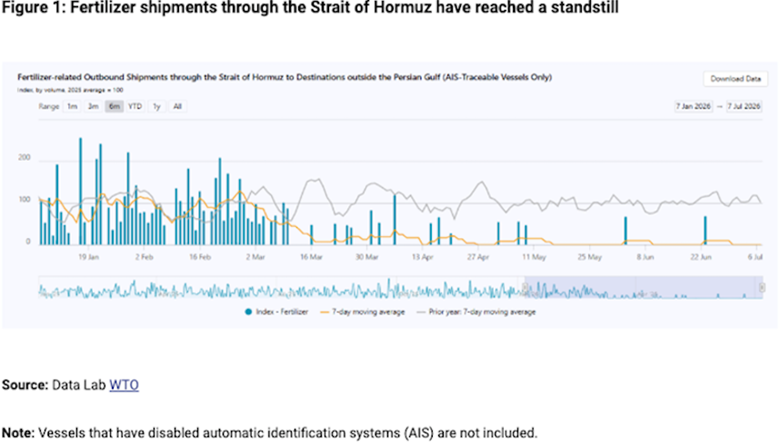
According to the World Trade Organization, outbound fertilizer-related shipments through the Strait of Hormuz to destinations outside the Persian Gulf came to a standstill once the conflict began and have remained close to zero since. A stable resumption of shipments remains to be seen.
Persian Gulf states face a severe grocery emergency, with 70% of regional food imports disrupted and local price spikes ranging from 40% to 120%. Food inflation in the Middle East is most acute in Iran, Lebanon, and Turkey, driven by severe currency depreciation, regional conflict, and high import costs.
Lower fertilizer usage risks future harvest yields, threatening up to 10 billion meals globally per week, with poorer nations hit hardest. The countries most severely affected by fertilizer reductions from the Iran war include Sudan, Sri Lanka, and Australia, alongside high dependency in Sub-Saharan Africa, India, and Mexico.
World Trade Organization analysis identifies 18 economies that are particularly exposed to nitrogenous fertilizer supply disruptions from the Gulf. These economies — roughly one-fifth of the 81 economies that import from the Gulf region — combine high import dependence with strong reliance on Gulf suppliers. The group includes developing African economies such as Kenya, Malawi, Mozambique, Rwanda, South Africa, Tanzania, Uganda, and Zimbabwe, along with Brazil, Nepal, and Sri Lanka. Seven countries in this group are classified as least developed countries (LDCs). For these economies, where fertilizer often accounts for a larger share of total agricultural spending than in wealthier nations, even partial supply disruptions can translate directly into reduced planting and lower harvests within a single growing season.
A Perfect Storm for Farmers
The blockade of vital fertilizer and natural gas shipments from the Middle East has triggered skyrocketing input costs, forcing farmers to alter crop selections and raising concerns about compromised yields. Farmers in Canada, the US, and across Africa and Asia are confronting exorbitant fertilizer price spikes that challenge operating budgets.
To manage high input costs, many farmers are substituting away from nitrogen-demanding crops like wheat and maize in favor of less demanding alternatives such as soybeans. This shift threatens to alter agricultural outputs and the availability of food commodities. Many farmers are also choosing to use less fertilizer overall to save money — a practice the Food and Agriculture Organization (FAO) warns will severely lower crop productivity and yields.
Unlike past supply chain crises, prices for harvested agricultural commodities have not surged at the same rate as nutrient and fuel costs, leaving farmers facing significantly squeezed profit margins. This divergence means that the fertilizer price spike has not yet been fully transmitted to consumer food prices, but historical patterns from the 2008 and 2022 food price crises suggest a lag of several months between input cost increases and retail price effects.
The FAO Food Price Index — a monthly measure tracking price changes in a basket of globally traded food commodities including cereals, vegetable oils, and meat — initially rose from 124 points in January 2026 (the month before the war started) to a peak of 131 points in April, but has since fallen for two consecutive months.
Source: Trading Economics
According to Trading Economics, dairy prices in June slipped 1.5%, reaching their lowest level since 2023, with weaker prices across all major products. Meat prices edged up 0.4% to a fresh record high, driven primarily by higher poultry prices. Vegetable oil prices rose 3.8%, supported by stronger palm and rapeseed oil quotations, while sunflower oil prices remained broadly stable.
The United States imports urea, ammonia, sulfur, and processed phosphates from the Middle East. With the Hormuz blockade, US imports from affected ports fell to zero, resulting in a nearly 44% drop in overall crop nutrient imports and a 30% spike in domestic urea prices.
Source: Trading Economics
NPR reports that an American Farm Bureau Federation survey released in April found 70% of respondents could not afford all the fertilizer they needed for the current season. Producers of corn and wheat — crops that rely heavily on fertilizer — can spend around a third of their operating costs on fertilizer alone. Half of the farmers responding to a National Corn Growers Association survey in early April said they would not apply the full amount of fertilizer to their corn crop this year, citing higher costs and limited availability. Southern producers face the highest pressure, with 78% reporting unaffordability, compared to 48% in the Midwest where more pre-booking occurred.
Source: American Farm Bureau Federation
According to the Farm Bureau, "more than 80% of rice, cotton and peanut producers reported they cannot afford all required fertilizer, highlighting the vulnerability of these production systems to input cost shocks."
Source: American Farm Bureau Federation
The USDA's 2026 June Acreage and quarterly Grain Stocks reports showed wheat acreage at just 42.7 million — 1.1 million below expectations and the lowest wheat acreage on record. Corn and soybean estimates were only modestly different from pre-report expectations.
Meanwhile, US ranchers face a severe crisis due to widespread drought, high input costs, and tight hay supplies. Over half of US hay-producing regions suffer from dry conditions, forcing early herd sell-offs and steep trucking expenses. Pastures in states including Colorado, Wyoming, Montana, and South Dakota lack sufficient grass for grazing. Previous fires destroyed vital grazing lands, and multiple dry years have left local hay reserves nearly depleted.
The US cattle herd stands at 94.2 million head as of July 1, 2026 — a slight year-over-year increase of 200,000 head and the first mid-year inventory increase since 2018, though supplies remain near historic multi-decade lows due to lingering drought and tight calf crops.
The New World screwworm is currently active in South America, Central America, Mexico, and parts of the Caribbean, with recent 2026 detections in Texas and New Mexico. The screwworm causes severe tissue damage, major livestock losses, and fatal infections by burrowing into the living flesh of warm-blooded animals. The United States and Mexico previously eradicated the pest through a decades-long sterile insect release program, and its re-emergence has already prompted cross-border cattle trade restrictions, adding further pressure to North American beef supply chains.
Impact on Canadian Farmers
Fertilizer backlogs and supply-chain disruptions have hit Canadian farmers with soaring input costs, reduced supply options, and significant risks to crop yields. When combined with Strait of Hormuz conflicts and existing tariffs, producers face severe margin squeezes that threaten domestic food security. As one of the world's leading exporters of wheat, canola, and barley, Canada's production decisions have direct implications for global grain supplies.
Canadian farmers effectively lost access to nearly half of the global nitrogen fertilizer supply due to trade tariffs on imports from Russia and Belarus. Conflicts in the Middle East have further tightened global availability, raising replacement costs for urea and ammonia by upwards of $100 per ton.
Diesel Prices Remain Elevated
High farm input costs, exacerbated by elevated diesel prices, have forced farmers into a precarious gamble over whether crop prices will cover planting costs. The Financial Times reports that Russia pulled roughly 11% of the world's seaborne diesel supply after announcing a ban on diesel exports effective July 8, lasting until at least July 31 — a consequence of the war in Ukraine. Ongoing drone strikes on Russian oil refineries have steadily eroded the country's refining capacity. By June 2026, Russian diesel exports had collapsed to roughly 428,000 barrels per day, more than 50% below prior averages.
Regions that had been relying on Russian diesel are now scrambling for alternatives, with Turkey, Brazil, and North Africa facing particularly acute supply constraints. US retail diesel prices currently stand at $4.22 per gallon, compared to the record high of $5.81 reached in June 2022 during the outset of the war in Ukraine.
Source: YCharts
On average, diesel accounts for 5–15% of total farm operating expenses, depending on region and crop type. Within direct energy and fuel budgets, diesel typically makes up about 60% of total farm fuel and oil expenditures.
Source: American Farm Bureau Federation
Water Loss, Heat, Droughts, El Niño
Global warming is disrupting the water cycle, causing severe droughts, shrinking snowpacks and glaciers, and saltwater contamination in coastal aquifers — all of which reduce the fresh water available for people, farms, and ecosystems.
In North America, the Colorado River and its reservoirs serve as a leading indicator of water loss. More than half of Colorado River water is used for crop irrigation. Recent data from the U.S. Bureau of Reclamation shows water levels at Lake Mead and Lake Powell — the country's two largest reservoirs — continuing to dwindle due to a historically warm winter and low snowpack. Agriculture consumes roughly 70% of all freshwater withdrawn globally, making it especially exposed to water cycle disruptions.
ABC News reported that as of Monday, pool elevation at Lake Mead measured 1,041.17 feet, approaching the record low of 1,040.58 feet set in July 2022. Lake Powell's elevation stood at 3,522.78 feet, nearing the previous record low of 3,519.92 feet from April 2023 and the critical threshold needed for hydropower generation. Projections indicate a new record low at Lake Powell could be reached in August.
Source: U.S. Bureau of Reclamation
Parts of Canada are also experiencing notable water shortages and drought conditions this summer, with British Columbia and portions of the Prairies facing the most severe concerns.
Globally, droughts are devastating farmers through severe crop yield losses, escalating production costs, and critical livestock threats. Farmers are forced to contend with depleted soil moisture, dying orchards, and skyrocketing feed prices — conditions that often lead to total income collapse and threaten rural livelihoods worldwide. Nearly 40% of the US is currently in moderate drought or worse.
Source: U.S. Drought Monitor
El Niño conditions are currently present and intensifying. A strong El Niño generally warms the entire planet, as heat from the ocean spreads far beyond the tropics. Combined with heat domes, this is bringing a hotter-than-usual summer to the western US and Canada, worsening wildfire seasons in both countries. The 2015–16 El Niño, one of the strongest on record, contributed to severe drought across Southeast Asia and sharp declines in palm oil, rice, and coffee production.
The BBC reported that over a recent weekend, dozens of wildfires burned over 1 million acres in the US state of Oregon, with thousands under evacuation orders as fires destroyed homes and forced the closure of major highways. In Canada, thousands of lightning strikes ignited fresh fires in British Columbia. Prime Minister Mark Carney has stated this is one of the worst wildfire seasons on record for the country.
US media reports indicate an unusually strong heat dome is expected to descend on much of the western United States, with temperatures climbing 10 to 20 degrees above normal. Approximately 40 million people are under heat alerts.
Crop yields begin to decline at temperatures above 30°C for most agricultural crops. An El Niño event could put upward pressure on cocoa, food oils, rice, sugar, bananas, tea, coffee, chocolate, and soy-fed meat prices. If the El Niño intensifies into a "Super El Niño," effects on crops could be significantly worse.
A column in Seed World notes that a rare climate setup is unfolding that could rival the 1877–78 Super El Niño — one of the worst droughts in Asian history. Two warning signs are high sand dust aerosols from the Arabian Peninsula, which suppress the Asian monsoon during the growing season, and an early start to the western Pacific typhoon season, which pulls moisture away from Asia.
"The number of variables aligning in ways similar to the 1877-78 super El Niño is one reason the drought unfolding across Asia, particularly in India, could rival the severity of the event 150 years ago…. We could see extreme shortages develop in key crops like rice, sugar, corn, soybeans and palm oil over the next 12 months."
Conclusion
According to the World Food Program, an estimated 645 million people face chronic hunger globally, and approximately 2.1 billion experience moderate or severe food insecurity. If the war in Iran continues — and there is no indication it will stop — access to food will become even more restricted, as synthetic fertilizers feed up to 5 billion people, roughly half of the world's population.
Farmers are confronting a convergence of factors that threaten the food supply of tens of millions: supply chain disruptions from the closure of key Persian Gulf waterways, higher input costs for fertilizer and diesel, Russian tariffs on fertilizer, droughts and water shortages, global warming, a potential Super El Niño, and the annual need to purchase expensive GMO seeds.
While global food supplies remain broadly adequate on a macro scale, the world is facing severe localized food crises driven by wartime conflict, economic shocks, and climate extremes. The UN Food and Agriculture Organization identifies high-risk hunger areas including Yemen, Nigeria, and Somalia, where millions face acute food insecurity. Key indicators to monitor in the coming months include the status of Hormuz shipping access, urea and ammonia price trends, USDA acreage and stocks reports, Lake Powell reservoir levels, El Niño intensity readings from NOAA, and FAO Food Price Index releases.
Richard (Rick) Mills writes at aheadoftheherd.com.

