European Stocks Fall as U.S.-Iran Military Strikes Push Oil Prices Higher
Key Takeaways
- •U.S. forces struck two Iranian missile launchers on Larak Island on Sunday, the first such action against Iran since late July, and Iran reportedly attacked two U.S. air bases in Jordan in response.
- •Brent crude climbed more than 2% to about $90.70 a barrel, pushing European energy stocks up 0.6%.
- •Germany's DAX dropped 0.5% and the Euro Stoxx 50 fell 0.13% at the open, while France's CAC 40 was near flat and London's FTSE 100 was closed for a bank holiday.
- •The Strait of Hormuz handles roughly a fifth of global oil trade, and escalation there raises concerns about tanker disruptions, inflation, and energy costs in Europe.
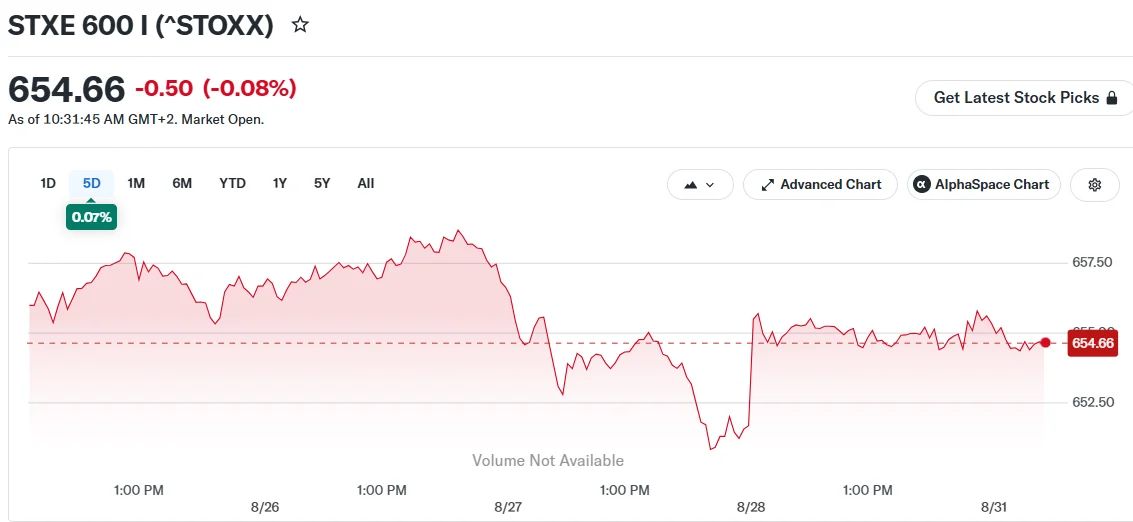
- •The STOXX 600 steadied at around 655 points and is on course for a fifth straight monthly gain, with euro zone inflation and U.S. payrolls data due this week.
European markets opened lower on Monday after U.S. forces struck Iranian missile launchers in the Strait of Hormuz, sending oil prices sharply higher.
🚨🇺🇸🇮🇷 BREAKING: U.S. official, speaking to Axios: "Earlier today U.S. forces struck two Iranian launchers on Larak Island. Islamic Revolutionary Guard Corps forces were observed preparing to launch rockets with sea mines into Strait of Hormuz." Source: @BarakRavid, Axios, pic.twitter.com/xyAh2PNU6Z — Mario Nawfal (@MarioNawfal) August 30, 2026
U.S. forces hit two missile launchers on Iran's Larak Island on Sunday. It was the first known U.S. military action against Iran since late July. Iran responded by launching attacks on two U.S. air bases in Jordan, according to Iranian media reports.
Oil Prices Jump on Middle East Tensions
Brent crude climbed more than 2%, trading around $90.70 a barrel following the news. Energy stocks across Europe rose 0.6% in response.
The market reaction reflects the Strait of Hormuz's outsized role in global energy supply: the narrow waterway between Iran and Oman handles roughly a fifth of the world's oil trade, including crude and refined products from major Gulf producers. Any escalation near the chokepoint tends to lift oil prices because traders price in the risk of disrupted tanker traffic, which in turn feeds through to inflation expectations and energy costs across Europe.
The fresh military exchanges rattled investor confidence at the start of the trading week, sending most major European indexes lower at the open. Germany's DAX dropped 0.5% in early trading, with investors watching the index closely ahead of German inflation data due later in the day. Euro zone inflation figures and U.S. payrolls data are also expected this week; both reports could give clues on where the European Central Bank takes interest rates next. The oil price moves add another variable for policymakers, as energy costs feed directly into headline inflation readings.
The Euro Stoxx 50 fell 0.13% at the open, while Siemens Energy was among the worst performers, down 2.39% shortly after the opening bell. France's CAC 40 opened near flat. The FTSE 100 in London was closed for a bank holiday.
STOXX 600 Holds Ground Despite Weak Open
The pan-European STOXX 600 started the session weaker but steadied, trading flat at around 655 points by mid-morning. Despite Monday's shaky start, the index remains on course for a fifth straight monthly gain.
The euro traded at 1.15886 against the dollar and the pound stood at 1.35433, both roughly flat on the day.
Salmon farming company Bakkafrost was one of the biggest fallers on the STOXX 600, dropping 7.1% after reporting its second-quarter results. The Faroe Islands-based company gave no immediate boost to investor confidence.
Energy was the one bright spot in an otherwise cautious session, as rising oil prices lifted stocks in that sector. Markets will be watching closely this week as key economic data rolls in from both Europe and the United States, and further developments in the Middle East could continue to influence oil prices and investor sentiment in the days ahead.
