For the First Time Ever, 10-Year Treasury Yields Track Diesel Prices More Closely Than Crude — and Trump's Fuel Deal With Putin May Be Too Little, Too Late
Key Takeaways
- •The national average diesel price sits near $6.277 per gallon, down from a $6.528 peak but still 71% above year-ago levels, while U.S. crude has risen 56% over the same period due to refining capacity damage in the Middle East and Russia.
- •According to Energy Aspects' Amrita Sen, 10-year U. Treasury yields have correlated more closely with diesel prices than crude prices since May, marking the first time that relationship has held.
- •Trump signed an executive order deferring the 24-cent federal diesel tax until year-end and announced an agreement with Putin for Russian diesel shipments of over 300,000 tons now, 500,000 tons in November, 1 million tons shortly after, and 3 million tons thereafter.
- •Farmers, truckers, and analysts such as the Energy Policy Research Foundation's Michael Lynch say the measures will barely move the needle, since per-gallon prices are $2.60 higher than a year ago and Russian supply would largely displace existing customers' cargoes.
- •A new Politico Poll found only 10% of undecided voters would be more likely to vote Republican if gas prices fell by $1 a gallon, with similar results regarding an end to the Iran war or a sharp inflation drop.
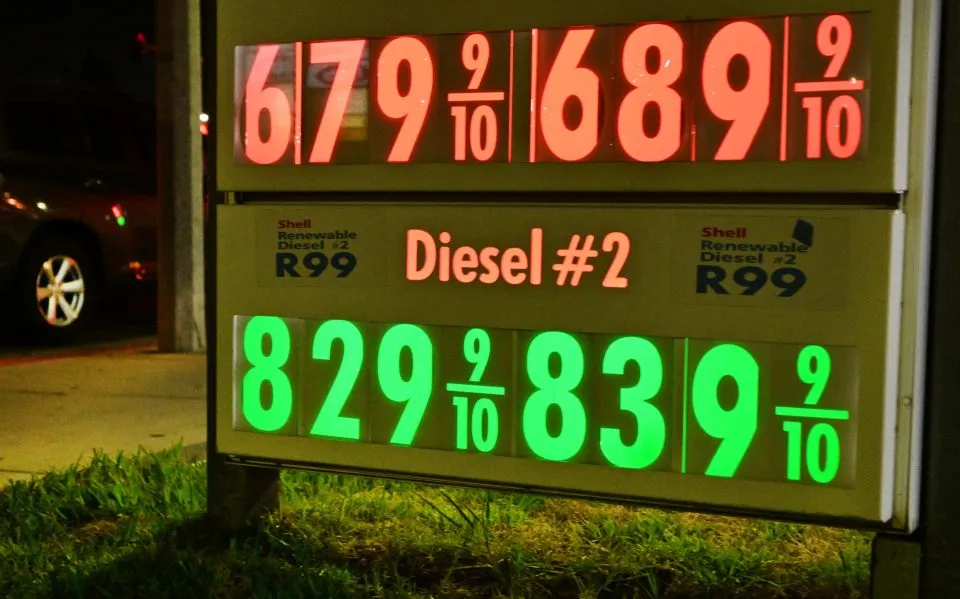
Diesel prices have pulled back from their all-time highs in recent weeks, but the key industrial fuel has already left a deep imprint on the broader economy and on financial markets, turning affordability into an increasingly potent issue ahead of the midterm elections.
The national average price for diesel stands at about $6.277 per gallon, according to AAA, down from its $6.528 peak but still 71% above year-ago levels. By contrast, U.S. crude oil is up 56% from a year earlier, as damage to refining capacity in the Middle East and Russia has produced a sharper crunch in fuel markets than in crude. Refineries are the link between the two: they convert crude into diesel, gasoline, and other fuels, so when capacity goes offline, crude can stay comparatively plentiful even as diesel grows scarce.
Because diesel is a critical input for manufacturing, agriculture, and logistics, the recent price surge has been felt across the economy. The latest consumer and producer price indexes showed jumps in costs, while purchasing manager surveys signaled big spikes in the prices businesses are paying.
"This is why products have been trading at double the price of crude during the past few months, something that has never happened before. Ultimately, diesel and gasoline drive inflation, not crude oil," Amrita Sen, director of market intelligence and co-founder at Energy Aspects, wrote in the Financial Times on Wednesday.
With elevated fuel costs keeping inflation forecasts high, markets are pricing in a more hawkish Federal Reserve that is prepared to raise interest rates further. Bond yields have climbed in anticipation of tighter monetary policy, pushing up borrowing costs for consumers. The 10-year Treasury yield in particular serves as the benchmark for mortgage rates and a wide range of long-term borrowing costs.
Crude prices historically moved in tandem with refined-product prices and long served as a proxy for those costs, but that relationship has now broken down, according to Sen.
"In fact, since May, 10-year US Treasury yields have correlated more closely with diesel prices than crude prices, for the first time ever," she added.
That shift, Sen said, explains why the Trump administration has recently begun paying closer attention to bringing diesel prices down.
Over the past week alone, President Donald Trump has taken steps to ease the cost burden. On Monday, he signed an executive order deferring the 24-cent federal tax per gallon on diesel until the end of the year, though most states impose separate levies of their own.
On Friday, he said he had reached a deal with Vladimir Putin to obtain diesel from Russia, a stunning reversal after years of U.S. pressure on Moscow over its invasion of Ukraine.
According to Trump, Russia will supply more than 300,000 tons of diesel now, followed by an additional 500,000 tons in November and 1 million tons "immediately thereafter." Moscow will deliver another 3 million tons "within a short period of time" after that. Every tranche after the first would therefore land in November at the earliest — the same month as the midterm elections.
The announcement was all the more surprising given that Trump signed a sweeping sanctions law last month imposing steep tariffs on the top buyers of Russian energy.
Still, the administration's efforts to lower diesel costs are unlikely to meaningfully improve affordability.
Farmers and truckers said the executive order on the diesel tax will offer little relief, noting that per-gallon prices are $2.60 higher than a year ago while the federal tax is only 24 cents a gallon. Energy experts, similarly, said the Russian diesel deal is unlikely to make much of a dent.
"It's of shuffling deck chairs on the Titanic," Michael Lynch, distinguished fellow at the Energy Policy Research Foundation, told the Associated Press. "If we get diesel from Russia, basically it means that their existing customers are not going to get it and they'll have to go somewhere else, and that will keep the price basically where it is now."
And even if Trump somehow managed to end his Iran war or bring fuel prices down sharply, Republicans may not see a lift with voters in November.
According to a new Politico Poll, just 10% of undecided voters said they would be more likely to vote for a Republican if gas prices fell by $1 a gallon, versus 29% who said it would have no impact and 57% who did not know. The results were similar when respondents were asked how an end to the Iran war or a sharp drop in inflation might affect their midterm choices.
"There's nothing that Trump can do, and frankly, even if he did something, no one would believe it anyway at this point," one GOP operative working on battleground races told Politico.
This story was originally featured on Fortune.com.

