Diesel and Jet Fuel Prices Diverge from Falling Brent Crude, EIA Data Show
Key Takeaways
- •Weekly EIA data published on Econbrowser show wholesale diesel and jet fuel prices failing to fall alongside a substantially lower Brent crude benchmark.
- •Econbrowser attributes part of the gap between crude and refined product prices to elevated transport and insurance costs.
- •Rebased to their February 23, 2026 levels, the Brent f.o.b. price was 26% higher in log terms as of November 10, 2026, diesel was up 48%, and jet fuel was roughly unchanged.
- •Because diesel powers trucking and freight and jet fuel is a central airline operating input, product prices holding up while crude eases raise costs for goods movement and air travel.
- •Diesel and kerosene jet fuel are middle-distillate products whose prices tend to move together, and Monday-anchored weekly EIA readings will track whether the crude-to-product spread holds, widens, or narrows.
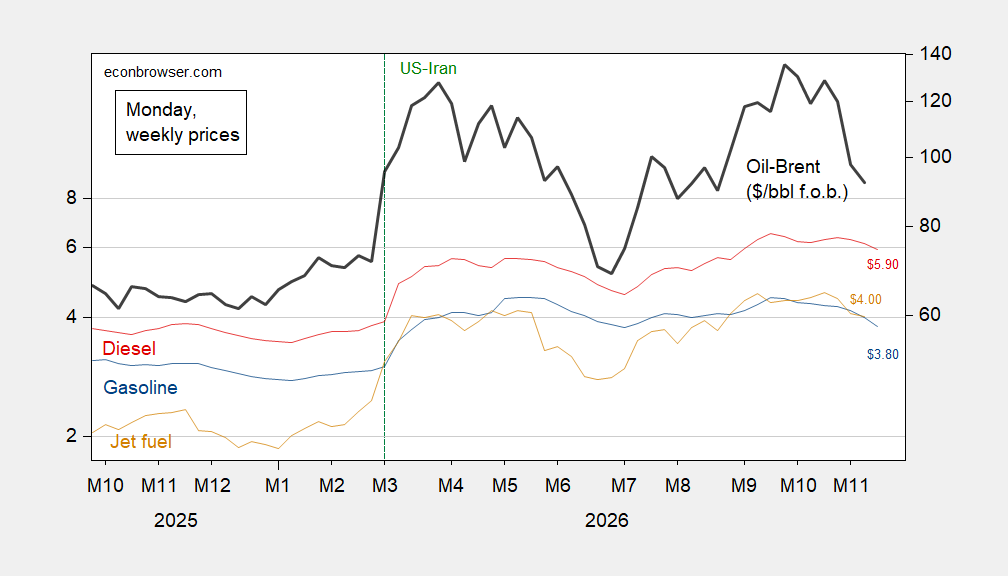
Wholesale prices for refined petroleum products are moving out of step with crude oil, according to weekly data compiled by the U.S. Energy Information Administration (EIA) and published on Econbrowser.
The first figure charts three refined products — regular gasoline, diesel, and kerosene jet fuel, each in dollars per gallon on a logarithmic scale — against the Brent crude oil price on a free-on-board (f.o.b.) basis, in dollars per barrel, on a separate logarithmic scale. All observations are taken on Mondays, the EIA's standard reference day for its weekly petroleum price series. Source: EIA.
The comparison reveals a clear divergence: while Brent has come down substantially, diesel and jet fuel prices have not fallen correspondingly. Econbrowser attributes this gap in part to elevated transport and insurance costs, a theme examined in greater depth in a companion post. The gap is more than a charting curiosity: diesel powers the trucking and freight sector, jet fuel is a central operating input for airlines, and product prices that hold up while the crude benchmark eases therefore feed directly into the operating costs of goods movement and air travel.
To put the relative moves on a common footing, a second figure normalizes all four series to their levels on February 23, 2026, plotted in logarithmic terms. Source: EIA. Rebasing to a single date on a log scale makes the percentage changes directly comparable even though the series are quoted in different units — dollars per gallon for the products versus dollars per barrel for crude.
On that basis, as of November 10, 2026, the Brent f.o.b. price stood 26% higher (in log terms) than its late-February level, diesel was up 48%, and jet fuel was roughly unchanged. Because every observation in these series is anchored to a Monday, upcoming weekly EIA readings will keep tracking whether the spread between the crude benchmark and the middle-distillate products holds, widens, or narrows.
Both diesel and kerosene jet fuel are middle-distillate products, so their prices tend to move together. The f.o.b. designation denotes a crude price quoted at the point of loading, before freight and insurance charges incurred further along the delivery chain — costs that help explain why delivered product prices have held up even as the benchmark crude quote has eased.

