Cove Point LNG Maintenance Outage to Cut Appalachian Feedgas Demand
Key Takeaways
- •Cove Point LNG's scheduled maintenance, the Pleasant Valley turnaround, runs from Sept. 19 to Oct. 2 and could eliminate about 850 MMcf/d of Appalachian feedgas demand.
- •During past maintenance events, feedgas deliveries to the terminal fell to as little as 15,000 Dth/d, effectively halting liquefaction operations.
- •Eastern storage inventories are 6% above the five-year average, providing a supply cushion that makes a material regional tightening unlikely.
- •Cove Point, with nameplate capacity of about 5.25 million tonnes per annum (0.7-0.8 Bcf/d of feedgas), is one of few East Coast export outlets for Appalachian gas.
- •The demand loss coincides with the fall shoulder season, when weaker weather-driven consumption typically pressures Appalachian basis differentials.
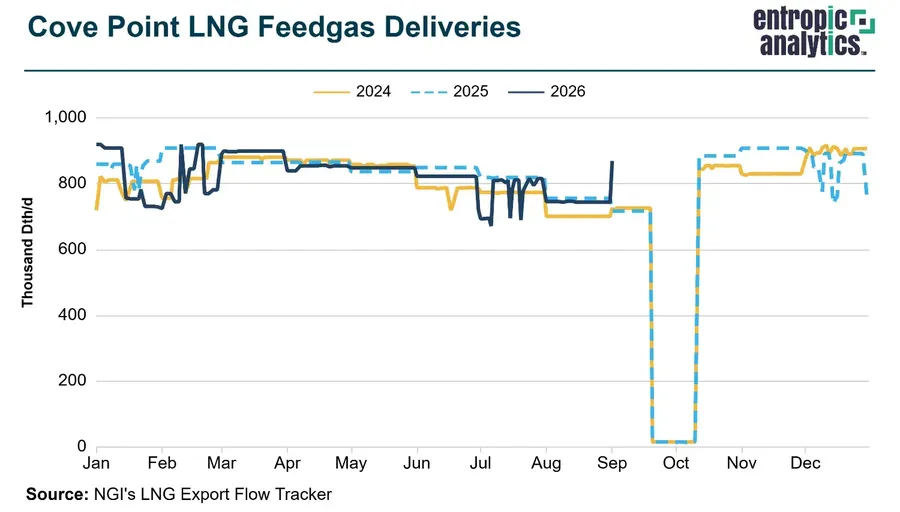
Annual maintenance at Cove Point LNG in Maryland could remove about 850 MMcf/d of feedgas demand from Appalachia for up to three weeks beginning Sept. 19, if recent outage patterns repeat. The timing coincides with the fall shoulder season, when milder weather typically weighs on power demand for natural gas. That combination — a large export demand pull fading just as weather-driven consumption eases — typically leaves regional producers and pipelines with more gas than end-use markets readily absorb, which can pressure Appalachian basis differentials until the terminal returns.
The scheduled work, referred to as the Pleasant Valley turnaround, is set for Sept. 19 through Oct. 2. During past maintenance events at the terminal, feedgas deliveries fell to as little as 15,000 Dth/d, indicating that the facility effectively halts liquefaction operations for the duration of the outage. The roughly 0.7-0.8 Bcf/d of gas normally consumed at Cove Point is significant for a producing region like Appalachia, where takeaway and demand outlets — rather than production capacity — have historically been the binding constraint, a dynamic that has kept regional prices at a discount to national benchmarks for years.
The demand reduction comes as storage inventories in the East stand 6% above the five-year average, providing additional supply cushion for the region while the export facility is offline. The extra cushion means the outage is unlikely to tighten regional supply materially; the more relevant question for market participants is whether producers curtail output, storage operators slow injections, or flows reroute to other demand points while Cove Point is down.
Cove Point LNG, located on the Chesapeake Bay in Lusby, Maryland, is one of the oldest liquefaction and export terminals in the United States, originally built as an import facility in the 1970s before being converted to exports in 2018. The terminal draws its feedgas supply primarily from Appalachian production via interstate pipelines, including deliveries referenced at the Texas Eastern M-2, 30 Receipt point and on Transco. The facility operates alongside the much larger Dominion Energy-led Cove Point pipeline system and is one of a small number of East Coast export outlets for Appalachian gas, making its maintenance schedule a recurring seasonal marker for regional flow patterns.
The facility's nameplate liquefaction capacity is about 5.25 million tonnes per annum of LNG, roughly equivalent to 0.7-0.8 Bcf/d of natural gas feedgas.
The data on feedgas flows cited in this report are drawn from NGI's Entropic Analytics.
Source: Natural Gas Intelligence
