Week 38 Commodities Market Watch: Oil Held Above $100, Gold Rebounded After the Fed Hike, and Copper Recovered on China Demand
Key Takeaways
- •WTI crude settled Friday at $100.30, holding above $100 for the week, as a smaller-than-feared Saudi pipeline disruption and Hormuz shipments at a six-month high eased concerns.
- •US commercial crude stocks fell 0.64 million barrels in the week ended September 11 while gasoline and distillate inventories built, and record diesel at $6.29 per gallon, up 68% year over year, kept consumer inflation pressure elevated.
- •December gold futures finished the week higher at $4,424.90 even after the Federal Reserve raised rates 25 basis points to 3.75%–4.00% on September 16, its first hike in more than three years, with the 10-year yield bouncing toward 4.995% on Friday.
- •Copper rebounded above $6.60 per pound on strengthening Chinese demand, with the Yangshan premium reaching $121 per ton, the highest since November 2022, after an early-week drop triggered by a postponed decision on refined-copper tariffs.
- •Soybeans closed the week higher at $13.03½ while corn and wheat finished softer, showing that agriculture continues to trade on its own crop, export, and trade calendars rather than following energy or metals.
Quick Answer
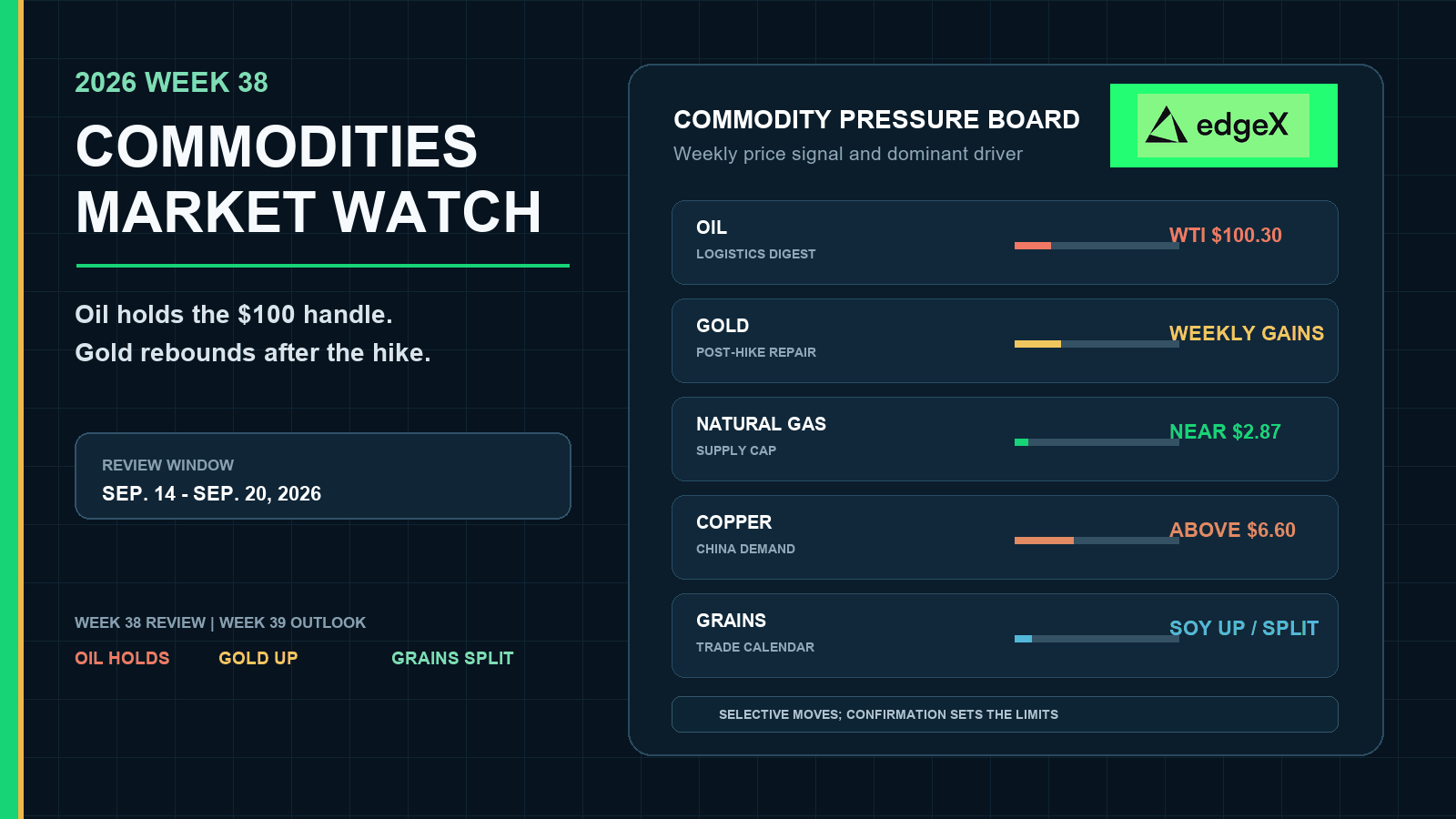
Week 38 did not deliver one commodity script. Oil held WTI above $100 into Friday while products rebuilt and diesel stayed at a record, showing the energy complex was digesting logistics risk rather than launching a fresh demand boom. Gold moved the other way from Week 37: December futures closed the week higher even after the Fed’s first hike, as oil eased and bullion repaired prior rate damage. Natural gas remained supply-capped near $2.87. Copper recovered above $6.60 on stronger China demand signals after an early tariff-delay flush. Grains refused both the oil and copper paths, with soybeans higher on the week and corn and wheat softer into Friday. Week 39 therefore opens with energy still the loudest inflation channel, metals more sensitive to yields and Chinese physical demand, and agriculture still trading its own export and crop calendars.
Week 38 Split the Complex After the First Fed Hike
After Week 37 cleared $100 on logistics risk and left gold damaged by hike odds, Week 38 tested whether energy would keep climbing into the FOMC decision or mean-revert under inventory and diplomacy pressure. Oil stayed three-digit on WTI, then eased into Friday without surrendering the handle. Gold’s weekly rebound showed the opposite constraint: bullion can repair even in a hike week when oil softens and the prior rate shock is already priced. Copper and grains again refused one path.
Oil held three-digit WTI while products rebuilt
Friday futures closes put October crude at $100.30 and Brent at $103.87 after a down day that still left WTI above Week 37’s $100.05 finish and Brent a little under the prior week’s $104.61 area. That split mattered more than a forced weekly percentage. Markets digested smaller-than-feared Saudi pipeline impact, higher Hormuz shipment commentary, and a product rebuild. Diesel’s record retail print kept inflation pressure open.
Metals and grains refused a single energy script
Gold finished higher despite the Fed’s 25 basis-point hike to 3.75%–4.00% and a Friday bounce in the 10-year yield toward 4.995%. Natural gas stayed near $2.87 under cooler weather, strong Lower-48 production, and LNG maintenance. Copper recovered above $6.60 after early-week lows on a postponed refined-copper tariff decision. Grains split on their own calendars: soybeans higher weekly, corn and wheat softer. Energy remained the loudest input.
Week 38 Commodities Dashboard
| Market | Completed Week 38 evidence | What the result means |
|---|---|---|
| WTI crude | Friday settle $100.30 (−$1.61 day); above Week 37’s $100.05 | Three-digit U.S. crude survived Friday digestion |
| Brent crude | Friday settle $103.87 (−$0.95 day); softer than ~$104.61 | Global benchmark eased while WTI held the handle |
| U.S. petroleum stocks | Crude −0.64M; gasoline +0.794M; distillates +1.585M | Crude still drew, but products rebuilt |
| Diesel | Record $6.29/gal, +68% year over year | Consumer inflation channel stayed loud |
| Gold | Dec futures $4,424.90 Friday; week with gains | Bullion repaired Week 37 rate damage |
| U.S. natural gas | High-$2s/mmBtu neighborhood near $2.87 | Weather and LNG support remained supply-capped |
| Copper | Rebound above $6.60; Yangshan premium $121/t | China demand recovered after a tariff-delay flush |
| Corn, soybeans, wheat | Corn $5.27½; soybeans $13.03½ higher weekly; wheat $7.14¼ | Agriculture split rather than copying oil or copper |
Oil Digested Logistics Risk Into a Product Rebuild
Oil’s Week 38 story was digestion, not a clean breakout extension. Investrade’s September 18 market review and Brownfield’s closing futures both put October WTI at $100.30, down $1.61, and Investrade put Brent at $103.87, down $0.95. The complex stayed three-digit into the Fed decision, then softened into Friday as markets judged the Saudi East-West pipeline disruption less severe than initially feared and tracked higher Hormuz volumes. Trading Economics later noted Hormuz oil and LNG shipments over the prior two weeks at a six-month high, per U.S. Central Command commentary into the Week 39 turn.
Three-digit WTI survived Friday without proving a demand boom
Holding above $100 still mattered for inflation and freight math. It did not prove a synchronized global demand boom. Coverage emphasized logistics reassessment and product rebuilds rather than a shortage stampede. One Trading Economics Friday note said oil fell about 0.5% on the week after a volatile session erased earlier gains, while dated closes showed WTI slightly above and Brent slightly below their Week 37 finishes. That split is the useful weekly signal. If Hormuz flows improve and products rebuild further, oil can lose the three-digit handle quickly; if diplomacy stalls or diesel stays at record stress, inflation pressure can remain open.
Inventories and diesel kept the inflation channel open
The EIA Weekly Petroleum Status Report for the week ended September 11, as summarized by Trading Economics and WSJ inventory coverage, showed crude stocks down 0.64 million barrels against expectations for a deeper 1.6 million barrel draw. Cushing inventories fell 0.342 million barrels. Gasoline stocks rose 0.794 million barrels against forecasts for a draw, and distillates rose 1.585 million barrels against a much smaller expected build. Refinery crude runs fell 256,000 barrels a day. That mix left crude firm enough to support a three-digit WTI handle while products rebuilt. Diesel remained the closer consumer-inflation link: Investrade’s EIA-linked note put average U.S. diesel at a record $6.29 a gallon, up 68% from $3.74 a year earlier. Week 38 left oil as a logistics-and-product market that held the handle without restoring Week 37 urgency.
Gold Rebounded Even as the Fed Delivered Its First Hike
Gold exited Week 38 repairing rather than repeating Week 37’s rate damage. Investrade put December gold at $4,424.90, up $25.20 or 0.57% on Friday, and December silver at $67.15, up $1.05 or 1.59%, closing the week with gains. Trading Economics gold notes tracked the same post-hike bullion path. Brownfield listed a same-day December gold close of $4,415.60, up $15.90; this review prefers Investrade’s settlement wrap and flags Brownfield’s alternate listed print. Versus Week 37’s December close at $4,391.30, the Investrade settle implies a clear rebound from the prior week’s rate-damaged finish.
Yields still rose Friday; bullion still finished the week higher
The Fed raised the funds range 25 basis points to 3.75%–4.00% on September 16, the first hike in more than three years, and left markets pricing additional 2026 tightening. The 10-year yield still bounced toward 4.995% on Friday. That combination would normally remain hostile for non-yielding metal. Week 38 showed the constraint is not absolute once the hike is delivered and oil softens: bullion can finish higher in a hike week if the prior rate shock has already been paid. The gold repair was selective digestion, not proof the Fed no longer matters for bullion.
Natural Gas Stayed Supply-Capped in the High-$2s
U.S. natural gas again refused to behave like a pure satellite of crude. Trading Economics left Henry Hub near $2.87/mmBtu into the Week 38/39 turn after cooler weather forecasts trimmed power-burn demand. With no consistently verified full-week percentage available, the cleaner read is directional around that high-$2s neighborhood.
Weather and LNG helped less; production still protected the range
September Lower-48 production averaged about 113.1 billion cubic feet a day, above August’s record monthly average of 112.2 billion cubic feet a day. Average flows to the nine major U.S. LNG export plants were expected near a three-week low of 17.5 billion cubic feet a day on Cameron LNG maintenance. The EIA storage print for the week ended September 11 was a below-average build that narrowed the inventory surplus versus the five-year average to 118 billion cubic feet from 148 billion cubic feet a week earlier. That mix left gas firmer than a pure surplus story and softer than an oil-led breakout, with high-$2s support and no scarcity stampede.
Copper Recovered Above $6.60 After an Early Tariff Flush
Copper left Week 38 stronger than the Week 37 soft patch after a two-part week. Trading Economics copper notes said futures rose above $6.60 a pound on Friday, extending gains for a fourth straight session on stronger China demand signals. The Yangshan premium climbed to $121 a ton on Thursday, the highest since November 2022. Earlier in the week, copper dropped to multi-week lows after reports that the Trump administration had postponed a decision on potential tariffs on refined copper. LME warehouses recorded fresh deliveries at the highest level in nearly four weeks, and London copper moved into contango, pointing to ample near-term availability even as the China demand premium firmed.
China demand recovered first; near-term inventory still argued for caution
Versus Week 37’s softer high-$6.20s / about $6.28 neighborhood, the Friday rebound above $6.60 marked a clear recovery without erasing the early tariff flush or the LME inventory rebuild. Near-term confirmation still depended on Chinese physical premiums and whether contango signals fade. Week 38 left copper as a China-demand rebound after a policy scare, not a squeeze.
Grains Split: Soybeans Higher Weekly, Corn and Wheat Softer
Agriculture again refused to copy the energy or copper scripts. Brownfield Ag News closing futures for September 18 put December corn at $5.27 1/2, down 3 cents; November soybeans at $13.03 1/2, down 16 1/4 cents; and December Chicago wheat at $7.14 1/4, down 12 3/4 cents. Versus Week 37 Friday closes near $5.30 1/4 corn, $12.96 1/2 soybeans, and $7.25 1/4 wheat, corn and wheat finished lower while soybeans finished higher. Farm Progress framing said soybeans still managed a higher weekly move despite Friday’s selloff, with Trump–Xi trade caution cited in oilseed commentary.
Crop, export, and trade calendars still dominate
Late-summer weather can still change corn and soybean yield assumptions, while wheat remains sensitive to global supply headlines and export competition. Higher diesel and freight costs can support the longer-run floor, but nearby direction still depends on production, export sales, and trade headlines. Week 38’s Friday soybean slide into a still-higher weekly finish showed traders taking profits into weekend diplomacy risk without erasing the week’s oilseed bid. That is selective agricultural digestion, not oil trade.
Cross-Market Impact Map
| Commodity signal | Economic transmission | What would confirm it |
|---|---|---|
| WTI held $100.30 while Brent eased to $103.87 | Energy inflation stayed open without a fresh panic spike | Hormuz flow path and the next product inventory print |
| Crude draw with gasoline and distillate builds | Supportive crude balance, less product scarcity | Whether the next EIA report keeps rebuilding products |
| Gold’s weekly rebound after the first Fed hike | Rate shock digestion and less automatic metal damage | Softer real yields, weaker dollar, or renewed hedge demand |
| Gas near $2.87 with strong production | Demand support capped by output and LNG maintenance | Bullish storage or weaker Lower-48 production |
| Copper rebound above $6.60 on Yangshan $121 | China demand recovery after a tariff-delay flush | Sustained premiums without quick inventory restocking |
| Soybeans higher weekly; corn/wheat softer | Trade and crop calendars still separate from oil | Export sales, Trump–Xi headlines, and crop updates |
What Week 38 Changed
Week 38 replaced Week 37’s oil breakout and gold loss with a digestion week under the first Fed hike. Energy held the WTI $100 handle while products rebuilt and diesel stayed at a record. Gold repaired prior rate damage even as policy tightened. Natural gas stayed supply-capped. Copper recovered above $6.60 on China demand after an early tariff flush. Grains split, soybeans higher weekly and corn and wheat softer.
Week 39 Outlook: Diplomacy, Inventories, and Selective Confirmation
Week 39 covers September 21–27. The base case is selective confirmation under diplomacy and inventory lenses rather than a uniform commodity rally. Oil starts from a three-digit WTI handle with product rebuilds already on the tape, so Hormuz flows and the next EIA prints matter more than last week’s logistics scare. Gold starts from a repaired finish and needs post-hike yields and the dollar to stay cooperative. Copper must prove Chinese demand beyond one Yangshan spike. Grains need trade or crop follow-through after the soybean-led split.
Oil and gas will be decided by Hormuz flows, products, and storage
Energy’s first tests remain physical. Watch Hormuz shipment volumes, U.S.–Iran message traffic around the UN General Assembly window, and Saudi pipeline repair headlines for whether the logistics premium can hold above $100 without midweek panic. Use the next EIA Weekly Petroleum Status Report to test whether gasoline and distillate rebuilds continue after the September 11 product builds. If products keep rebuilding while Hormuz flows stay elevated, oil can lose the three-digit WTI handle; if products tighten again or diplomacy stalls, diesel’s record retail path can keep the inflation channel open. For U.S. gas, the next storage print, production trend, and LNG feedgas path remain decisive after cooler forecasts and Cameron maintenance capped Week 38.
Gold needs the post-hike rate channel to stay friendly
Gold’s Week 39 path depends less on oil’s exact handle and more on Fed speaker follow-through, real yields, and the dollar after the first hike. A delivered hike can still hurt bullion if officials push real yields higher again; softer communication, a weaker dollar, or renewed safe-haven demand would help extend the Week 38 repair. Residual geopolitical risk is not automatic gold support while rates turn hostile.
Copper and grains must convert Friday evidence into follow-through
Copper already carries a China-demand rebound and an open longer-run supply story. Week 39 confirmation requires the Yangshan premium to stay firm, broader industrial data to cooperate, and inventory signals to stop arguing for near-term ample supply. Without that, tariff headlines or rate pressure can dominate. Grains need trade and export follow-through after soybeans’ higher weekly finish and Friday oilseed selloff. Trump–Xi headlines, stronger export sales, or further crop-condition deterioration would rebuild premium; comfortable production assumptions and weaker overseas demand would not.
A single Hormuz headline can reprice oil faster than weekly inventories, while a single Fed speaker paragraph can reprice gold faster than commodity-specific flows. For Week 39, the decision criteria are clear: oil needs impaired logistics and firmer product balances, gold needs cooperative yields after the hike, copper needs sustained Chinese physical demand, and grains need trade or weather tightening.
Trade Commodities Perpetuals On-Chain with edgeX
Commodity markets move fast. Your trading infrastructure should too.
edgeX is a decentralized exchange built on EDGE chain, settling on Ethereum via Arbitrum, that lets traders access tokenized RWA commodities perpetuals with institutional-grade execution and true self-custody. No KYC. No centralized custodian. Just full control of your assets, your private keys, and your positions.
Why traders choose edgeX for commodities:
- Ultra-deep liquidity: $10 million of depth within a one-basis-point spread, with sub-0.1-basis-point slippage on trades over $100,000, even during peak volatility.
- High-performance engine: Up to 200,000 orders per second with sub-10 millisecond matching latency.
- True self-custody: Withdrawals require only your wallet authorization; no platform approval needed.
- No KYC required: Start trading commodities, tokenized stocks, and crypto perpetuals without identity verification.
- 100% trading fee rewards: edgeX’s Trade to Own program returns 100% of trading fees back to users in $EDGE tokens.
- USDC-backed settlement: USDC is designed by Circle to be redeemable 1:1 for U.S. dollars, giving traders a familiar settlement base.
Whether you're trading gold, oil, or other RWA commodities, edgeX gives you the liquidity depth of a centralized exchange with the security of on-chain settlement.
The platform is available on desktop and as a native mobile app on iOS and Android, so you can manage positions and react to commodity market moves from anywhere.
Ready to trade commodities perpetuals without the constraints of a centralized exchange? Start trading on edgeX with no KYC and no compromises.
Frequently Asked Questions
What dates did 2026 Week 38 cover?
This review covers September 14 through September 20, 2026. The principal futures-market close was Friday, September 18, after the Federal Reserve’s September 16 rate decision.
Why did oil hold above $100 in Week 38?
October WTI settled Friday at $100.30 and Brent at $103.87 after a down day that still left U.S. crude above Week 37’s $100.05 finish. The week was logistics digestion and product rebuild more than a fresh demand boom, with diesel still at a record $6.29 a gallon.
What did inventories say about the oil balance?
For the week ended September 11, U.S. commercial crude stocks fell 0.64 million barrels, less than the roughly 1.6 million barrel draw expected. Gasoline stocks rose 0.794 million barrels and distillates rose 1.585 million barrels, reducing the product-scarcity case even while crude still drew.
Why did gold gain the week while the Fed hiked?
December gold settled Friday at $4,424.90 and closed the week with gains even after the Fed raised the funds range to 3.75%–4.00%. Bullion repaired Week 37’s rate damage as oil eased and the delivered hike was digested, rather than proving that policy rates no longer matter for gold.
What is the Week 39 commodities outlook?
The base case is selective confirmation under diplomacy and inventory lenses. Oil needs Hormuz flows and product-inventory follow-through above $100, gold needs cooperative post-hike yields, copper needs Chinese demand to validate the rebound above $6.60, and grains need trade or crop follow-through. A uniform commodity rally is not the base case.

