Cobre Panamá Restart Prospects Strengthen as Government Engages Mine Workers and Suppliers
Key Takeaways
- •Panama's interministerial commission is evaluating proposals from stakeholder consultations to determine whether a new contractual framework or alternative arrangement can be established for the Cobre Panamá mine.
- •First Quantum has processed 2.1 million tonnes of stockpiled ore through June, producing approximately 3,200 tonnes of contained copper, with roughly 38 million tonnes of stockpiled ore sufficient for about 12 months of processing remaining.
- •The mine's closure since late 2023 eliminated approximately 40% of First Quantum's revenue, erased 4.5% of Panama's GDP, and removed more than 1% of global copper supply.
- •First Quantum has paused its $20 billion arbitration claim against Panama, and the Mulino administration has authorized concentrate sales, restarted the power plant, and completed an environmental audit showing 87.7% compliance.
- •Once a framework agreement and approvals are secured, First Quantum projects the mine could reach 80–90% of capacity within six to nine months, though hiring 6,000 workers poses a potential bottleneck.
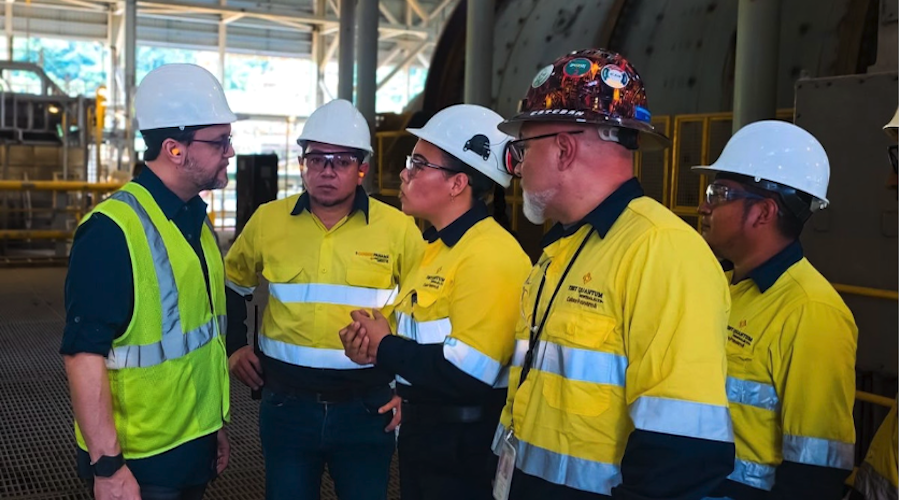
Prospects for restarting First Quantum Minerals' (TSX: FM) halted Cobre Panamá copper mine improved Tuesday as senior Panamanian government officials met with workers, suppliers, and local authorities to discuss the operation's future.
Commerce and Industries Minister Julio Moltó visited the Donoso, Omar Torrijos Herrera, and La Pintada regions, where he held talks with mine employees, community leaders, and supply-chain partners. Proposals gathered during those meetings will be forwarded to the government's interministerial commission tasked with evaluating the suspended mine's path forward — a body whose recommendations are expected to shape whether Panama pursues a new contractual framework or an alternative arrangement for the operation.
Employment and workforce
Panama's government authorized First Quantum in April to extract and process stockpiled ore at the site. That limited activity currently sustains approximately 3,200 direct jobs and over 3,000 indirect positions, according to data presented at the meetings. Panamanian nationals account for more than 91% of the workforce, and women represent 17% of employees.
Moltó noted that the consultations underscored the depth of specialized talent that has developed around Cobre Panamá, pointing to professionals and technicians who have built multi-year careers tied to the operation.
Operational groundwork
For First Quantum investors, the engagement signals continuing momentum around an asset that was formerly among the company's largest sources of earnings and cash flow. Before its shutdown, Cobre Panamá produced approximately 350,000 tonnes of copper annually, placing it among the largest single-site copper operations in the world.
The company restarted one of the mine's three milling trains in May and produced its first concentrate in June, CEO Tristan Pascall confirmed last month during First Quantum's second-quarter earnings release. Processing subsequently transitioned to a second train as part of a scheduled maintenance rotation.
By the end of June, First Quantum had processed 2.1 million tonnes of stockpiled ore, yielding approximately 3,200 tonnes of contained copper. The first shipment is anticipated this month. Roughly 38 million tonnes of stockpiled ore remains, holding an estimated 70,000 tonnes of recoverable copper — enough material to sustain approximately 12 months of processing at current rates.
Stockpile processing also keeps critical infrastructure at Cobre Panamá, including the port and power plant, operational while the government deliberates on the mine's long-term status. That maintained readiness could prove significant for the pace of any full restart. First Quantum estimates Cobre Panamá would need approximately 6,000 workers at full capacity and has flagged the hiring and training of specialized personnel as a potential bottleneck. Once a framework agreement is reached and necessary approvals obtained, the company projects the mine could reach 80% to 90% of capacity within six to nine months.
Background and economic impact
Cobre Panamá has sat idle since late 2023, when Panama's Supreme Court declared First Quantum's 20-year mining contract unconstitutional following broad environmental and governance protests. According to IMF data, the shutdown erased roughly 4.5% of Panama's gross domestic product, removed more than 1% of global copper supply, and eliminated approximately 40% of First Quantum's revenue.
The closure came at a time when global copper demand is projected to rise significantly, driven by the expansion of electric vehicle manufacturing, renewable energy infrastructure, and power grid build-out. The International Energy Agency has forecast that copper demand could grow by more than 50% by 2040 under current energy transition trajectories, intensifying interest in restarting large-scale operations like Cobre Panamá.
Since taking office in 2024, President José Raúl Mulino's administration has authorized the sale of stockpiled concentrate, restarted the mine's power plant, and completed an environmental audit that found the operation 87.7% compliant with its environmental commitments. First Quantum has also paused its $20 billion (C$28 billion) arbitration claim against Panama while discussions over the mine's future proceed.
Key unresolved questions include whether any restart framework can satisfy the constitutional requirements that led to the original contract's invalidation and whether environmental and community concerns that fueled the 2023 protests can be addressed in a new arrangement.
First Quantum shares declined 1.5% to C$43.77 in Tuesday afternoon trading in Toronto, giving the company a market capitalization of approximately C$37 billion ($26 billion). The stock has traded between C$22.21 and C$46.36 over the past year.

