Chinese Banks Halt Retail Paper Gold Trading as Debate Grows Over Gold Price Discovery
Key Takeaways
- •ICBC said it will stop offering individual precious metals trading linked to the Shanghai Gold Exchange effective July 24.
- •Several other Chinese banks have also announced plans to discontinue retail paper gold trading products.
- •Officials and market participants cited risk management, price volatility and leveraged retail exposure as reasons for the withdrawals.
- •Some observers argue the move could shift more gold pricing influence from Western paper markets toward Asian physical bullion markets.
- •The Shanghai Gold Exchange is the world’s largest physical spot gold exchange but has historically had less influence on global pricing than Western benchmarks.
Several large Chinese banks have announced plans to halt retail paper gold trading, prompting discussion over whether China is seeking a greater role in global gold pricing and a reduced reliance on Western paper markets.
Last month, the Industrial and Commercial Bank of China (ICBC) said it would stop offering individual trading in precious metals linked to the Shanghai Gold Exchange effective July 24. ICBC is the world’s largest bank by assets.
Postal Savings Bank of China, Ping An Bank, and China Guangfa Bank have also announced plans to end paper gold trading.
Paper trading involves futures, which are exchange-traded contracts between two parties that agree to buy or sell a set amount of gold at a predetermined price on a specific future date. At the end of the contract, the buyer can roll the contract into a new one or take delivery of the physical metal.
Futures are used both to hedge against price fluctuations and to speculate on market movements. Because most futures traders never take delivery of physical gold, the volume of paper claims can exceed the amount of available metal. If every investor holding a buy contract demanded delivery, there would not be enough gold to satisfy all claims. Critics say that dynamic creates room for price manipulation through the movement of paper contracts.
Debate Over Price Discovery
Some market observers have speculated that the withdrawal of Chinese banks from futures trading, together with a new Hong Kong-based gold clearing and settlement system, reflects a coordinated effort by China to gain a stronger hand in global gold pricing.
Such a shift would move more pricing influence away from paper-dominated Western markets and toward Asian markets that are more focused on physical metal. That question matters because gold benchmarks are used not only by speculators, but also by banks, refiners, dealers, and investors to reference transactions and manage risk across the bullion market.
London, New York, and Switzerland have been central to the gold trade for nearly two centuries. The spot price is driven by the London Bullion Market Association (LBMA) morning and evening gold fixes.
The Shanghai Gold Exchange (SGE), meanwhile, is the world’s largest physical spot gold exchange. Its activity centers on physical bullion delivery, in contrast with COMEX, which is primarily associated with paper trading. Despite its size, the SGE has had far less influence on global pricing.
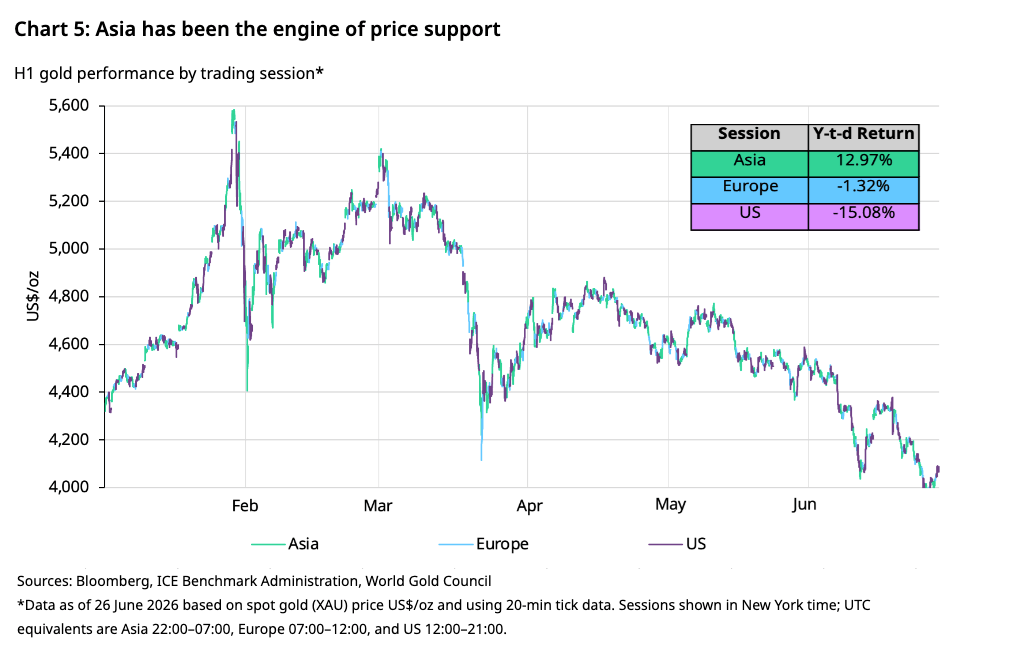
The World Gold Council highlighted a notable pattern in its H1 gold market analysis.
"Interestingly, intraday analysis suggests that the bulk of gold’s movements have been linked to activity during Asian and U.S. trading hours. Many of the pullbacks occurred during U.S. hours and, conversely, gold’s rebounds generally occurred during Asian hours."
Through the first six months of the year, gold rose 12.9 percent during Asian trading hours. During North American trading hours, the metal fell 15 percent. European sessions were in between, with gold declining modestly by 1.3 percent.
The pattern is not limited to recent trading. The source article said gold prices in Asian markets have typically outperformed Western gold prices for decades.
Analyst Ed Steer argues that the pattern reflects Western price manipulation through paper markets.
“This simple difference in investment strategy is all the proof needed that the world's banks and large commercial traders are actively managing the price between the a.m. and p.m. gold fixes in London -- and have been doing so since the paper market in gold first opened on 02 January 1975.”
The source article said it would not be surprising if Chinese institutions preferred to increase their influence over gold pricing and reduce the role of Western paper traders.
Risk Management Cited
Officials have said Chinese banks are exiting paper futures trading to manage risk and prevent “speculative excesses.”
“Chinese banks are tightening retail precious metals trading as a risk-control response to heightened price volatility,” State Street Investment Management gold strategist Robin Tsui told the South China Morning Post.
Joshua Rotbart, who operates a precious metals firm with offices in Hong Kong and Singapore, also told the Investing News Network that the move should not be interpreted as a sign that China is “cooling on gold.”
“What is being switched off is the speculative paper layer. This move reflects a distinction between leveraged paper trading and physical ownership.”
That distinction is central to the debate: the announced bank exits concern retail paper products, while the broader Chinese gold market remains closely associated with physical bullion and delivery through venues such as the SGE.
Paper trading can increase volatility because positions can be shifted easily. Rotbart said Chinese banks have grown more concerned about leveraged retail products amid recent price swings.
“When gold prices move sharply, leveraged paper products expose both the investor and the institution to greater risk. Discontinuing these products reduces operational and reputational risk while supporting broader financial stability.”
The shift also moves pricing emphasis away from speculative paper and toward the physical market. The source article said that could result in pricing that more closely reflects market fundamentals rather than speculative expectations.
Rotbart suggested that a more Asia-centered gold pricing framework could direct the market toward physical gold.
“Over time, this development may encourage greater emphasis on physical ownership rather than short-term leveraged speculation. It channels demand toward the metal itself rather than reducing it.”
VRIC Media CEO Jay Martin said he does not accept the official explanation.
“I think that July 24th is the day that China starts finding out what gold is actually worth.”
Martin said the paper market creates the appearance that more gold exists than is physically available, making it easier for paper traders to depress prices.
“If there are 10 paper claims for every real ounce of gold, the market sees 10 times more gold than actually exists.”
By removing that dynamic from the market, Martin argued that the market will discover “the real price of gold.” He said he believes that price is much higher than the LBMA fix indicates.
Matthew Piepenburg, a partner of Von Greyerz, expressed a similar view.
“I've written ad nauseam for years about the COMEX and the LBMA markets, and how they legalize price manipulation and fraud legally, and China isn't stupid. They've been watching this since 1973 ... They know that we use massive amounts of leverage to force the boot to the neck of gold and silver, so we don't have natural price discovery. Fast forward to 2026, China is saying for us to have more credibility, more trust, and more natural price discovery, we are now going to try and make the paper trade, which is an open secret that it's a lie; we're going to call the bluff on that. We're going to go focus more on physical supply and demand.”
Piepenburg called the development “another move in the direction toward true price discovery.”
“What Shanghai and Hong Kong and China in the East are doing is anchoring the trade in something more valuable, actual supply and demand, less nonsense, less dishonesty, and that gives them more credibility.”
The source article said the true motives of Chinese participants in the gold market are impossible to know. It added that whether the Chinese government is trying to shift pricing control away from the West or simply protect investors from volatility and market excess, the practical outcome may be similar: China is positioning itself to become a more influential participant in gold pricing.
Because the Chinese market is more oriented toward physical bullion, the source article argued that Asian pricing may come to reflect the value of physical metal more strongly than paper-based speculation.

