Boston Dynamics' Spot Robot Deployed at Utah Copper Mine for Autonomous Inspections
Key Takeaways
- •Spot is being used at Copper One to automate routine plant inspections that were previously done by human operators.
- •The robot collects thermal, camera and acoustic data to look for wear, vibration and temperature changes that may indicate maintenance issues.
- •Mariana Minerals already operates automated drills and robotic haul trucks through its MarianaOS platform.
- •The company wants to use Spot’s data to build more predictive and preventative maintenance systems, but it is still focused on reducing false positives.
- •Boston Dynamics said the deployment could lead to additional uses for Spot across mining, construction and other industrial sites.
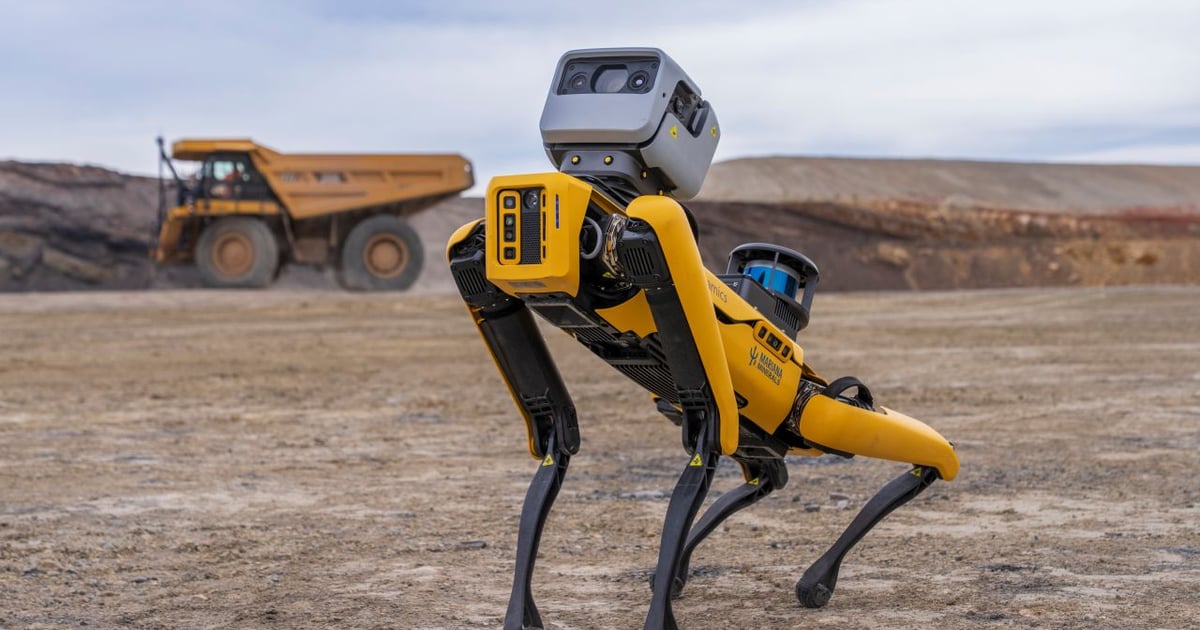
Boston Dynamics' quadruped robot, Spot, has been deployed at Mariana Minerals' Copper One facility near Moab, Utah, in a move the operator says brings it closer to operating the world's first autonomous mine. The deployment comes as copper demand intensifies driven by electric vehicle manufacturing, renewable energy infrastructure, and grid modernization, placing pressure on producers to scale output while managing costs and safety.
Mariana Minerals is using Spot to automate routine inspection tasks, collecting data through the robot's onboard sensors, including thermal imaging, cameras, and acoustic capabilities. The deployment is also expected to lay the groundwork for more predictive operations as the mining company seeks to integrate greater embodied AI into its workflows.
Mariana already operates automated drills for excavation and robotic haul trucks for transporting ore to processing, all coordinated by an AI-enabled platform called MarianaOS that tracks and directs the entire operation. Major mining operators including Rio Tinto and BHP have similarly invested in autonomous haulage and drilling systems across sites in Australia and elsewhere, though Mariana's pitch of a fully integrated autonomous mine — encompassing inspection as well as extraction and transport — goes a step beyond the fleet-automation deployments that dominate the sector today. Spot's role targets the traditionally time-consuming, manual site inspection process. The company said automating these tasks allows employees to concentrate on more complex maintenance and optimization work.
"The way we're thinking about Spot is: how do you free up people to do more value-accretive tasks?" Juan Lozano, co-founder and CTO of Mariana Minerals, told AI Business. "It [allows] our team to focus on work where they can add more value."
"We got excited about the combination of the platform's flexibility and its advanced sensing capabilities," he added.
Why Inspections Are the Starting Point
Copper One previously depended on human operators walking the plant to conduct inspections. The sheer scale of the task — the site spans 10,000 acres — combined with its repetitive nature, made it a natural candidate for automation, Lozano explained.
"If you're running a good refinery, 99% of the time an inspection confirms that everything is operating as expected," he said. "You are, by definition, looking for something that you don't expect to find. That can make it challenging to maintain the same level of operational discipline every single time, particularly when inspections are repeated multiple times a day."
Spot's multi-sensor approach addresses this challenge by combining thermal imaging, cameras, and acoustic sensing to detect equipment wear, vibration, and temperature changes that could signal a maintenance issue. Spot has been deployed across a range of industrial settings — including offshore oil and gas platforms, nuclear power facilities, and construction sites — where reducing human exposure to hazardous environments is a core driver.
Marco Da Silva, vice president and general manager at Waltham, Mass.-based Boston Dynamics, said the deployment reflects a broader trend in mining robotics, but with a notable distinction.
"There has been a lot of interest in mobile robotics in mining, often focused on inspecting mine faces or tailings dams," he said, referring to engineered structures that hold mining waste. "This deployment is interesting because it applies Spot's core inspection capabilities, looking at motors, pumps and using thermal and visual inspections, in a way that is applicable across many industries."
Once Spot's effectiveness in inspecting the copper refinery is demonstrated, Da Silva said Boston Dynamics can begin exploring additional applications for the robot.
Building Toward Predictive Maintenance
Beyond immediate labor savings, Mariana views the deployment as a foundation for smarter, more predictive operations. Currently, when Spot identifies an anomaly, the alert is still routed to a person for assessment. The objective, Lozano said, is to achieve automatic alerting — where a detected problem is automatically matched to its historically required fix, without human intervention.
Mariana also intends to correlate Spot's data with everything else it already knows about the site to construct a more complete operational picture.
"The first level of autonomy is taking a monotonous task and allowing the human who was doing it to focus on something else," Lozano said. "The thing we're really excited about is building that dataset and using it to take more predictive and preventative actions rather than being reactive."
Achieving that vision, however, requires trust. For Mariana Minerals, Lozano said the priority is reducing false positives and ensuring alerts are as accurate as possible before adding more predictive capabilities. Da Silva echoed that perspective from Boston Dynamics' side.
"The immediate focus is helping customers build trust in the automated alerts the robot is producing and developing systems where those thresholds can be identified automatically," Da Silva said. "There's still a roadmap ahead in terms of expanding the value Spot can deliver out of the box, but further automation of the inspection process will help deployments happen faster and deliver value sooner."
Looking ahead, Lozano said Mariana is also evaluating Spot for tasks on construction sites — particularly large, integrated facilities such as chemical refineries or mineral processing plants.
"These facilities require a lot of infrastructure — wiring, piping, cabling," he said. "So, using vision, thermal and acoustic sensor systems to continuously walk the site and live update your 3D understanding of what is happening on-site and how it is happening, is super important."
Da Silva said Boston Dynamics sees applications extending well beyond mining. Because Spot is already traversing a site, he noted, it could potentially serve as a data-gathering tool for other stakeholders — flagging safety hazards for an EHS (environmental, health and safety) team the way a security guard would, for instance. That role would be separate from manipulation tasks suited to a robotic arm or maintenance work that a bipedal robot might eventually handle.
"We want to continue working with partners like this who have their eye on the future of how to manage remote, dangerous, and sometimes dull sites," he said.

