Aztec Reports 88.4 Meters of 1.42 g/t Gold and 14.58 g/t Silver in First North Extension Step-Out at Tombstone
Key Takeaways
- •TR26-39 intersected 88.4 meters of gold-silver mineralization starting at 10.7 meters in the North Extension Zone, including a 6.1-meter high-grade core.
- •TR26-38 returned 97.5 meters of near-surface mineralization from surface in the Contention Zone, including a 6.1-meter high-grade interval.
- •Aztec said the shallow oxide gold-silver system remains open in all directions, including to the north and at depth.
- •The 2025-2026 program has completed 90 RC holes, while assays are still pending for TR26-40 through TR26-50.
- •Aztec said the reported holes and pending assays are expected to be incorporated into its maiden mineral resource estimate for Tombstone.
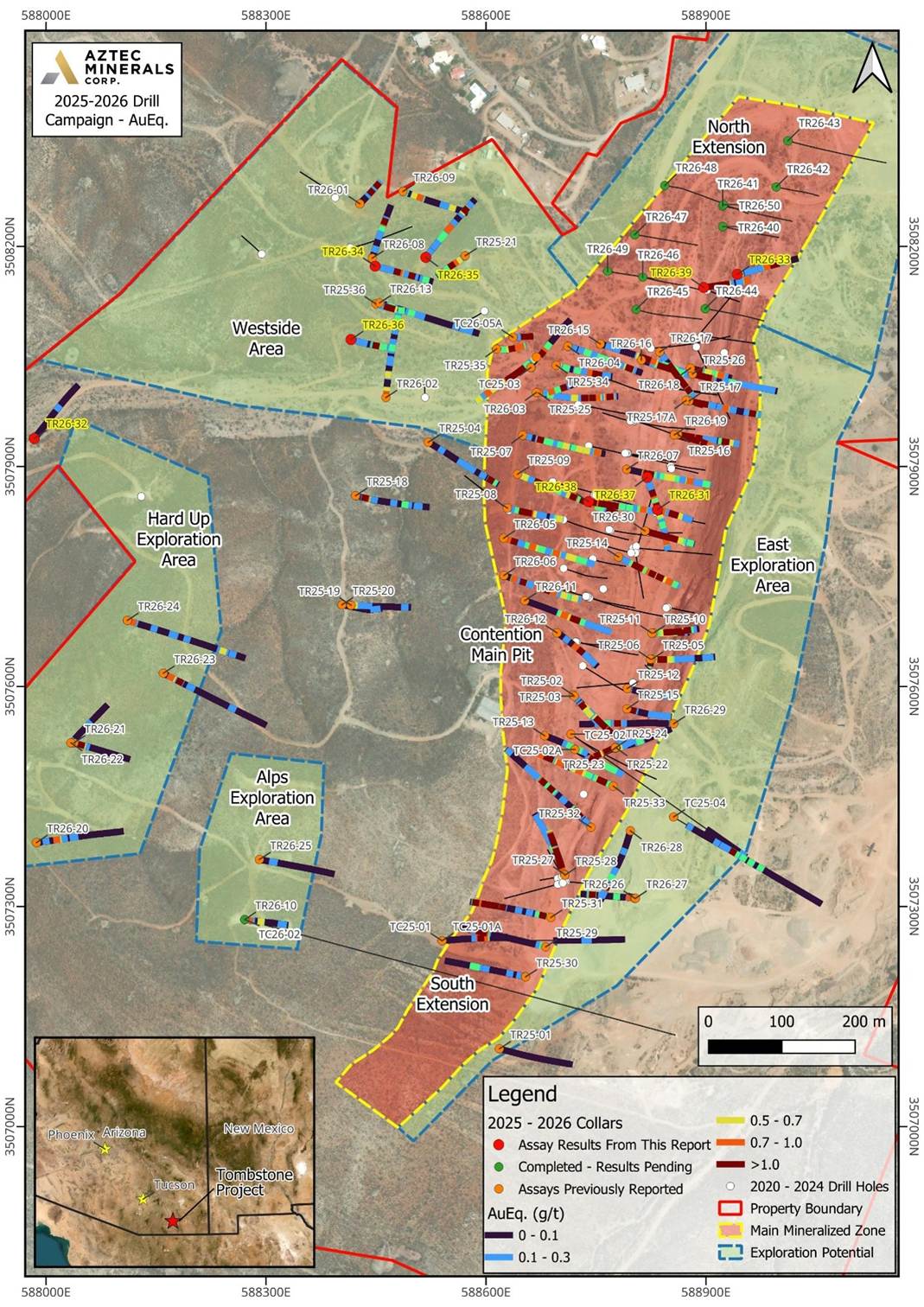
Aztec Minerals Corp. reported results from nine reverse circulation (RC) drill holes, TR26-31 to TR26-39, at its Tombstone Property in southeastern Arizona, including the first step-out drilling into the newly acquired North Extension Zone.
The company said holes TR26-33 and TR26-39 both intersected oxide gold-silver mineralization on ground not previously drilled by Aztec. Drill hole TR26-39, one of the first two holes in the North Extension Zone, returned 88.4 meters averaging 1.42 g/t gold and 14.58 g/t silver, or 1.69 g/t gold equivalent, from 10.7 meters. In the Contention Zone, hole TR26-38 returned 97.5 meters averaging 1.06 g/t gold and 16.08 g/t silver, or 1.36 g/t gold equivalent, from surface.
Aztec said both intervals represent shallow, continuous oxide mineralization of the type it is targeting at Contention, described as bulk-tonnage material beginning at or near surface and potentially amenable to heap leaching. Each interval also included a high-grade core: 6.1 meters averaging 12.23 g/t gold and 56.28 g/t silver, or 13.25 g/t gold equivalent, in TR26-39, and 6.1 meters averaging 12.17 g/t gold and 69.08 g/t silver, or 13.43 g/t gold equivalent, in TR26-38.
The company said the near-surface oxide gold-silver zone remains open in all directions, including to the north and at depth. That matters for a project still being defined by step-out drilling, because the current program is intended to outline the size and continuity of mineralization around the historic Contention mine and nearby extensions before a maiden resource estimate is finalized.
As of the date of the release, 90 RC holes had been completed in the 2025-2026 program, including 40 in 2025 and 50 in 2026. Assay results remain pending for the 11 most recent step-out holes, TR26-40 to TR26-50, which include first-pass holes collared up to about 230 meters north of TR26-39 along the trend of the North Extension Zone. Aztec said those results are expected in the coming weeks, and drilling is expected to continue through at least September 2026.
Results from the holes in this release, together with the pending TR26-40 to TR26-50 assays, are expected to be incorporated into the company’s previously announced maiden mineral resource estimate for the Tombstone Project.
Aztec Minerals CEO Simon Dyakowski said: “The story in these holes is continuity. We are seeing thick oxide intervals starting at or near surface across the Contention area, and now we are seeing them in the North Extension on a first pass through ground we had not drilled before. That tells us the system is larger than the footprint we have defined to date. It remains open in all directions, including to the north and at depth, and with ninety RC holes completed and assays still pending, we expect to keep adding to it through the balance of the program.”
RC drilling highlights
The company highlighted the following RC drill results from the Tombstone Property:
- TR26-39, a first-pass hole in the North Extension Area, intersected 88.4 meters averaging 1.42 g/t gold and 14.58 g/t silver, or 1.69 g/t gold equivalent, from 10.7 meters. The interval included 6.1 meters averaging 1.55 g/t gold and 4.53 g/t silver, or 1.63 g/t gold equivalent, from 27.4 meters, and 12.2 meters averaging 6.38 g/t gold and 33.93 g/t silver, or 7.00 g/t gold equivalent, from 64.0 meters, including 6.1 meters averaging 12.23 g/t gold and 56.28 g/t silver, or 13.25 g/t gold equivalent, from 65.5 meters. The hole ended in mineralization, with 30.5 meters averaging 0.18 g/t gold and 5.63 g/t silver, or 0.28 g/t gold equivalent, from 146.3 meters to the end of the hole, including 4.6 meters averaging 0.56 g/t gold and 11.97 g/t silver, or 0.78 g/t gold equivalent, from 169.2 meters.
- TR26-38 intersected 97.5 meters averaging 1.06 g/t gold and 16.08 g/t silver, or 1.36 g/t gold equivalent, from surface, including 18.3 meters averaging 4.60 g/t gold and 52.49 g/t silver, or 5.55 g/t gold equivalent, from 68.6 meters, which includes 6.1 meters averaging 12.17 g/t gold and 69.08 g/t silver, or 13.43 g/t gold equivalent, from 79.2 meters. A second zone beginning 7.7 meters below returned 106.7 meters averaging 0.10 g/t gold and 4.16 g/t silver, or 0.17 g/t gold equivalent, from 105.2 meters, giving near-continuous mineralization from surface to 211.8 meters.
- TR26-33, a first-pass hole into the North Extension Area, intersected 13.7 meters averaging 1.50 g/t gold and 23.56 g/t silver, or 1.93 g/t gold equivalent, from 85.3 meters, including 7.6 meters averaging 2.64 g/t gold and 40.72 g/t silver, or 3.38 g/t gold equivalent, from 88.4 meters. The interval includes a historic working from 94.5 to 97.5 meters. Four shallower zones were intersected starting at surface.
- TR26-31 intersected 21.3 meters averaging 1.07 g/t gold and 28.42 g/t silver, or 1.59 g/t gold equivalent, from 82.3 meters, within a broader zone of 64.0 meters averaging 0.42 g/t gold and 13.54 g/t silver, or 0.67 g/t gold equivalent, from 65.5 meters. An upper zone returned 10.7 meters averaging 0.39 g/t gold and 2.73 g/t silver, or 0.44 g/t gold equivalent, from 21.3 meters, and three deeper zones were intersected between 141.7 meters and 185.9 meters.
- TR26-37 intersected 79.2 meters averaging 0.26 g/t gold and 8.88 g/t silver, or 0.42 g/t gold equivalent, from 45.7 meters, including 3.0 meters averaging 0.86 g/t gold and 22.70 g/t silver, or 1.27 g/t gold equivalent, from 85.3 meters and 6.1 meters averaging 0.59 g/t gold and 15.58 g/t silver, or 0.88 g/t gold equivalent, from 100.6 meters. An upper zone returned 6.1 meters averaging 0.13 g/t gold and 3.43 g/t silver, or 0.19 g/t gold equivalent, from 16.8 meters. Four additional zones were intersected between 131.1 meters and 205.7 meters.
- TR26-34, TR26-35 and TR26-36, all drilled in the Westside Exploration Area, each intersected multiple mineralized zones. The strongest were 25.9 meters averaging 0.19 g/t gold and 11.95 g/t silver, or 0.41 g/t gold equivalent, from 44.2 meters in TR26-34, including 9.1 meters averaging 0.49 g/t gold and 20.05 g/t silver, or 0.85 g/t gold equivalent; 22.9 meters averaging 0.12 g/t gold and 10.61 g/t silver, or 0.31 g/t gold equivalent, from 83.8 meters in TR26-35; and 32.0 meters averaging 0.13 g/t gold and 12.50 g/t silver, or 0.36 g/t gold equivalent, from 91.4 meters in TR26-36, including 4.6 meters averaging 0.55 g/t gold and 26.37 g/t silver, or 1.03 g/t gold equivalent. Aztec said the holes indicate continued resource potential in the Westside Exploration Area.
- TR26-32, drilled in the Ingersol anticline area about 800 meters west of the Contention pit, returned no results with values of interest.
Drilling program and interpretation
Aztec said the 90 RC holes completed in the current 2025-2026 program are primarily part of a fan-grid pattern in the Contention zone. Most were designed to test extensions on the western and eastern borders, as well as the southern and northern extensions, and beneath the north-trending main Contention target zone, which hosts the historic underground and open-pit Contention mine. Several RC holes tested targets in the Westside and Hard Up areas on projected anticline, dike and fissure vein intersections beneath mineralized outcrops and historic shafts.
The company said the drilling continues to identify pervasive oxidized and hematite-rich silicified hydrothermal breccias at depth and laterally. These breccias are composed of quartz feldspar porphyry dike and Bisbee Group clastic sedimentary fragments, which Aztec described as typical of the material historically mined at the Contention Mine.
Additional mineralization types outlined by the current drilling include manganese replacements in limestone beds and skarns, quartz veinlets, oxidized sulfide relicts as disseminations, silicification of altered hornfels, quartz feldspar porphyries and hydrothermal breccias.
Aztec said the primary objectives of the 2025-2026 drilling program were to expand known mineralization to the west, north and south, and down dip beyond the holes drilled in 2020-2024 at the Contention Pit; to use step-out drilling to enlarge the shallow, broad, bulk-tonnage gold-silver mineralization; to test initial deep CRD targets by core drilling; and to explore new first-pass targets in the Westside area. The company said the drilling results show that mineralization in the Contention area remains open in all directions, including at depth, and that the mineralized volume is expanding.
Gold equivalent calculations and drilling methods
Aztec said gold and silver equivalents in Table 1A were calculated using recovery percentages from third-party metallurgical testing of RC drill pulps completed January 21, 2026 — 81.5% for gold and 75.9% for silver — and average prices from January 1, 2026 to May 1, 2026 of US$4,817 per ounce gold and US$81.36 per ounce silver, a price ratio of 59.2:1. Adjusted for the difference in metal recoveries, a 55:1 silver-to-gold ratio was used for the holes reported in this release. The company said AuEq had been reported at 70:1 for November 2025 to February 2026, 90:1 in 2025 prior to November, 80:1 in 2023 and 2024, and 70:1 in 2021.
Drill samples were collected every 1.52 meters from RC chips and every 1.5 meters from sawed core holes. Samples were analyzed by Bureau Veritas for gold using a 30-gram sample size and method FA430 followed by multi-element MA300, or by Skyline Labs using a 30-gram sample size and method FA-1 followed by multi-element TE-3. Over-limit samples, when present, were analyzed by MA370/MEA-2 or FA530/FA-3. Aztec said the labs are independent of the company and the qualified person, and that the sampling program includes certified blanks, standards and duplicates as part of its QA/QC procedures. Samples were shipped regularly to Bureau Veritas Minerals in Hermosillo, Mexico, or Skyline Labs in Tucson, Arizona.
Tombstone Project overview
Aztec Minerals holds an 85.0% interest in the Tombstone Property joint venture, which includes most of the original patented mining claims in the main district as well as some recently acquired properties.
The main target of the current drilling is shallow, bulk-tonnage, potentially heap-leachable mesothermal gold-silver oxide mineralization adjacent to and below the previously mined Contention pit, tested by step-out drilling. Aztec said future drilling is expected to focus on follow-up work from the current program. Possible targets could include strike and dip extensions of the shallow oxide mineralization and, along those trends, deeper sulfide-zone targets, as historical production extended to 300 meters depth.
The Tombstone project is about 100 kilometers southeast of Tucson, Arizona, and covers much of the historic Tombstone silver district. The district is known for high-grade, oxidized silver-gold mesothermal stringer-lode veins, hydrothermal breccias and manto CRD orebodies mined in the late 1800s and early 1900s. Historic silver production in the district from 1878 to 1939 was estimated at 32 million ounces of silver and 250,000 ounces of gold.
Aztec said the district geology includes shallow-level oxidized gold-silver and base-metal deposits related to CRD and skarns hosted in folded and thrusted sediments, intrusive dikes and lode veins, as well as underexplored sulfide systems below the water table. Host rocks are primarily clastic sediments of the lowest portion of the Cretaceous Bisbee Formation. Between 50 and 300 meters depth, the Bisbee is underlain by approximately two kilometers of Paleozoic carbonate formations that host the Hermosa-Taylor zinc-lead-silver deposit of South32, about 60 kilometers southwest of Tombstone.
Since 2017, Aztec has completed geological mapping, geochemical sampling and geophysical surveying to identify prospective areas for gold-silver mineralization around and below the Contention open pit, as well as CRD zinc-lead-copper-silver-gold mineralization below the district. The company said management views the district as highly prospective for mesothermal and CRD mineralization.
Tombstone project highlights
- Well-located property on 46 patented and 73 unpatented claims, covering 833.25 hectares / 2,058.1 acres
- Historic Tombstone silver district production from 1878 to 1939 estimated at 32 million ounces of silver and 250,000 ounces of gold
- Aztec drilling from 2020 to 2026 has shown the Contention Pit target hosts significant, shallow, oxidized gold-silver bulk-tonnage mineralization open in all directions
- Multiple other prospective targets occur in Cretaceous and Paleozoic rocks related to major NW- and NNE-trending structures hosting porphyritic intrusions that crosscut a possible caldera ring structure
Aztec noted that it has not verified historic results and is not relying on them. The company said it has historic drill logs, maps and reports in its possession, but does not have information on the quality assurance or quality control measures used for those historical exploration results.
The scientific and technical information in the release was reviewed and approved by Allen David Heyl, B.Sc., CPG, AIPG No. 11277, VP Exploration of Aztec, who is a qualified person under NI 43-101 and supervises the Tombstone exploration programs. Aztec said Mr. Heyl verified the data, including a review of the sampling, analytical and test methods underlying the disclosed data, information and opinions.
Simon Dyakowski signed the release as Chief Executive Officer of Aztec Minerals Corp.
Aztec Minerals said it is a mineral exploration company focused on two emerging discoveries in North America: the Cervantes project, an emerging porphyry gold-copper discovery in Sonora, Mexico, and the Tombstone project, an emerging gold-silver discovery with high-grade CRD silver-lead-zinc potential in southern Arizona. The company’s shares trade on the TSX-V under AZT and on the OTCQB under AZZTF.

