Appalachian Natural Gas Industry Turns Toward In-Basin Demand as Pipeline Bottlenecks Persist
Key Takeaways
- •The Appalachian natural gas industry is shifting its strategic focus from production growth to serving demand within the producing region itself.
- •Power generation is the leading driver of gas consumption inside the Appalachian Basin.
- •Pipeline bottlenecks restrict takeaway capacity, forcing gas that cannot leave the region to be sold to local buyers.
- •Marcellus gas trades at a sharp discount to the Henry Hub benchmark, with the spread acting as an indicator of takeaway constraints.
- •The region's prospects depend on whether local demand keeps growing and whether new capacity to move gas out of the basin materializes.
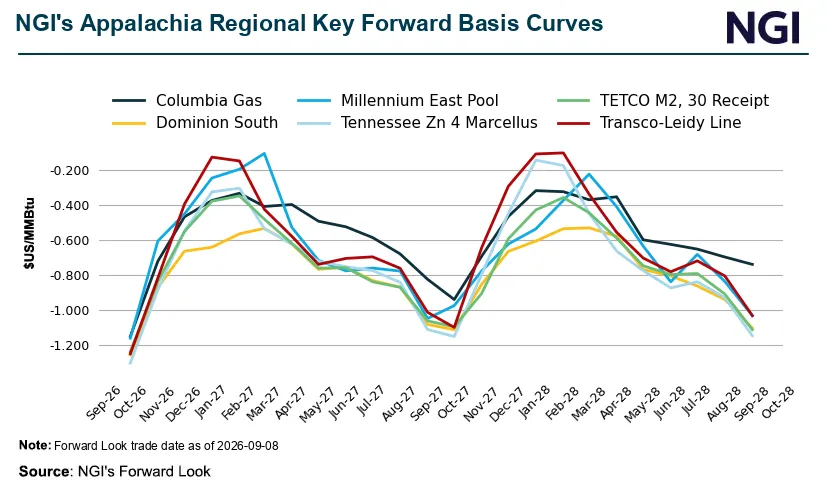
The Appalachian natural gas industry is undergoing a structural shift, moving away from a scramble for production growth and toward a strategy centered on local, in-basin demand, according to Natural Gas Intelligence.
In-basin demand refers to consumption of gas within the producing region itself rather than shipment to distant markets. Power generation is driving demand in the Appalachian Basin, but pipeline bottlenecks continue to strand supply. Because takeaway capacity out of the region is limited, gas that cannot be moved must find buyers locally — a dynamic that has made in-basin markets increasingly important for producers as the region contends with limits on moving natural gas to markets outside Appalachia.
The strain shows up in pricing. Marcellus — the shale formation at the heart of Appalachian output — is trailing Henry Hub, the benchmark for U.S. natural gas, by a sharp margin. That discount reflects the difficulty of moving Appalachian supply to demand centers beyond the basin, and it functions as a barometer of takeaway constraints: the wider the gap between Marcellus and Henry Hub, the more visibly pipeline capacity is binding.
The path forward turns on two variables highlighted in the report: whether local demand, led by power generation, continues to grow, and whether the region gains new ability to move gas out. As long as takeaway limits persist, in-basin outlets remain the industry's most accessible market.
