The Abqaiq Attack Signals That Oil Markets May Be Underestimating a Systemic Threat to Saudi Export Reliability
Key Takeaways
- •Abqaiq processes over seven million barrels of crude per day and serves as the central stabilization hub for output from Saudi Arabia's largest oil fields before it enters the export system.
- •Satellite imagery indicates the latest attack may have damaged crude processing infrastructure rather than just storage tanks, but no official engineering assessment has been issued days after the incident.
- •The assault on Abqaiq is part of a coordinated campaign by Iran-aligned groups simultaneously pressuring multiple critical nodes in Saudi Arabia's export chain, including pipelines, the Yanbu terminal, and nearby maritime chokepoints.
- •Saudi Arabia has historically maintained an estimated two to three million barrels per day of spare production capacity, serving as a de facto insurance policy for global oil markets during supply disruptions.
- •Analysts argue that sustained attacks on processing and refining infrastructure could erode the geopolitical risk premium in oil markets even if crude production volumes remain largely unaffected.
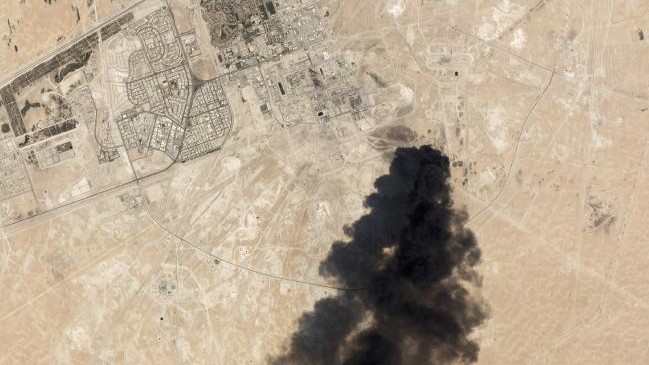
As facts continue to emerge following the latest attack on Saudi Aramco's Abqaiq oil-processing complex, the incident is rapidly establishing itself as one of the most consequential energy developments of 2026. Its significance does not lie in the immediate removal of millions of barrels of oil from international markets, but rather in what it exposes: a vulnerability that traders, governments, and investors had largely assumed no longer existed.
At present, oil prices show no real impact and remain restrained. The Kingdom has been remarkably quiet, with no reports of major interruptions to exports. Yet the real importance of the attack lies elsewhere—it demonstrates once again that Saudi Arabia's meticulously constructed export architecture, built over decades to guarantee uninterrupted supplies under nearly any circumstances, is now squarely in the crosshairs of an ongoing regional confrontation.
Abqaiq has occupied a unique and pivotal position within the global energy system since its inception. It is widely described as the world's largest oil-processing facility, but its significance extends well beyond that designation. Abqaiq is the heart of the Kingdom's hydrocarbon export machine—the central hub where crude from the giant Ghawar, Khurais, and Shaybah fields is stabilized before entering storage, pipelines, and export terminals. With a daily processing capacity exceeding seven million barrels per day, it is arguably the single most strategically important piece of energy infrastructure anywhere in the world. If Abqaiq is offline or not operating properly, the Kingdom can still produce oil, but exporting that oil safely, consistently, and to international specifications becomes significantly more difficult. Related: ADNOC Makes One of the Biggest Changes to Middle East Crude Pricing in Years
Recent satellite imagery from the past several days increasingly suggests that the attack was not confined to peripheral storage infrastructure but may have reached areas associated with crude processing itself. The scene evokes déjà vu for those who remember the September 2019 coordinated drone and missile strike on Abqaiq and the nearby Khurais facility, which was attributed to Iran and temporarily removed roughly 5.7 million barrels per day of Saudi production—about half the Kingdom's output and nearly 5% of global supply at the time. That attack was repaired within weeks, and Aramco restored full capacity far faster than most analysts predicted, helping cement the market's confidence in Saudi resilience. Images from the current incident show burn scars visible around several of the large stabilization spheroid vessels, fueling growing concerns that at least part of the processing system may have been affected.
Satellite imagery alone cannot provide a complete picture of operational damage. However, the continued absence of a detailed engineering assessment from either Saudi Aramco or the Saudi Ministry of Energy should command the market's attention.
It's really bizarre that we don't have official (or even firm) confirmation of the current operating status of Abqaiq. Most important single oil facility on planet earth, was very obviously on fire earlier this week, and we know... very little atm. — Rory Johnston (@Rory_Johnston) July 30, 2026
It's really bizarre that we don't have official (or even firm) confirmation of the current operating status of Abqaiq.
Most important single oil facility on planet earth, was very obviously on fire earlier this week, and we know... very little atm.
The lack of official confirmation days after the incident—particularly regarding which processing units were affected, how much capacity has been lost, and how long repairs may take—should be treated as a worrying signal rather than dismissed. Such silence does not automatically imply catastrophic damage, but it also does not support the assumption that the incident was operationally insignificant.
There is a fundamental difference between damage to storage facilities and damage to processing infrastructure. Storage tanks can often be isolated while the remainder of a facility continues operating. Processing systems, by contrast, cannot—they function as an integrated chain. Even minor physical damage can force extensive shutdowns, with major implications during inspections, repairs, and safety certifications. In modern energy infrastructure, the loss of a single critical processing node can have far broader temporary effects on larger volumes than visible damage assessments might suggest.
Abqaiq is also no longer facing these pressures in isolation. Saudi Arabia has been experiencing increased pressure across its wider export system, including the East-West Pipeline, renewed Houthi operations against infrastructure linked to Yanbu, and fresh disruption at the Jizan refinery. The Jizan and Yanbu attacks simultaneously affect domestic fuel requirements, crude processing, and export commitments. While Saudi Arabia can manage each individually, collectively they are eroding the redundancy that has long distinguished the Kingdom from every other major oil producer.
Saudi Arabia's position in global energy markets has always rested on redundancy. When tensions rise in the Strait of Hormuz, crude can be diverted westward through the East-West Pipeline to Yanbu on the Red Sea. When individual facilities require maintenance, spare processing capacity elsewhere in the system has kept exports flowing. Traders and clients have always regarded Saudi Arabia not simply as the world's largest exporter with spare production capacity, but as the only producer with proven capabilities to maintain reliable supplies during geopolitical crises. Saudi Arabia has historically maintained spare capacity estimated at 2–3 million barrels per day—a buffer no other producer possesses at comparable scale, and one that has functioned as the de facto insurance policy for global oil markets during supply disruptions ranging from the Libyan civil war to sanctions on Iranian and Venezuelan exports.
That foundation is now under challenge. The latest attacks—attributed to Iran, Houthis, and Iraqi Shi'a militias or IRGC-affiliated groups—are not designed to abruptly remove millions of barrels per day from the market. Their real objective is to undermine confidence in the reliability of Saudi exports by simultaneously pressuring every critical link in the export chain: Abqaiq processes crude, the East-West Pipeline transports it, Yanbu serves as the main outlet to global markets, and the Bab el-Mandeb strait connects those cargoes to clients worldwide. The Bab el-Mandeb, one of the world's most important maritime oil chokepoints, sees millions of barrels transit daily between the Red Sea and the Gulf of Aden on routes connecting Persian Gulf producers to European and North American buyers. Applying pressure to all of these nodes simultaneously transforms isolated operational incidents into systemic strategic risk.
This may explain why markets have not reacted more forcefully following the Abqaiq attack. Traders have focused on immediate production losses, for which there is no evidence as yet. The Kingdom continues to draw on extensive inventories, highly capable engineering teams, and decades of investment in operational resilience. Long-term contractual customers are expected to remain protected for as long as inventories and alternative routing options permit.
However, the risk hiding in plain sight is that markets are underestimating the lag between physical infrastructure damage and commercial consequences. If multiple nodes are hit or under stress, disruptions will likely first surface in cargo nominations, tanker loading schedules, crude quality adjustments, and refinery operations—all of which eventually feed into benchmark prices. Today's calm does not necessarily reflect tomorrow's market reality.
There is also a growing tendency to underestimate the role of refining and processing infrastructure in determining future energy prices. While attention remains fixated on upstream production, the current wave of attacks highlights that the real bottleneck increasingly lies further downstream. Processing plants transform crude into exportable feedstock, while refineries determine the availability of diesel, jet fuel, and gasoline. Simultaneous attacks on these assets reduce flexibility across the entire energy chain, even if production itself remains comparatively stable. The recent rise in refining margins across Europe and Asia already reflects the market's growing sensitivity to processing capacity rather than crude availability alone.
Perhaps the greatest misconception surrounding the latest attack is that most analysts are attempting to measure its effects in lost barrels of crude per day. This appears to be precisely what the attackers have sought to avoid. A temporary shutdown of several million barrels would almost certainly provoke an overwhelming international response while simultaneously allowing the Kingdom to demonstrate its remarkable recovery capabilities. Instead, attackers seem to understand that a sustained campaign of forcing repeated inspections, delaying repairs, driving up insurance costs, disrupting shipping schedules, and sowing uncertainty about export reliability can produce an outsized impact—without ever removing catastrophic volumes from the market.
For Riyadh, the principal challenge is increasingly strategic rather than operational. There is no doubt about the Kingdom's production capacity. Yet Aramco now faces a situation in which protecting every element of an integrated export system—from producing fields in the Eastern Province, across pipelines spanning the Arabian Peninsula, to export terminals on both coasts and shipping lanes through two of the world's most contested maritime chokepoints—has become progressively more difficult. Any additional attack or incident at existing nodes will consume engineering resources, reduce operational flexibility, and, perhaps most critically, gradually narrow the margin available to absorb future shocks.
The facts currently available do not support claims that Abqaiq has suffered a catastrophic and prolonged loss of its full processing capacity. Operational data does not substantiate such conclusions. Nevertheless, the combination of satellite imagery, continuing official silence on precise damage, and the broader pattern of attacks against Saudi energy infrastructure strongly suggests the incident was considerably more significant than a limited storage fire.
The market may be focusing on the wrong question. The question is not whether Saudi Arabia can continue producing sufficient oil, but whether it can guarantee uninterrupted exports while the infrastructure underpinning its role as the world's supplier of last resort is subjected to sustained and coordinated pressure.
That is ultimately why Abqaiq matters. The attack represents a clear global warning that the next phase of energy warfare is aimed not primarily at oil wells or production volumes, but at the reliability of the global energy system itself. If that reliability erodes, the geopolitical risk premium embedded in oil markets will not disappear—even if production remains intact. Global markets have spent decades assuming that Saudi Arabia's export system was the ultimate backstop for global energy security. That assumption now looks increasingly fragile.
By Cyril Widdershoven for Oilprice.com

