HYPE вырос на 22% после комментариев Трампа о пути Hyperliquid к соблюдению норм в США; пресейл LiquidChain в центре внимания
Ключевые выводы
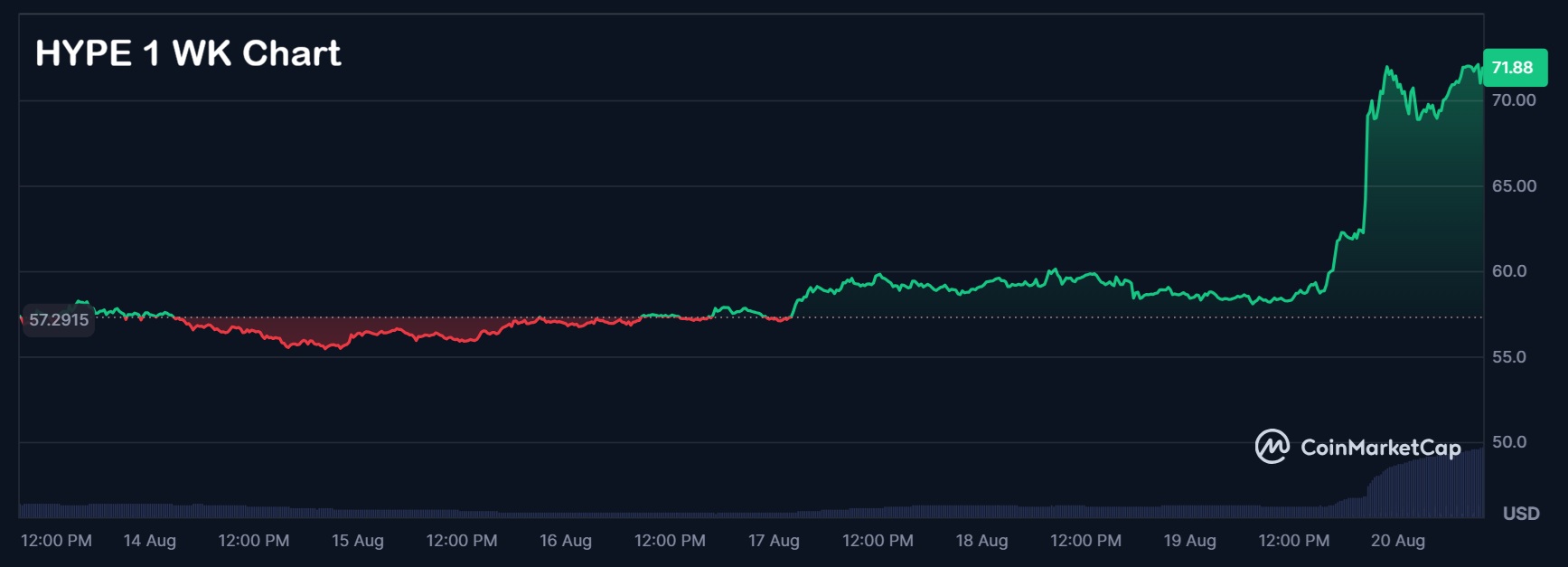
- •HYPE вырос на 21,93% за последние 24 часа до примерно $71.97 и достиг исторического максимума $76.85 после слов президента Трампа о том, что председатель CFTC Майкл Селиг работает над выводом Hyperliquid в США в полностью соответствующем требованиям и законном формате.
- •Hyperliquid сейчас геоблокирует трейдеров из США, поэтому регулируемый внутренний маршрут может открыть его некастодиальную платформу perpetual futures для существенно более крупного рынка.
- •LiquidChain (LIQUID) находится в пресейле по цене $0.0148, уже привлёк $943,000, предлагает стейкинг с доходностью 1,200% APY и ожидает запуск в течение следующих шести месяцев.
- •Layer 3-сеть LiquidChain предназначена для объединения ликвидности Bitcoin, Ethereum и Solana в единый общий пул, доступный пользователям и разработчикам без необходимости bridging между отдельными экосистемами.
- •Bitcoin вырос на 11,01% за последние 24 часа до $71,300.83, а контракты проекта LiquidChain были проверены SpyWolf и CertiK.
Hyperliquid has given the crypto market another reminder of how quickly an infrastructure token can reprice when its potential market suddenly looks bigger.
HYPE was trading around $71.97 after jumping 21.93% over the past 24 hours. The move followed remarks by President Donald Trump, who said CFTC Chair Michael Selig is "working to bring Hyperliquid into the United States in a fully compliant and legal fashion, working very hard on that."
Hyperliquid currently geoblocks U.S. traders, so a regulated domestic route could open the perpetual futures venue to a substantial new market. Traders responded to that possibility, sending HYPE to an all-time high of $76.85 before the price settled down a little.
For investors who missed that move, the piece points to LiquidChain (LIQUID), a much earlier-stage trade that its backers liken to the period when HYPE itself changed hands in the low-dollar range, built around a different infrastructure idea.
LiquidChain aims to solve fragmented capital across crypto by bringing all liquidity from Bitcoin, Ethereum, and Solana into a single shared liquidity pool. LIQUID is currently in presale, priced at $0.0148, with a launch expected over the next six months. The project has raised $943,000 so far and offers staking at 1,200% APY.
Hyperliquid operates a non-custodial on-chain trading platform best known for perpetual futures, but its U.S. availability has been limited by the regulatory questions surrounding those products.
Trump's comments put a possible compliance route directly on the agenda, which helps explain why HYPE attracted so much attention: legal U.S. access can expand the platform's potential user base.
The broader lesson for the rest of crypto is how infrastructure can become considerably more valuable when it suddenly reaches a larger pool of users or capital.
LiquidChain approaches the infrastructure problem from the other side. BTC, ETH, and SOL have each built substantial pools of capital, but those pools are entirely separate from each other. A user may hold value in Bitcoin but want to deploy that capital elsewhere; an application may be built for Ethereum but want to access liquidity on other networks.
Moving between those environments right now introduces wrapping, bridging, mispricing, and risks — a tax in both time and money that becomes harder to justify as institutional finance enters the space.
L1 laid the foundation. L2 scaled it. Now L3 rises above them all. ⟁ pic.twitter.com/X96p0CjhzH
— LiquidChain (@getliquidchain), August 19, 2026
LiquidChain's Layer 3 is designed to make those divisions less intrusive, combining liquidity and creating a common environment capable of interacting with Bitcoin, Ethereum, and Solana all at once. For users, that means accessing liquidity across BTC, ETH, and SOL without repeatedly moving money between separate ecosystems. For developers, it means building products that can reach capital across several major chains without treating each one as an isolated market — they only need to access LiquidChain.
Bitcoin's own move helps illustrate the scale of the issue: BTC has surged to $71,300.83, up 11.01% over the past 24 hours. Every large increase in the value of Bitcoin adds to an already enormous pool of capital, while Ethereum, Solana, and other ecosystems continue to accumulate liquidity of their own.
A rising market does not make crypto more unified — it can do the opposite. More wealth across several successful networks means more capital separated by blockchain boundaries.
LiquidChain says applications will increasingly want to reach across those boundaries without forcing users to manage every movement beneath the surface, framing shared liquidity as being about both connecting the three largest blockchains and capital efficiency. Money is most useful, the project notes, where someone can trade, lend, pay, or build with it.
While in presale at $0.0148, LIQUID offers staking at 1,200% APY — with the rate expected to decline as participation grows. SpyWolf and CertiK have reviewed the project contracts.
The project remains early, so the decisive test will come when developers and users can try out that shared multichain liquidity for themselves.
LiquidChain still needs its Layer 3 to turn the fragmented liquidity sitting across Bitcoin, Ethereum, and Solana into something developers want to use. The article frames the speculative case as early-stage infrastructure with a massive addressable market in the making — not chasing yesterday's HYPE candle.
HYPE rallied as traders saw a path to more users, and LiquidChain's thesis is that applications will focus on easier ways to use existing capital and liquidity.
This article appeared first on icobench.com.

