Warsh dice que los mercados están haciendo el trabajo mientras las acciones caen y los rendimientos del Tesoro suben
Puntos clave
- •La Reserva Federal mantuvo las tasas sin cambios, y tres miembros discreparon a favor de una subida.
- •El S&P 500, el Dow Jones Industrial Average y el Nasdaq cerraron a la baja en la sesión.
- •El rendimiento del Tesoro a 10 años subió 9 puntos básicos hasta 4.69%, mientras que el rendimiento a 30 años subió hasta 5.21%, el nivel más alto desde julio de 2007.
- •Los rendimientos de corto plazo del Tesoro cayeron, con el rendimiento a 2 meses 9 puntos básicos abajo y el de 6 meses 8 puntos básicos abajo, hasta 3.95%.
- •Warsh dijo que el mercado de bonos ha endurecido las condiciones financieras al reaccionar a datos en tiempo real y no a la guía prospectiva de la Fed.
“En cierto nivel, no hemos hecho mucho en 42 days, pero los mercados han hecho bastante”: Warsh
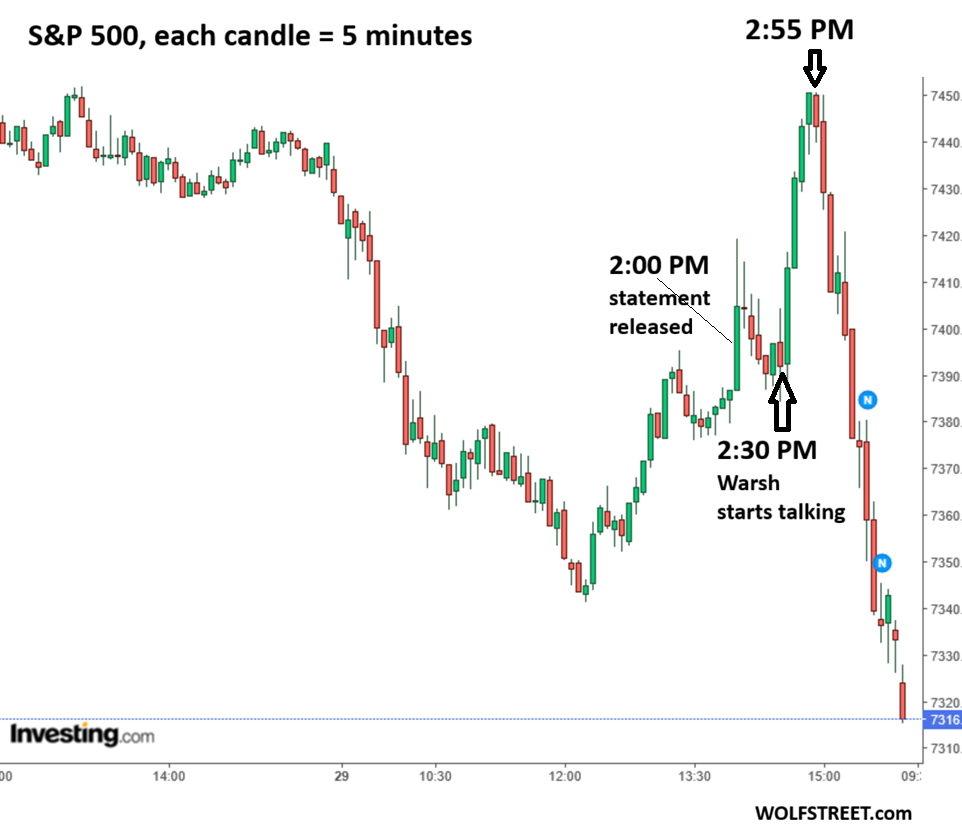
Entre las 2:55 p.m., aproximadamente a la mitad de la conferencia de prensa de Warsh, presidente de la Fed, y el cierre del mercado, el S&P 500 cayó 138 puntos, o 1.85%, en 65 minutos. El índice pasó bruscamente de terreno positivo a rojo intenso.
En toda la sesión, el S&P 500 bajó 1.52%, el Dow Jones Industrial Average perdió 2.19% y el Nasdaq retrocedió 1.74%.
Warsh dejó una impresión clara durante la conferencia de prensa posterior al FOMC, después de que la Reserva Federal mantuviera las tasas de interés sin cambios, con tres miembros disintiendo a favor de una subida de tasas. Incluso si hubiera preferido una subida, aún estaba a tres votos de distancia, según un gráfico de Investing.com.
Durante la conferencia de prensa, Warsh no fue abiertamente restrictivo ni flexible. Evitó cuidadosamente cualquier cosa que pudiera interpretarse como orientación futura, no dio indicios de hacia dónde podría llevar la Fed las tasas de política en septiembre o más adelante, no reveló nada sobre su propia posición y rechazó repetidamente los intentos de los periodistas por extraerle orientación.
Lo que destacó, sin embargo, fue su énfasis reiterado y detallado en la idea de que poner fin a la guía prospectiva ya estaba funcionando. Dijo que los rendimientos del Tesoro ya habían subido con fuerza desde la última reunión, a medida que los mercados empezaban a procesar los datos y no los comentarios de la Fed, que los compradores y vendedores del mercado de bonos estaban haciendo el trabajo pesado y que los mercados ya habían elevado las tasas y endurecido las condiciones financieras, lo cual “has provided us some comfort that we’ve got the ability and capability to deliver.”
Eso importa porque el movimiento de los rendimientos no se limitó a una parte de la curva. Los rendimientos del Tesoro de tres años y más aumentaron, con un salto en el extremo largo. El rendimiento del Tesoro a 10 años subió 9 puntos básicos en el día, a 4.69%. Estas son las tasas que importan para una gran parte de la economía: por ejemplo, las hipotecas fijas a 30 años y la mayoría de los bonos corporativos siguen el rendimiento del Tesoro a 10 años.
El rendimiento del Tesoro a 30 años saltó 12 puntos básicos, hasta 5.21% hoy, el nivel más alto desde julio de 2007.
Las tasas de política de la Fed sirven de referencia para tasas a un día como SOFR. Por ejemplo, los préstamos a tasa variable y las hipotecas de tasa ajustable que están en su fase de ajuste se ven afectados por los cambios en las tasas de política de la Fed a través de SOFR. Si la Fed sube las tasas, esos costos de endeudamiento aumentan para esos prestatarios.
Los rendimientos de corto plazo del Tesoro reflejan una combinación de las tasas de política actuales de la Fed y de las tasas futuras esperadas dentro de su ventana. Los rendimientos de corto plazo cayeron hoy, deshaciendo así la parte de la subida de tasas que ya se había descontado para hoy.
El rendimiento a 2 meses cayó 9 puntos básicos, deshaciendo el resto del salto de la semana pasada que había descontado por completo una subida de tasas en esta reunión, algo que no ocurrió.
El rendimiento a 6 meses bajó 8 puntos básicos, hasta 3.95%, aún descontando una subida de tasas dentro de su ventana, pero no más de una.
Warsh sobre cómo el mercado de bonos ya está haciendo el trabajo pesado y endureciendo las condiciones financieras ahora que opera por su cuenta, sin guía prospectiva:
“Nominal and real yields are materially higher across the Treasury curve. In fact, some of the increases in market interest rates between FOMC meetings are among the most significant in the last two decades, ranking around the top decile or so, but if the committee didn’t change its policy, what happened?
“In the intervening period, market attention centered on real data and real economic developments. Prices [of bonds] reacted in real time to incoming information, and the reduction in forward guidance may have been a factor.
“Market participants are learning to play the ball, not the referee, and market prices will continue to respond in the direction and magnitude they see fit. This is, in my view, a change for the better, and we’re just getting started…. We need to observe market reaction to developments, direct and unfiltered.”
También dijo:
“What I’ve really been trying to do is getting an unfiltered message from markets, getting a direct message, letting buyers and sellers meet at prices for Treasuries, for the foreign-exchange value of the dollar, and then trying to judge for ourselves: What does that mean about our remit? How are we doing on inflation? How are we doing on employment?
“We’re trying not to interfere with that market signal. It’s part of the reason we’ve been somewhat spare in our words and pulled back from forward guidance, so they’re reacting to events much more directly over the 42 days since we last met.
This is a good thing. As I mentioned in the prepared remarks, we’ve seen material tightening not just in nominal rates but in real rates too, and we’re observing it, we’re trying to stay out of that because … we’re interested in the reaction of financial markets.”
Warsh añadió:
“First, as we said in the FOMC statement, the economy output is solid, CapEx and productivity are strong, labor markets solid, steady. The Treasury market seems to be saying that as well… and that’s why we’re seeing a tightening both in nominal rates and in real rates. While at some level, we haven’t done much in 42 days, the markets have done quite a bit.”
Continuó:
“So rates are higher today than they were 42 days ago. Markets have made decisions in part because we stepped back from trying to influence those. Market judgments have moved up on what nominal rates are across the Treasury curve…. Markets are reacting in real time.”
Y también:
“If you were to try to force a description that this [no hike today] was a pause, I would say financial market [bond] prices would take the other side of that. Financial market prices, in this intervening period, didn’t pause. They reacted to the inflation data in one direction, strong economic growth in the other direction, and nominal and real rates went up.”
Dijo que le tranquilizó que los mercados estuvieran respondiendo a los acontecimientos entrantes y no a las señales de la Fed:
“I was comforted that markets in the intermeeting period weren’t reacting to us, they weren’t reacting to dots or to speeches. They appeared more than ever to be reacting to real-time events so they’re gauging themselves how restrictive the Treasury curve should be, and that I think has been a useful development.”
Warsh también dijo:
“By not spoon-feeding markets, by not previewing our decisions, by not sort of giving nudges and leans, my colleagues and I have found in the intermeeting period, what we’re getting is the views from a very accomplished economist. That’s the internals of financial markets. Instead of just repeating or echoing back to us what we’re saying, they’re giving us somewhat, not perfect, their own judgment.”
Añadió:
“If you look broadly at [bond] market prices, they are certainly not saying ‘all clear’ but they are working in concert to keep us on our toes, and they have tightened financial conditions in this intermeeting period and that has provided us some comfort that we’ve got the ability and capability to deliver.”
Finalmente, dijo:
“We’re not going to be constrained or take verbatim from what the markets are doing, but I think it’s useful to understand that markets can be a very good source of information, not a determining source, not a perfect source. But if we’re trying to land the plane and deliver 2% inflation, and we take a very useful source of information and get it all fogged up by giving it our own forecast, by providing rolling commentary, I can assure you that we’re going to have less information, less ability to land the plane successfully, and deliver price stability. We’re just trying to make sure that that source of information is as direct and unfiltered as possible.”
Enjoy reading WOLF STREET and want to support it? You can donate. I appreciate it immensely. Click on the mug to find out how:

