Altman ve a Corea como campo de pruebas para el primer dispositivo de OpenAI
Puntos clave
- •La oficina presidencial dijo que Altman expresó interés en usar Corea como campo de pruebas para el primer producto de hardware de OpenAI.
- •El dispositivo reportado apunta al primer trimestre del próximo año, pero OpenAI no ha confirmado públicamente ni el producto ni su ventana de lanzamiento.
- •Los reportes describen el dispositivo como un altavoz inteligente sin pantalla, con batería recargable, cámara y sensores, que funciona con ChatGPT.
- •Los planes de hardware de OpenAI están vinculados a su adquisición de io Products por $6.5 billion, la startup cofundada por Jony Ive.
- •Corea podría ser útil para una validación temprana por su alta adopción de smartphones, su infraestructura de telecomunicaciones y las consideraciones locales de idioma y privacidad.
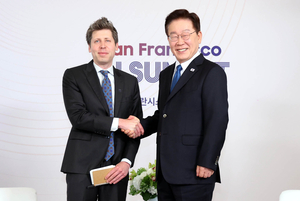
OpenAI CEO Sam Altman told President Lee Jae Myung that the company hopes to use Korea as a testbed for its first hardware product, the presidential office said Tuesday.
The two met in San Francisco on Friday to discuss expanding cooperation, including on next-generation AI devices. Senior presidential spokesperson Kang Yu-jung said Altman "expressed expectations for using Korea as a testbed" for the device, which is due in the first quarter of next year, and signaled a willingness to broaden the partnership.
The account came secondhand from the presidential office, and the mention of a specific launch quarter was unusual for a company that has kept its hardware plans under wraps. OpenAI has not publicly detailed the product or confirmed a launch window.
Much of what is known about the device comes from reporting rather than disclosure. Bloomberg reported on July 15, citing people familiar with the project, that OpenAI's first product is a screenless smart speaker with a rechargeable battery, designed to be carried from room to room as a household AI companion. It carries a camera and sensors to read a user's surroundings and runs on ChatGPT to handle tasks such as controlling appliances and answering questions.
OpenAI declined to comment on the specifications.
The effort rests on OpenAI's $6.5 billion acquisition last year of io Products, the startup co-founded by former Apple design chief Jony Ive.
The timeline is not entirely OpenAI's to set. During trademark litigation brought by audio startup iyO, the company said in February that it would not ship the device before the end of February 2027. On July 10, Apple sued OpenAI and its chief hardware officer Tang Tan in the Northern District of California, alleging theft of trade secrets, and is seeking an injunction that could delay sales.
OpenAI has said it is unaware of any evidence supporting the complaint.
Altman did not elaborate on what he meant by "testbed." It could refer to prototype testing limited to employees and partners, a trial involving some Korean consumers, or inclusion in a first-wave launch. Neither the presidential office nor OpenAI has clarified.
The distinction matters because Korea has often been left off launch lists for global tech products.
Apple did not add the country to an iPhone first-wave launch until the iPhone 16 series in 2024, roughly 15 years after the 3GS arrived in November 2009. Analysts at the time pointed to the conformity assessment required by the National Radio Research Agency, which makes certification filings public and sat poorly with Apple's secrecy around unreleased products, along with supply allocation that favored larger markets.
Meta followed a similar pattern, but more recently. Its second-generation Ray-Ban smart glasses reached the US last September but did not arrive in Korea until May, after roughly eight months of sales elsewhere.
Korea's appeal as an early market comes from high smartphone penetration and quick adoption of new product categories. It also hosts the semiconductor supply base anchored by Samsung Electronics and SK hynix. OpenAI has also been widening service tie-ups with local firms including Kakao, which could make the country useful not just as a sales market but as a place to check how the product performs with Korean-language prompts and local privacy expectations before a broader rollout. A device that continuously captures voice and ambient surroundings would also need its handling of those rules verified on the ground.
"Korea has strong telecom infrastructure and users respond fast to new products," an industry official said. "If OpenAI wants to validate Korean-language performance and actual usage patterns, running a testbed here could pull forward the formal launch."

