El dólar cae a un mínimo de tres meses mientras el Tesoro amplía las recompras de bonos
Puntos clave
- •El Departamento del Tesoro de EE. UU. al menos duplicará ciertas operaciones de recompra de bonos de vencimiento más largo, elevando el tope por operación de $2 mil millones a $4 mil millones para valores con vencimiento de diez años o más.
- •El rendimiento del Treasury a 30 años, que antes alcanzó un máximo de 19 años de 5.337%, bajó a alrededor de 5.18% tras el anuncio de recompra.
- •El índice del dólar cayó a cerca de 98.80, su nivel más débil desde fines de mayo, mientras el euro subió a $1.1674 y la libra esterlina avanzó a $1.3614.
- •Analistas de TD Securities dijeron que el programa de recompra no equivale a relajación cuantitativa, y el Tesoro publicará más detalles el 4 de noviembre, un día después de las elecciones de medio término en EE. UU.
- •El precio del petróleo volvió a acercarse a $92 por barril, y las minutas de la reunión de julio de la Reserva Federal mostraron que algunos responsables estaban abiertos a más alzas de tasas si la inflación no avanza hacia el objetivo de 2%.
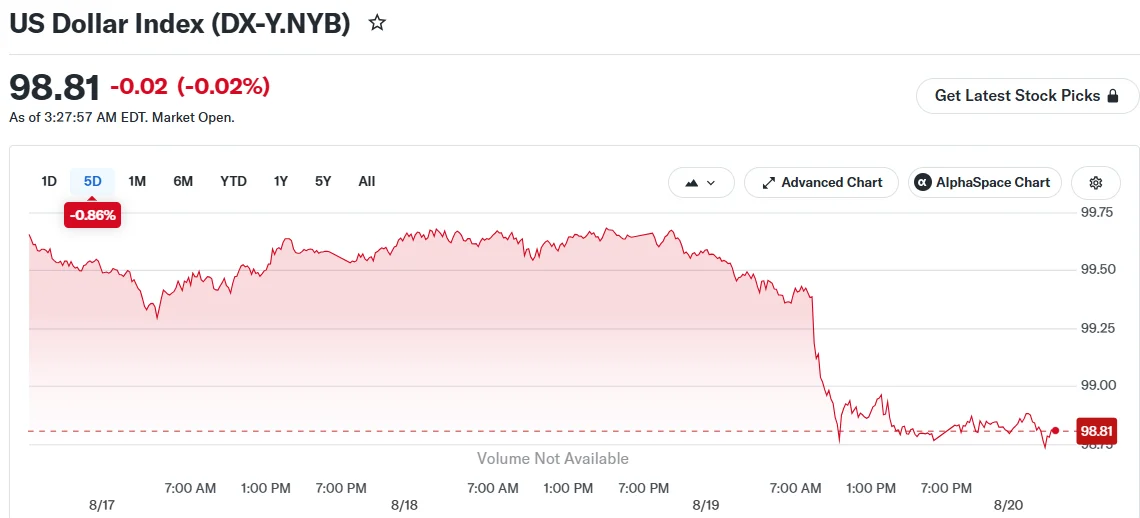
The U.S. dollar fell to its lowest level in three months on Thursday after the Treasury Department moved to ease pressure in the bond market.
The dollar index fell to around 98.80, its weakest level since late May. The euro rose to $1.1674, its highest level since late May.
Bond markets had faced heavy selling pressure this week as investors worried about rising government debt and higher oil prices linked to the ongoing U.S.-Israeli conflict with Iran. Earlier in the week, the 30-year Treasury yield reached a 19-year high of 5.337%, a level that rattled financial markets globally and underscored how quickly long-end borrowing costs can feed through to currencies and other assets.
Treasury doubles bond buybacks
On Wednesday, the Treasury announced that it would at least double the size of some buyback operations for longer-dated bonds, raising the cap to $4 billion per operation from $2 billion. The purchases apply to securities with maturities of 10 years or more.
BREAKING: The US Treasury announces it will double the size long-term US government debt buybacks following the rapid surge in US Treasury yields. Repurchases of $2 billion will now be increased to "at least" $4 billion, the US Treasury said. The move is intended to provide… — The Kobeissi Letter (@KobeissiLetter) August 19, 2026
Following the announcement, the 30-year yield fell to around 5.18%, down about 9 basis points. The 10-year yield also retreated.
Analysts at TD Securities said the buyback program is not the same as quantitative easing, but noted that the timing was significant because it came shortly before an auction of 20-year Treasury notes. The Treasury also said it would release additional details on future buybacks on November 4, the day after the U.S. midterm elections. Analysts said that leaves room for the government to expand the program later.
The move effectively shifts more government borrowing toward short-term bills while buying back longer-dated debt. That can reduce pressure on long-term yields without requiring the Federal Reserve to expand its balance sheet, making the policy relevant well beyond the bond market itself as investors watch how funding costs ripple into currencies and rate expectations.
Currency markets react
The dollar’s decline gave the Japanese yen some relief. The yen had been trading close to the closely watched 160 level and was last at 158.55 per dollar. A joint U.S.-Japan intervention in late July did not produce a lasting effect.
The South Korean won had fallen 1.8% overnight but recovered some of those losses. The Australian dollar held steady after rising 0.5% in the previous session.
Sterling climbed to $1.3614, just below a three-month high, while the Swiss franc eased slightly from a two-month high.
The Indian rupee edged lower after five straight sessions of gains. The Reserve Bank of India had reportedly intervened in spot, futures, and offshore markets.
Oil prices also rose back toward $92 a barrel as hopes for a quick resolution to the U.S.-Iran conflict faded, adding to inflation concerns.
Minutes from the Federal Reserve’s July meeting showed policymakers remained focused on inflation, with some willing to support further rate increases if prices do not move toward the 2% target.

