Pi Network-Preis erholt sich, während Händler im Zuge der Marktrallye $0,10 im Blick behalten
Wichtige Erkenntnisse
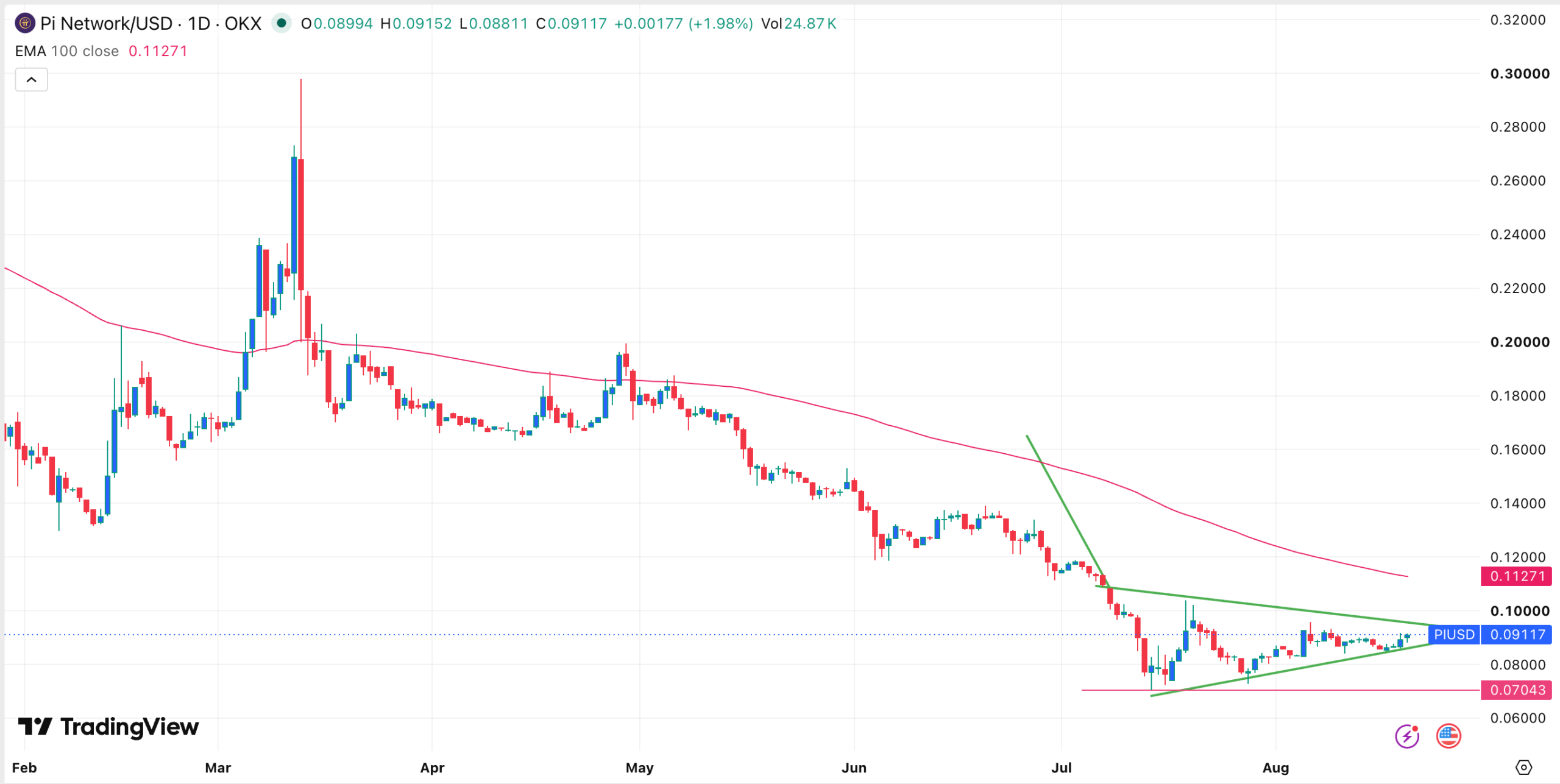
- •PI erholte sich vom Juli-Tief bei $0.07043 und wurde bei rund $0.0917 gehandelt, während der breitere Kryptomarkt zulegte.
- •Der Tageschart zeigt Pi nahe der Spitze eines symmetrischen Dreiecks, das Teil eines bearishen Pennant-Musters ist.
- •Pi liegt weiterhin unter dem 50-Tage-EMA; ein Anstieg über den 100-Tage-EMA bei $0.1127 würde den bärischen Ausblick abschwächen.
- •Zu den jüngsten Updates gehörten Pi Node Version 0.6.2, SoloHost-Upgrades und eine Preisänderung beim Pi AI Studio.
- •Token-Freischaltungen, geringes Handelsvolumen, zentrale Tokenkontrolle und ein kleines Ökosystem begrenzen weiterhin das bullische Szenario.
Pi Network price extended its recent recovery as the broader crypto market improved. PI traded near $0.087, above its July low near $0.071.
The rebound has pushed Pi back toward a technical decision point. The daily chart shows price approaching the apex of a symmetrical triangle after months of weaker trading, a setup that often draws attention because it can signal a sharper move once the range tightens.
However, supply growth and muted market activity continue to limit the bullish case.
Pi Network-Preis erreicht technischen Wendepunkt
The daily chart shows that Pi Coin’s price has crawled back in the past few weeks, moving from the year-to-date low of $0.07043 in July to the current $0.0917. A closer look shows that the coin is at an inflection point as the two lines of the symmetrical triangle are about to converge.
This triangle is part of the formation of the bearish pennant pattern, which forms after a strong downtrend. It has moved below the 50-day Exponential Moving Average (EMA), a sign that bears are in control for now.
Therefore, the token may soon have a strong bearish breakout in the near term. If this happens, the next key target to watch will be the year-to-date low of $0.07043. A drop below this level will point to more downside.
However, a move above the 100-day Exponential Moving Average (EMA) at $0.1127 will invalidate the bearish view and point to more upside, potentially to $0.200.
Pi Network Coin chart | Source: TradingView
Pi Coin könnte von der Rallye am Kryptomarkt profitieren
A potential catalyst that may boost the Pi Network is that the crypto market rally is happening this week. Bitcoin has already moved above the crucial resistance level of $70,000, while Ethereum is comfortably above the $2,000 level.
The Crypto Fear and Greed Index has moved to the greed zone, a sign that investors are embracing a risk-on sentiment. The same is happening with the stock market, with some of the most popular companies like SanDisk and Micron continuing the uptrend.
This also explains why top crypto stocks like Coinbase and Robinhood are continuing the uptrend this week. Historically, cryptocurrencies like Pi Network benefit when there is a risk-on sentiment, though PI’s own trading remains far thinner than larger tokens and can be more sensitive to changes in liquidity.
Pi Network hat einige wichtige Ankündigungen gemacht
Pi Coin has made some major announcements this month. One of them is the recent release of Pi Node Version 0.6.2 and SoloHost upgrades. The node upgrade introduced new features like automatic port configuration, support for unlisted SoloHost apps, SoloHost status management, and a fix for the SoloGost app state tracking.
Additionally, Pi Network recently launched an upgrade for the Pi AI Studio. This upgrade focuses on its pricing, with the developers ending free support for some of its developers. Instead, it will focus on providing free support to developers building applications with some utility.
These updates matter because Pi’s long-term case depends less on short-term price action than on whether the network can keep improving infrastructure and attract developers to build within its ecosystem.
Pi steht vor einigen erheblichen Risiken
In addition to the formation of the bearish pennant pattern, Pi Network faces some major risks that may affect its performance. One of the risks is that its token unlocks have continued this year, increasing its supply at a time when its demand has faded. Data shows that its 24-hour volume was just $11.5 million, a tiny amount for a coin whose market capitalization jumped to $1 billion today.
Further, Pi is still a highly centralized project, with the team controlling close to 90 billion tokens. This centralization explains why very few exchanges have listed it. Even after being listed on Kraken earlier this year, its volume has remained muted, lowering the possibility that other exchanges will do the same.
Pi Network has a tiny ecosystem, with many developers staying on the sidelines as the crypto winter has intensified. That makes the current rebound important to watch, but also keeps the market focused on whether the project can convert recent product updates into broader participation rather than just short-lived trading interest.

